Queen Hatshepsut was one of the most powerful and successful rulers in the history of Ancient Egypt. Known as one of the greatest ancient Egyptian female pharaohs, Hatshepsut transformed Egypt into a prosperous empire through trade, architecture, diplomacy, and political stability. Unlike many Egyptian pharaohs who focused primarily on military conquest, Queen Hatshepsut built her reputation through economic growth, monumental construction, and strategic leadership that strengthened Egypt’s influence across the ancient world.
Today, historians and travelers continue to search for answers about “Who was Queen Hatshepsut?” “What was Queen Hatshepsut known for?” and “How did Queen Hatshepsut die?” Her reign remains one of the most fascinating periods of the New Kingdom because she successfully ruled as a female pharaoh in a society traditionally dominated by men. From the magnificent mortuary temple of Hatshepsut to the mystery surrounding her death, her story continues to inspire global interest thousands of years later.
The reign of Hatshepsut in Egypt marked a golden age of prosperity, religious influence, artistic innovation, and architectural achievement. Her accomplishments reshaped Egyptian history and secured her place among the greatest rulers of the ancient world.
Who Was Queen Hatshepsut?
Many people ask, “Who is Hatshepsut?” or “Who was Hatshepsut?” The answer begins in the royal family of the 18th Dynasty of Ancient Egypt.
Hatshepsut was born around 1507 BCE as the daughter of Pharaoh Thutmose I and Queen Ahmose. Because she was born into royal blood, she received education, religious training, and political preparation uncommon for most women of her time. From an early age, she understood the importance of religion, royal symbolism, and leadership within Egyptian society.
After the death of her father, she married her half-brother Thutmose II, following the traditional royal practices of Ancient Egypt. Through marriage, she became Queen Hatshepsut, strengthening her claim to royal authority. However, her husband’s reign was relatively short, and after his death, the throne legally passed to the young Thutmose III, who was still a child.
Initially, Hatshepsut ruled as regent on behalf of the young king. Yet within a few years, she made one of the boldest political decisions in Egyptian history by declaring herself pharaoh. This transformed her from queen to ruler of Egypt itself.
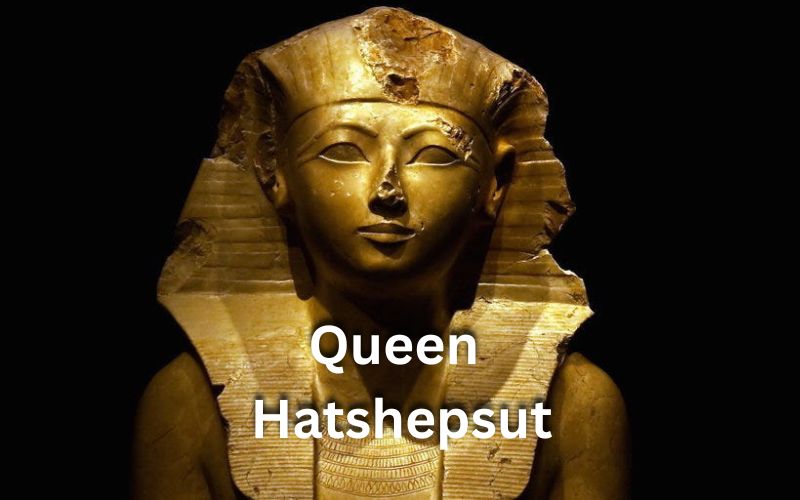
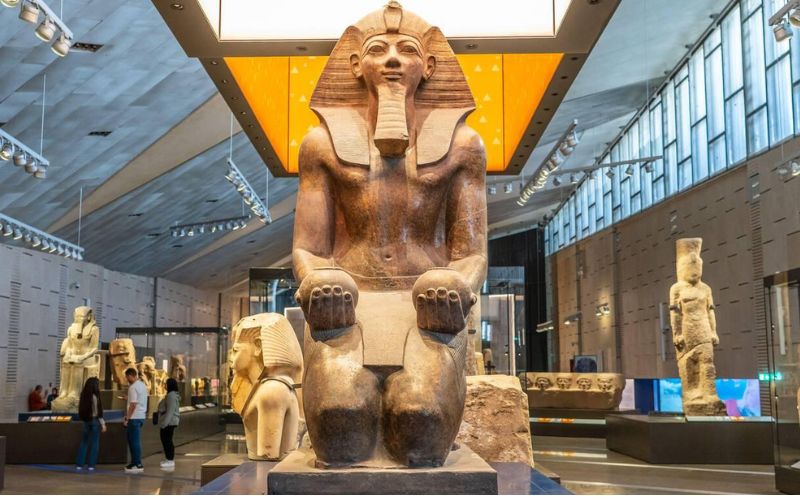
Unlike ordinary queens, Pharaoh Hatshepsut adopted the complete royal titulary of a king. She wore royal regalia, appeared in statues with the traditional pharaonic beard, and portrayed herself in masculine form to reinforce her legitimacy as ruler.
Her rise to power was revolutionary because Ancient Egypt was still largely dominated by male rulers. Although women possessed more legal rights in Egypt compared to many ancient civilizations, becoming a pharaoh was extremely rare. Nevertheless, Hatshepsut successfully consolidated power and governed Egypt for approximately twenty years.
Hatshepsut Definition and Meaning
The Hatshepsut definition originates from the ancient Egyptian language and is often translated as “Foremost of Noble Women.” The meaning of her name reflected both status and divine authority.
In Ancient Egypt, names were deeply connected to identity, religion, and destiny. Pharaohs carefully used titles and symbolism to establish their legitimacy. Queen Hatshepsut understood the political importance of image and presentation better than most rulers before her.
As her power expanded, she increasingly portrayed herself not merely as a queen but as the rightful divine ruler chosen by the gods. Temple inscriptions described her birth as divinely ordained by the god Amun, helping justify her unprecedented position as female pharaoh.
This sophisticated political strategy helped stabilize her reign and reduce resistance from religious elites and royal officials.
Was Queen Hatshepsut the First Female Pharaoh?
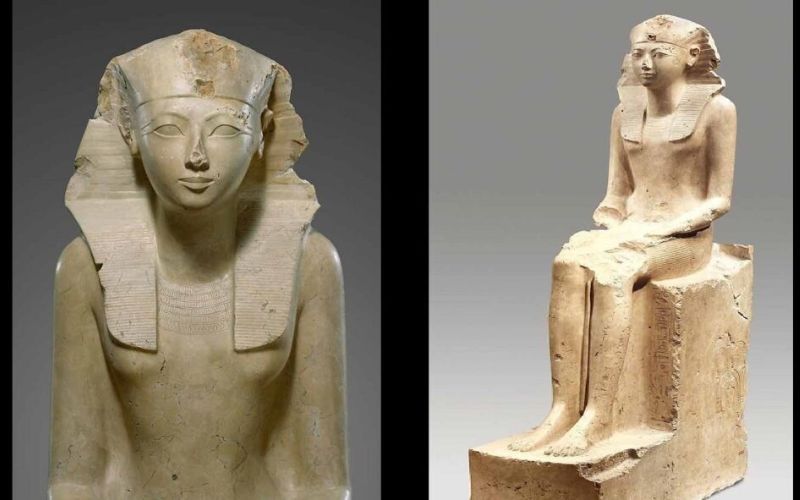
One of the most frequently searched questions online is: “Was Hatshepsut the first female pharaoh?”
Technically, she was not the first woman to hold authority in Egypt. Earlier royal women, such as Sobekneferu, had ruled before her. However, Hatshepsut became the first female pharaoh to establish a long, stable, and highly successful reign with full kingly authority.
Unlike temporary female regents, Hatshepsut ruled openly as king. She performed religious ceremonies, commissioned monuments, and issued official decrees exactly like male rulers. Her reign demonstrated that political competence and royal legitimacy could transcend gender expectations.
What makes her story particularly remarkable is that Egypt prospered significantly during her leadership. Rather than collapsing under controversy, the kingdom entered a period of wealth, peace, and monumental construction.
Her success permanently secured her place among the most influential ancient Egyptian female pharaohs.
Queen Hatshepsut in Egypt: A Golden Age of Stability and Prosperity
The era of Hatshepsut in Egypt is often considered one of the most peaceful and prosperous periods of the New Kingdom. Instead of focusing heavily on military conquest, she concentrated on economic development, religious legitimacy, international trade, and architectural expansion.
During her reign, Egypt experienced internal stability and growing wealth. This prosperity allowed the government to finance massive building projects throughout the kingdom. Temples, shrines, monuments, statues, and public works flourished under her leadership.
One of Hatshepsut’s greatest achievements was restoring and expanding Egypt’s international trade routes. Earlier political instability had weakened some economic connections, but Hatshepsut revived commercial networks that linked Egypt to Africa, the Near East, and other neighboring regions.
Her famous expedition to the Land of Punt became one of the defining moments of her reign. Egyptian reliefs describe ships returning with exotic treasures such as incense, gold, ebony, ivory, exotic animals, and living myrrh trees. These imports strengthened Egypt economically and symbolized divine favor for her rule.
Rather than glorifying war, Hatshepsut promoted prosperity through commerce and diplomacy. This distinguished her from many other pharaohs whose reputations depended primarily on military campaigns.
What Was Queen Hatshepsut Known For?
Another major search query asks: “What was Hatshepsut known for?”
The answer involves multiple accomplishments that changed the course of Egyptian history.
First, Hatshepsut was known for becoming one of the most powerful female rulers of the ancient world. Her ability to seize and maintain the throne in a male-dominated political system demonstrated extraordinary intelligence and political skill.
Second, she became famous for monumental architecture. Her reign produced some of the most beautiful temples and artistic achievements in Ancient Egypt. Among these projects, none surpassed the magnificence of the mortuary temple of Hatshepsut at Deir el-Bahari.
Third, she was known for expanding Egypt’s economy through international trade rather than warfare. Her commercial expeditions generated enormous wealth for the kingdom.
Finally, Hatshepsut’s accomplishments included strengthening religion and royal authority. She closely aligned herself with the god Amun and used religious symbolism to legitimize her rule.
Because of these achievements, historians today often describe her as one of Egypt’s greatest rulers, regardless of gender.
The Mortuary Temple of Queen Hatshepsut
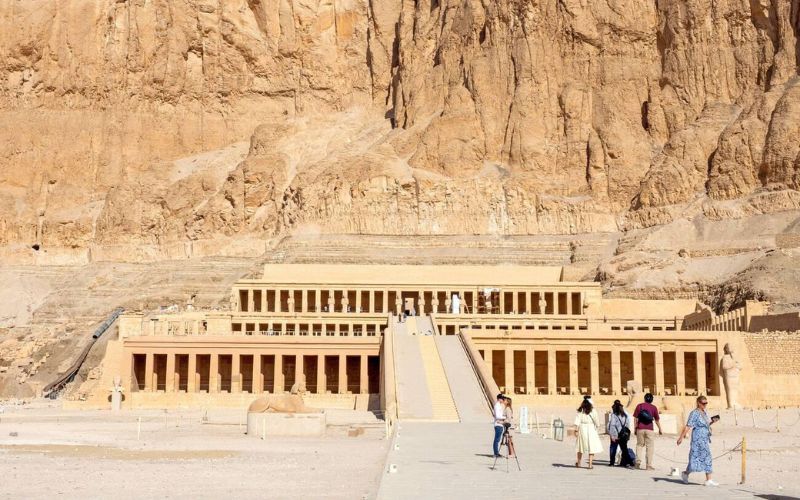
Perhaps the greatest surviving symbol of her reign is the extraordinary Mortuary Temple of Hatshepsut, often called the Hatshepsut mortuary temple.
Located beneath towering limestone cliffs near Luxor, the temple stands at Deir el-Bahari on the west bank of the Nile. It remains one of the most iconic monuments in Egypt and attracts visitors from around the world.
The mortuary temple of Hatshepsut is famous for its elegant terraces, massive colonnades, and harmonious architectural design. Unlike ancient Egyptian temples, the structure blends naturally into the surrounding cliffs, creating one of the most visually striking landscapes in ancient architecture.
The temple served both religious and political purposes. It honored the gods, celebrated Hatshepsut’s achievements, and reinforced her divine legitimacy as ruler. Detailed carvings on the temple walls depict scenes from her reign, including the famous expedition to Punt and stories of her divine birth.
The site remains one of the most searched Egyptian landmarks online, especially for travelers seeking “mortuary temple of Hatshepsut photos” or information about ancient Egyptian architecture.
Queen Hatshepsut Temple Architecture and Design
The Queen Hatshepsut temple represented a revolutionary architectural achievement for its time. The project was supervised by Senenmut, Hatshepsut’s trusted advisor and chief architect.
The architect of Hatshepsut temple designed a structure unlike anything previously built in Egypt. Rather than relying solely on pyramidal forms or enclosed sanctuaries, the temple emphasized openness, symmetry, and visual integration with nature.
Long ramps connected elevated terraces lined with elegant columns. Statues of Hatshepsut once decorated the pathways, presenting her in both feminine and masculine royal forms. The temple also included sanctuaries dedicated to Amun, Hathor, and Anubis.
Reliefs carved into the temple walls remain among the finest surviving examples of ancient Egyptian art. These scenes provide historians with valuable information about religion, trade, politics, and royal propaganda during her reign.
The temple became one of the defining masterpieces of Hatshepsut art and architecture.
Hatshepsut and Senenmut
The relationship between Hatshepsut and Senenmut continues to fascinate historians and archaeologists today.
Senenmut rose from relatively modest origins to become one of the most powerful officials in Egypt. He held numerous prestigious titles, including royal steward, tutor to Princess Neferure, and overseer of major construction projects.
Because of his unusually close association with the queen, some historians speculate that the relationship between Hatshepsut and Senenmut may have extended beyond politics. However, no definitive evidence proves a romantic connection.
What remains certain is that Senenmut played a critical role in shaping Hatshepsut’s public image and architectural legacy. His influence can be seen throughout the mortuary temple of Hatshepsut and other royal projects across Egypt.
Their partnership remains one of the most intriguing political relationships of Ancient Egypt.
Hatshepsut and Thutmose III
The political relationship between Hatshepsut and Thutmose III is another major subject of historical debate.
Thutmose III was technically the legitimate heir after the death of Thutmose II. However, because he was very young, Hatshepsut initially ruled as regent before eventually proclaiming herself pharaoh.
For many years, historians believed that tension and hostility existed between them. Some scholars suggested that Thutmose III later sought revenge by destroying Hatshepsut’s monuments and erasing her memory from official records.
Modern historians now believe the situation may have been more complex. Evidence suggests that Hatshepsut and Thutmose III may have ruled together relatively peacefully for years before her death.
Nevertheless, after she died, many statues and inscriptions connected to her were damaged or removed. This attempt to erase her legacy likely reflected political concerns regarding royal succession and legitimacy.
Ironically, these efforts failed. Today, Hatshepsut is remembered as one of Egypt’s most famous rulers.
Hatshepsut’s Accomplishments That Changed Egypt
The accomplishments of Hatshepsut extended far beyond royal symbolism.
Her economic policies transformed Egypt into a prosperous empire fueled by trade and construction. The expedition to Punt became one of the most successful commercial missions in Egyptian history.
She also launched enormous architectural programs across Egypt. Temples, chapels, obelisks, and monuments built during her reign demonstrated both national wealth and political stability.
At Karnak Temple, she erected massive obelisks dedicated to Amun. These monuments symbolized divine approval for her rule and showcased Egyptian engineering excellence.
Hatshepsut’s accomplishments also included strengthening centralized government authority and promoting artistic innovation. Under her reign, Egyptian sculpture and temple decoration reached extraordinary levels of sophistication.
Unlike rulers remembered primarily for destruction and warfare, Hatshepsut built a legacy centered on prosperity, diplomacy, religion, and culture.
Ancient Egyptian Female Pharaohs and Hatshepsut’s Legacy
When discussing ancient Egyptian female pharaohs, Hatshepsut almost always dominates the conversation.
Although other women ruled Egypt at different points in history, few achieved the same level of authority, stability, and historical impact. Hatshepsut proved that political leadership in Ancient Egypt could extend beyond traditional gender roles.
Her reign influenced how future generations viewed female authority. Even though later rulers attempted to diminish her memory, the scale of her achievements could not be completely erased.
Today, historians frequently compare her leadership to some of the most successful monarchs in global history.
Her story also continues to inspire discussions about women in leadership, political legitimacy, and historical memory.
Queen Hatshepsut Art and Artistic Representation
One of the most fascinating aspects of Hatshepsut art is the way she chose to represent herself visually.
Early depictions portrayed her as a traditional queen wearing feminine royal clothing. However, as her reign progressed, official statues increasingly showed her with masculine features associated with pharaohs.
She appeared wearing the royal kilt, ceremonial beard, and kingly crown typically reserved for male rulers. This transformation reflected political necessity rather than personal identity.
In Egyptian ideology, the pharaoh represented divine kingship itself, a role historically associated with male imagery. By adopting masculine symbols, Hatshepsut reinforced her legitimacy while maintaining political stability.
Today, surviving Hatshepsut artifacts and sculptures remain among the most valuable treasures of Ancient Egypt.
How Did Queen Hatshepsut Die?
Among the most searched historical questions is “how did Hatshepsut die?”
For centuries, historians did not even know where her mummy was located. However, in 2007, researchers identified a mummy believed to belong to Hatshepsut through dental analysis and archaeological evidence.
Modern scientific studies suggest that she may have suffered from several serious medical conditions, including obesity, arthritis, diabetes, and cancer.
Some researchers believe a medicinal skin cream she used may have contained carcinogenic substances that contributed to her illness. However, the exact cause of death remains uncertain.
The mystery surrounding how did Hatshepsut die continues to generate interest among historians and archaeologists worldwide.
Her death around 1458 BCE marked the end of one of the most prosperous eras in Egyptian history.
Hatshepsut Age and Early Life
Researchers estimate that Hatshepsut age at death was approximately fifty years old, which was relatively advanced for the ancient world.
When was Hatshepsut born? Most historians place her birth around 1507 BCE during the height of the 18th Dynasty.
As a royal daughter, she grew up within the highly ceremonial world of Egyptian court life. She received an education in religion, governance, and royal administration, preparing her for future political responsibilities.
This privileged upbringing helped shape the intelligence and political sophistication that later defined her reign.
Hatshepsut and Cleopatra
Comparisons between Hatshepsut and Cleopatra VII Philopator remain popular in modern discussions about powerful Egyptian women.
Although both queens became legendary female rulers, they lived more than fourteen centuries apart and ruled under completely different political circumstances.
Cleopatra ruled during the decline of the Ptolemaic Kingdom under heavy Roman influence. Hatshepsut, by contrast, ruled during Egypt’s rise as an independent imperial power.
Many historians argue that Queen Hatshepsut achieved greater administrative and economic success during her reign. While Cleopatra became famous through Roman literature and political drama, Hatshepsut built monuments and institutions that transformed Egypt itself.
Both rulers, however, remain enduring symbols of female leadership and political intelligence.
Facts of Queen Hatshepsut
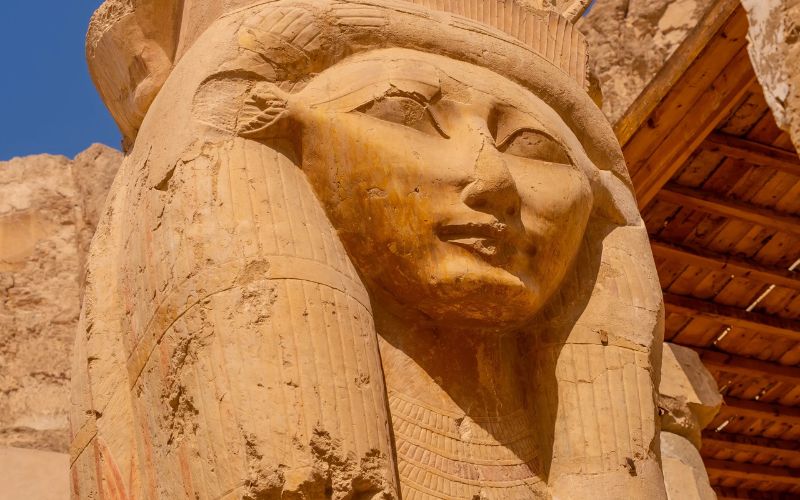
Many interesting facts about Hatshepsut continue to surprise historians and visitors today.
She ruled Egypt for approximately two decades during one of the kingdom’s wealthiest periods. She commissioned some of the greatest architectural works in Ancient Egypt and expanded international trade significantly.
She also reshaped royal imagery by presenting herself as both female ruler and traditional king. Her ability to maintain authority in a male-dominated political system demonstrated extraordinary strategic intelligence.
Another remarkable fact is that attempts to erase her legacy ultimately failed. Although some statues and inscriptions were destroyed after her death, enough monuments survived to preserve her story for future generations.
Today, Queen Hatshepsut remains one of the most studied rulers in Egyptology.
Ancient Egypt: Hatshepsut and Her Enduring Legacy
The story of Ancient Egypt’s Hatshepsut is ultimately a story of ambition, intelligence, political skill, and historical resilience.
She ruled during a transformative period in Egyptian history and demonstrated that leadership was not limited by gender. Through architecture, trade, diplomacy, and religion, she expanded Egypt’s wealth and strengthened its international influence.
Her magnificent mortuary temple of Hatshepsut still stands today as one of the greatest achievements of ancient architecture. Her monuments continue to attract scholars and tourists from around the world, while her life remains a central topic in the study of ancient Egyptian female pharaohs.
Despite attempts to erase her from history, Hatshepsut survived through stone inscriptions, statues, temples, and the enduring fascination of humanity itself.
More than three thousand years after her reign, Queen Hatshepsut remains one of the most iconic rulers of the ancient world, a visionary pharaoh whose influence continues to shape our understanding of Ancient Egypt and the power of leadership.