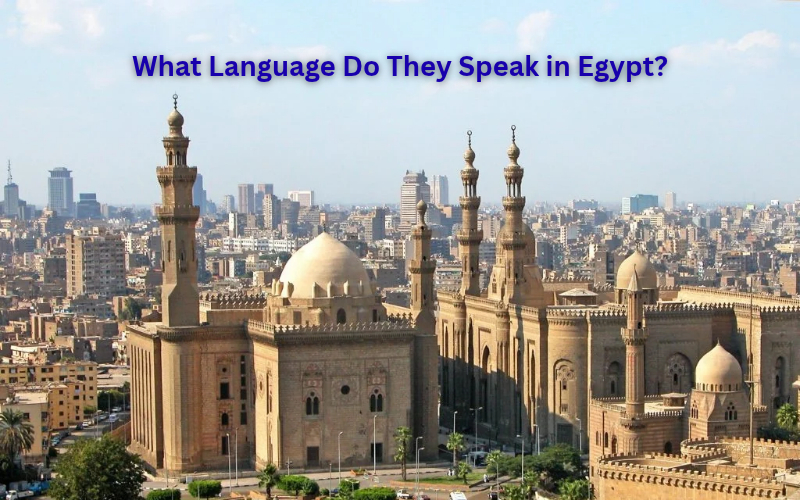
Quick Answer: What language do they speak in Egypt?
Arabic is the official language of Egypt, and Egyptian Arabic (Masri) is the language most Egyptians speak in everyday life. Modern Standard Arabic is used mainly in formal writing, education, government communication, and news broadcasts. English is commonly understood in hotels, airports, museums, and major tourist areas. Egypt also has other languages, including Nubian, Siwi, and Coptic, which preserve important parts of its cultural history.
If you are visiting Egypt in 2027, you do not need to speak fluent Arabic to enjoy the country. English is usually enough for a typical sightseeing trip to Cairo, Giza, Luxor, Aswan, or the Red Sea resorts.
However, knowing even a few Egyptian Arabic expressions can make everyday travel easier. Ordering a coffee, asking for directions, greeting a shopkeeper, or understanding a taxi driver becomes more comfortable when you recognize familiar words.
There is also an important distinction that many visitors miss: the Arabic you see on an official document is not necessarily the same Arabic you hear in a Cairo market.
Egyptian Arabic has its own vocabulary, pronunciation, humor, and conversational style. It is one of the most recognizable varieties of Arabic throughout the Arab world, partly because of Egypt’s long influence on film, television, and popular music.
And the country’s linguistic story extends much further into the past. Ancient Egyptians spoke a language that was not Arabic. Its final historical stage survives today through Coptic religious traditions.
Understanding these differences provides a more accurate picture of modern Egypt and a practical advantage for anyone planning a visit.
What Is the Official Language of Egypt?
Arabic is the only official language of Egypt. This is established by Article 2 of the Egyptian Constitution.
Arabic is used throughout the country’s public institutions, including government departments, courts, public education, and official documentation.
You will encounter Arabic on road signs, shopfronts, public notices, menus, transportation information, and government websites.
However, describing Egypt simply as an Arabic-speaking country does not explain the full situation.
Egyptians use different forms of Arabic depending on the setting, the people involved, and the purpose of the conversation.
The two most important varieties for visitors to understand are:
- Egyptian Arabic (Masri): The everyday spoken language used in conversations, family life, shops, restaurants, and informal communication.
- Modern Standard Arabic (MSA): The standardized form commonly used in formal writing, educational materials, official communication, and serious news reporting.
These varieties are closely related, but they differ in pronunciation, vocabulary, and some grammatical structures.
An Egyptian might discuss weekend plans with friends in Egyptian Arabic, read a newspaper in Modern Standard Arabic, and encounter a mixture of both during a television interview.
This ability to move between language varieties is a normal feature of Egyptian communication.
Language Overview: What Travelers Need to Know
| Language or variety | Main use in Egypt | What tourists should know |
| Egyptian Arabic (Masri) | Everyday conversations and informal communication | Most useful Arabic variety to learn for a holiday |
| Modern Standard Arabic | Official writing, formal media, education, and public communication | Helpful for recognizing written information |
| English | Tourism, international business, education, and hospitality | Commonly useful in major visitor areas |
| French | Some education, tourism, and professional settings | Less consistently available than English |
| German, Italian, Spanish, Russian, and other foreign languages | Selected tourist services and multilingual guiding | Availability depends on the destination and provider |
| Nubian languages | Nubian communities, particularly in southern Egypt | Important part of the cultural heritage of the Aswan region |
| Siwi | Siwa Oasis and associated communities | An Amazigh language distinct from Arabic |
| Coptic | Religious services, scholarship, and cultural preservation | Final historical stage of the ancient Egyptian language |
| Egyptian Sign Language | Communication within parts of Egypt’s Deaf community | Relevant to accessibility and linguistic diversity |
Arabic provides the shared national language, but Egypt’s linguistic identity is broader than Arabic alone.
For travelers, the most practical combination is straightforward: use English where available and learn a small selection of Egyptian Arabic phrases.
What Language Do Egyptians Speak in Everyday Life?
Most Egyptians speak Egyptian Arabic in everyday situations.
Locally, the language is commonly called Masri, meaning Egyptian. You may also encounter the term Al-Ammiya, referring to colloquial or everyday speech.
Egyptian Arabic is not simply Modern Standard Arabic spoken with a different accent. It has distinctive grammatical patterns, expressions, and vocabulary.
People use it naturally when discussing ordinary subjects such as family, shopping, work, food, transportation, entertainment, and daily plans.
Walk through a residential neighborhood in Cairo and you will hear people speaking Masri while buying bread, greeting neighbors, discussing football, or arranging transportation.
The same everyday variety appears in much of Egypt’s popular entertainment.
Movies, television comedies, conversational podcasts, online videos, and many songs use Egyptian Arabic because it reflects how people actually communicate.
For visitors, this means that learning conversational Egyptian Arabic is generally more practical than memorizing formal textbook sentences.
What Does Masri Mean?
The Arabic word Masri means Egyptian.
In language discussions, it commonly refers to the Egyptian variety of spoken Arabic.
You may see it written as:
- Masri
- Masry
- Egyptian Arabic
- Egyptian Colloquial Arabic
- Egyptian dialect
These terms usually refer to the same broad everyday language variety, although Egypt itself contains several regional dialects.
In Arabic, Masri is written as مصري.
The term does not imply that every Egyptian speaks in exactly the same way. Cairo speech, Upper Egyptian Arabic, and other regional forms have recognizable differences.
Nevertheless, the Cairo-based variety is especially familiar because of its influence in Egyptian broadcasting and popular culture.
Is Egyptian Arabic a Language or a Dialect?
Egyptian Arabic is generally classified as a variety or dialect of Arabic.
However, the boundary between a language and a dialect is not always determined by grammar alone. Historical development, identity, education, literature, and social conventions also matter.
Egyptian Arabic has distinctive characteristics, but it shares its broader linguistic ancestry with other Arabic varieties.
An Egyptian speaker and a speaker of Levantine Arabic, for example, may recognize considerable shared vocabulary while noticing differences in pronunciation and everyday expressions.
Communication can be more challenging between speakers of geographically distant Arabic varieties, particularly when neither is familiar with the other’s speech.
For tourism purposes, the distinction is less important than choosing the right form to learn.
If your goal is to speak with Egyptians during a holiday, Egyptian Arabic is the most directly useful variety.
If your goal is to read formal publications or communicate across many Arabic-speaking countries in formal settings, Modern Standard Arabic offers broader advantages.
Egyptian Arabic vs. Modern Standard Arabic: What Is the Difference?
Egyptian Arabic and Modern Standard Arabic are related forms of Arabic used for different purposes.
Modern Standard Arabic is often called Fusha. It is the standardized form used extensively in formal communication throughout the Arabic-speaking world.
Egyptian Arabic is the everyday spoken variety acquired through ordinary conversation and social interaction.
Many educated speakers move naturally between the two, sometimes combining features of each within one conversation.
Linguists describe the coexistence of formal and informal varieties as diglossia, although real language use is more flexible than a simple two-category division.
Egyptian Arabic Is the Language of Conversation
Imagine entering a small coffee shop in Cairo.
The server is unlikely to speak in the formal style of a television newsreader. Instead, the conversation will normally take place in everyday Egyptian Arabic.
Shortened expressions, familiar pronunciation, and informal vocabulary make speech sound natural.
The same pattern applies when asking a shopkeeper about a price, talking with a driver, or speaking with someone at a local restaurant.
Modern Standard Arabic Is More Common in Formal Contexts
Now imagine reading an official notice about a government service or listening to a formal news bulletin.
The language is likely to be much closer to Modern Standard Arabic.
Official documents need a standardized written form that can be understood across institutions and regions.
Modern Standard Arabic serves that function.
It is not accurate to say that Egyptians never speak Modern Standard Arabic. It can be used in prepared speeches, formal presentations, religious or academic discussions, and certain broadcasts.
However, sustained Modern Standard Arabic is not the normal style of casual conversation between friends.
Egyptian Arabic and Standard Arabic Compared
| Feature | Egyptian Arabic | Modern Standard Arabic |
| Principal purpose | Everyday conversation | Formal writing and communication |
| Common setting | Homes, cafés, markets, informal media | Official documents, education, news |
| Pronunciation | Characteristic Egyptian patterns | More standardized formal pronunciation |
| Vocabulary | Everyday expressions and regional words | Formal and standardized vocabulary |
| Grammar | Colloquial structures and constructions | Standardized formal grammar |
| Writing | Often used in informal messages and creative media | Standard in official and formal writing |
| Practical value for visitors | Direct conversation with residents | Reading and understanding formal information |
Neither variety is inherently better.
They serve different communication needs.
A traveler learning Egyptian Arabic is not learning an incorrect version of formal Arabic. They are learning the language variety used in ordinary Egyptian social life.
A Simple Example: Asking Where Something Is
In Egyptian Arabic, a traveler may ask:
Fein el-hammam? — Where is the bathroom?
In Modern Standard Arabic, the equivalent question is more formally expressed as:
Ayna al-hammam?
Both can be understood by Arabic speakers familiar with their respective forms, but the first sounds more natural in a casual Egyptian setting.
This small example demonstrates why learning the local variety can make practical communication easier.
What Makes Egyptian Arabic Different From Other Arabic Dialects?
Egyptian Arabic has recognizable pronunciation, vocabulary, and grammatical features that distinguish it from other varieties.
Some differences are immediately noticeable, while others become apparent only through longer conversations.
The Pronunciation of Certain Letters
One well-known feature of Cairo Arabic is the pronunciation of the Arabic letter ج.
In many common words, it sounds like the English hard g in go, rather than the j in jam used in many other Arabic varieties.
For example:
- The Arabic word for camel, جمل, is commonly pronounced gamal in Cairo.
- The word for mountain, جبل, is commonly pronounced gabal.
However, pronunciation varies within Egypt, and this feature should not be treated as universal across every community.
Another feature is the pronunciation of the letter ق.
In many everyday Cairene words, its traditional sound is replaced by a glottal stop, similar to the break in some English pronunciations of uh-oh.
Other Egyptian dialects may preserve or replace that sound differently.
This helps explain why different Arabic-speaking communities can recognize the same written word but pronounce it differently.
Vocabulary That Sounds Distinctly Egyptian
Egyptians frequently use conversational words that visitors may not encounter in formal Arabic lessons.
Examples include:
| Egyptian expression | Approximate meaning |
| Aiwa | Yes |
| La’ | No |
| Kwayyis | Good or fine |
| Tayyib | Okay or all right |
| Yalla | Come on or let’s go |
| Khalas | Finished, enough, or that’s settled |
| Maalesh | Never mind, sorry, or it’s okay, depending on context |
| Mish | Not |
| Fein? | Where? |
| Eh? | What? |
Several of these expressions are understood beyond Egypt, but their frequency, pronunciation, and conversational use can be distinctively Egyptian.
Egyptian Arabic Has Its Own Conversational Rhythm
Learning individual words does not immediately prepare someone for the speed and rhythm of natural speech.
In ordinary conversation, sounds may be shortened, vowels may change, and expressions may flow together.
Speakers also rely on context, tone, and shared cultural understanding.
For example, maalesh can express an apology, sympathy, reassurance, or mild frustration.
Its precise meaning depends on how it is said and what has happened.
A traveler does not need to master these details. Recognizing that one expression can have different meanings helps prevent overly literal translations.
Why Egyptian Arabic Is Familiar Across the Arab World
Egypt has played a major role in Arabic-language cinema, television, music, and entertainment for generations.
As a result, many Arabic speakers outside Egypt have considerable exposure to Egyptian pronunciation and vocabulary.
This familiarity can make Egyptian Arabic more recognizable than a visitor might expect.
However, recognition is not the same as complete mutual understanding.
Individual ability varies, and speakers of different dialects may need to adjust their vocabulary or speaking style.
Egyptian Arabic remains one important part of a much larger and diverse Arabic-speaking world.
What Language Do They Speak in Cairo, Egypt?
People in Cairo primarily speak Egyptian Arabic, especially the Cairene variety.
Cairo is one of the main cultural centers shaping how Egyptian Arabic is represented in national media.
Its influence extends through television, films, music, radio, online entertainment, and other communication channels.
Visitors exploring Cairo and its major neighborhoods will hear Egyptian Arabic almost everywhere.
The language appears in everyday life at street-food stalls, shops, workplaces, apartment buildings, and public transportation stops.
English is also common in many visitor-facing businesses, but it is not equally spoken in every part of the city.
What Language Will You Hear at the Pyramids of Giza?
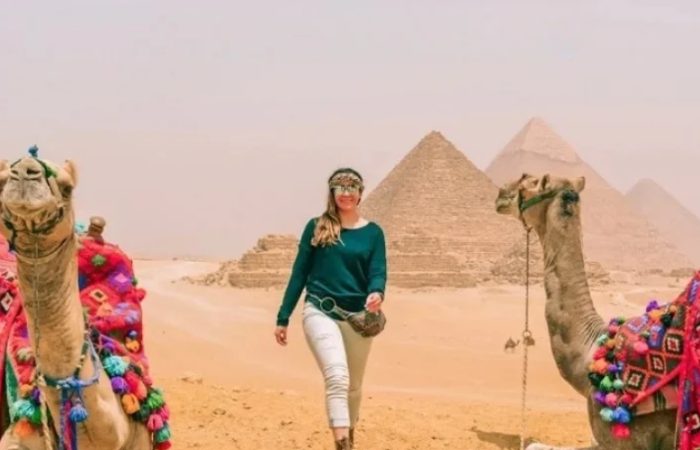
At the Pyramids of Giza, you are likely to hear Egyptian Arabic, English, and several other foreign languages.
Tour guides, tourism workers, and vendors regularly communicate with visitors from different countries.
Some may know phrases in German, French, Spanish, Italian, Russian, or other languages.
That does not mean every person working near the pyramids is fluent in those languages.
A few memorized sales expressions are different from being able to explain complex historical information.
If you want detailed archaeological explanations in English or another language, arrange a suitable qualified guide rather than assuming language support will be available spontaneously.
What Language Is Used in Cairo’s Markets?
Arabic dominates everyday local market conversations.
In heavily visited shopping areas, some vendors also use English and other foreign languages.
At Khan El Khalili Bazaar, visitors may hear prices, greetings, and sales pitches in several languages.
However, in smaller neighborhood shops, Egyptian Arabic is generally more reliable.
Knowing how to say bikam? — how much? — can be useful when asking about a price.
Equally important is confirming the price and currency clearly before agreeing to purchase.
What About Cairo’s Museums?
Major museums are accustomed to international visitors.
English-language signs, exhibition information, and guided experiences may be available, depending on the museum and gallery.
If ancient Egyptian history is a major interest, consider planning visits to the Grand Egyptian Museum and other archaeological collections with the help of a qualified guide.
A guide who speaks your preferred language can explain not only what an object represents but also the historical context that is difficult to communicate through a short label.
For travelers interested in museum collections, the difference between conversational English and specialized historical interpretation can be significant.
What Languages Are Spoken in Different Parts of Egypt?
Arabic is the dominant language across Egypt, but the linguistic environment changes according to region and community.
Some differences involve Arabic dialects. Others involve distinct languages with separate histories.
English and additional foreign languages also become more or less common depending on the amount and type of international tourism.
Language Expectations by Destination
| Destination | Main everyday language | Other languages visitors may encounter | Practical advice |
| Cairo and Giza | Egyptian Arabic | English and other foreign languages in tourist businesses | English is often sufficient for major sightseeing |
| Alexandria | Egyptian Arabic | English and some other foreign languages | Learn basic Arabic for local markets and neighborhood travel |
| Luxor | Egyptian Arabic and regional Upper Egyptian varieties | English and additional languages used in tourism | Confirm your guide’s language when booking |
| Aswan | Arabic, including regional varieties | Nubian languages in relevant communities; English in tourism | Be aware of local linguistic diversity |
| Hurghada | Egyptian Arabic | English, German, Russian, and other visitor languages | Language support varies by hotel and operator |
| Sharm El Sheikh | Egyptian Arabic | English and other languages used in international tourism | Ask providers about specific language services |
| Siwa Oasis | Siwi and Arabic | Variable English in tourism | A local guide can help with cultural interpretation |
| Rural communities | Regional Arabic varieties | Other local languages in some areas | Do not assume English proficiency |
These are general expectations, not population statistics or guarantees of fluency.
Language availability depends on the specific hotel, business, guide, or individual.
Cairo and Giza: The Most International Urban Setting
Cairo and Giza have extensive tourism infrastructure, international hotels, museums, universities, and businesses.
English is commonly useful in visitor-oriented environments.
But Greater Cairo is a large metropolitan area with many neighborhoods that serve local residents rather than international visitors.
A traveler may communicate comfortably in English at an international hotel and encounter very little English at a neighborhood bakery just a short distance away.
This is normal.
Alexandria: Arabic With an International Heritage
Alexandria has a long history of contact with the Mediterranean world.
Greek, Italian, French, and other communities have contributed to the city’s cultural history.
Modern Alexandria is nevertheless predominantly Arabic-speaking.
Visitors should not assume that the historical presence of European languages means they are widely spoken in everyday life today.
English is useful in parts of the hospitality sector, but Egyptian Arabic remains the main language for ordinary local interaction.
Luxor: A Different Regional Arabic Experience
Luxor is located in Upper Egypt, where regional varieties of Arabic differ from the Cairo dialect in pronunciation and some vocabulary.
The label Sa’idi Arabic is commonly associated with varieties spoken in Upper Egypt.
These varieties are not all identical, and speakers may use different forms depending on their community and the situation.
Visitors to Luxor will also encounter tourism workers who communicate in English and other languages.
Around major archaeological sites, experienced guides are accustomed to explaining complex topics to international visitors.
In local residential areas, Arabic is more prominent.
Aswan: Arabic and Nubian Heritage
Aswan is especially important when discussing languages other than Arabic.
Many residents use Arabic in everyday communication, while Nubian communities have maintained distinct linguistic traditions.
Nubian languages are not simply accents of Arabic. They have separate linguistic structures and historical backgrounds.
Visitors interested in the cultural landscape of Aswan may encounter Nubian language, music, traditions, and place names in certain communities.
A local cultural guide can help explain this heritage respectfully.
Red Sea Resorts: A Multilingual Tourism Environment
Hurghada and Sharm El Sheikh serve international visitors from many countries.
English is commonly used by hotel staff, excursion operators, and other tourism businesses.
Other languages may be available according to the markets served by individual hotels and resorts.
For example, a hotel with many German-speaking guests may provide German-language guest services, while another property may focus on English or Russian-language communication.
Always check directly if you require a specific language.
A multilingual hotel advertisement should not be treated as proof that every service, excursion, or emergency contact is available in that language.
Siwa Oasis: A Distinct Linguistic Identity
Siwa Oasis, in Egypt’s Western Desert, has a particularly important linguistic heritage.
Alongside Arabic, members of the local community speak Siwi, an Amazigh language.
Siwi belongs to a different branch of the Afroasiatic language family from Arabic.
Visitors planning a trip to Siwa Oasis should recognize that its culture is not simply a variation of Cairo culture.
The language forms part of a broader heritage expressed through local traditions, oral history, social practices, and community identity.
Arabic remains useful for communication, while tourism workers may also speak English.
Is English Widely Spoken in Egypt?
Yes, English is commonly spoken or understood in Egypt’s major tourist areas, but fluency varies widely outside them.
Egypt’s official tourism information identifies English as a language commonly used in urban centers and popular visitor destinations.
This makes English-speaking travel practical for many international tourists.
Hotels, travel agencies, museums, airports, and guided excursions often provide services in English.
However, it would be misleading to claim that everyone in Egypt speaks English.
Language proficiency depends on education, work, location, age, and personal experience.
Can You Travel Around Egypt Speaking Only English?
For a typical organized holiday, generally yes.
An itinerary involving Cairo, Giza, Luxor, Aswan, and a Nile cruise can often be arranged with English-speaking guides, drivers, and accommodation staff.
Visitors who stay mainly in internationally oriented hotels and use organized excursions may rarely need to conduct an extended conversation in Arabic.
Independent travelers have a different experience.
Local buses, small shops, traditional markets, and residential neighborhoods may require basic Arabic or translation assistance.
The best approach is to prepare for both situations.
Use English naturally, but keep a translation app and a few useful Egyptian Arabic phrases available.
Where Is English Most Useful?
English is particularly helpful for:
- Hotel check-in and guest services.
- Airport arrival procedures and tourism information.
- Communication with many licensed tour guides.
- Museum visits and organized sightseeing.
- Nile cruise guest services.
- Restaurant orders in tourist districts.
- Excursion bookings.
- Private transportation arrangements.
- Travel agency correspondence.
These services vary by operator.
If English-language assistance is important, request confirmation before booking rather than relying on a general description of the destination.
Where Might English Be Less Common?
English may be less consistently available in:
- Small rural communities.
- Neighborhood markets serving local residents.
- Some local transportation services.
- Small family-owned shops.
- Administrative settings not designed for tourists.
- Informal conversations with people outside the tourism sector.
This is not necessarily a barrier to visiting.
Simple language, written addresses, maps, gestures, and translation technology often solve ordinary communication problems.
More important matters, such as medical treatment or official documentation, may require professional translation or qualified assistance.
Do People in Egypt Speak American or British English?
Egyptian students and professionals may encounter different English accents through education, media, and international communication.
There is no single foreign accent that all Egyptians use.
You may hear Egyptian-accented English, British-influenced pronunciation, American-influenced pronunciation, or speech shaped by other educational and professional experiences.
For visitors from the USA, UK, Canada, or Australia, the important point is that clear international English is generally useful.
If someone does not understand a phrase, try simpler vocabulary rather than repeating the same sentence more loudly.
For example, instead of asking, “Would it be possible to arrange transportation back to the accommodation later this afternoon?” ask, “Can you arrange a car to my hotel at 4 PM?”
The shorter version is easier to translate and confirm.
Do People in Egypt Speak French, German, Spanish, or Russian?
Yes. Several foreign languages are used in Egyptian tourism and professional settings.
English is generally the most practical foreign language for an international traveler, but multilingual services are available in many destinations.
French is found in some educational and professional environments as well as tourism.
German, Italian, Spanish, and Russian are also used by some guides, hotel workers, and travel-service providers.
The exact distribution changes with the businesses and visitors involved.
Does Egypt Speak French as an Official Language?
No.
French is not an official language of Egypt.
It has historical and educational connections with the country, but Arabic remains the official national language.
A traveler who speaks French may be able to arrange French-speaking guides or hotel services, particularly by booking in advance.
However, French should not be assumed to be generally understood by the wider population.
Can Tourists Request Guides in Other Languages?
In many cases, yes.
Tour operators may arrange guides who speak English, French, German, Spanish, Italian, or other languages.
Availability depends on destination, date, guide specialization, and booking arrangements.
If you need a particular language, clarify whether the guide can deliver detailed historical explanations in that language.
Basic conversational ability is not the same as professional interpretation.
For visits involving complex archaeological or religious subjects, language proficiency can affect how much you learn.
Travelers who would prefer organized support can compare Egypt guided tours and confirm their preferred guiding language before booking.
Essential Egyptian Arabic Phrases Every Traveler Should Know
You do not need to become conversationally fluent in Arabic before visiting Egypt.
A small collection of familiar words can make greetings, shopping, dining, and transportation easier.
The phrases below are practical examples of everyday Egyptian Arabic.
Pronunciation is approximate. Egyptian speech varies by region, and there is no single universal system for writing Arabic sounds with English letters.
Basic Greetings and Polite Expressions
| English meaning | Egyptian Arabic | Easy pronunciation |
| Hello | أهلاً | Ahlan |
| Peace be upon you | السلام عليكم | Es-salamu aleikum |
| Reply to the greeting | وعليكم السلام | Wa aleikum es-salam |
| Good morning | صباح الخير | Sabah el-kheir |
| Good morning (reply) | صباح النور | Sabah en-noor |
| Good evening | مساء الخير | Masa el-kheir |
| Good evening (reply) | مساء النور | Masa en-noor |
| Thank you | شكراً | Shukran |
| You’re welcome | عفواً | Afwan |
| Please (to a man) | من فضلك | Min fadlak |
| Please (to a woman) | من فضلك | Min fadlik |
| Excuse me (to a man) | لو سمحت | Law samaht |
| Excuse me (to a woman) | لو سمحتي | Law samahti |
| Yes | أيوه | Aiwa |
| No | لأ | La’ |
| Goodbye | مع السلامة | Ma’a salama |
| No, thank you | لأ، شكراً | La’, shukran |
You will not need every expression every day.
The most useful starting point is probably ahlan, shukran, law samaht, aiwa, and la’, shukran.
These phrases cover many ordinary interactions.
How to Say Hello in Egypt
The simplest informal greeting is ahlan.
It works in many casual situations, including shops, cafés, and introductions.
Another common greeting is es-salamu aleikum, meaning peace be upon you.
A traditional response is wa aleikum es-salam.
These greetings are culturally familiar across Egyptian society and are not restricted to conversations between tourists and one particular religious community.
A visitor does not need to use a long greeting to be polite.
A friendly sabah el-kheir in the morning is often enough.
How to Say Thank You in Egyptian Arabic
The word is shukran.
It is one of the most practical Arabic words a traveler can learn.
You can use it after receiving directions, completing a purchase, being served food, or getting assistance.
Unlike some expressions, shukran does not change depending on whether you are speaking to a man or a woman.
A more emphatic expression is alf shukr, literally a thousand thanks.
For ordinary travel situations, however, shukran is entirely sufficient.
How to Say No Thank You
Say la’, shukran.
This phrase is particularly useful in markets and busy tourism areas.
It provides a simple, polite refusal when you do not want to buy something or accept an offer.
If someone continues trying to sell you something, you do not need to enter a long conversation.
A calm refusal followed by moving on is often the simplest response.
How to Ask How Someone Is
In everyday Egyptian Arabic, a common question is:
Izzayyak? — How are you? (addressing a man)
Izzayyik? — How are you? (addressing a woman)
The difference relates to the person being addressed.
A common response is kwayyis, meaning good or fine, although forms vary according to the speaker.
You may also hear el-hamdu lillah, meaning praise be to God, used in everyday responses and expressions of gratitude.
These are common cultural expressions, not instructions that visitors must use.
Useful Egyptian Arabic for Shopping and Bargaining
Shopping is one of the situations where knowing a little Arabic becomes particularly practical.
In major shopping centers, prices are usually displayed clearly.
In traditional markets, visitors may need to ask the price of individual items.
A few expressions can make the exchange easier.
| English | Egyptian Arabic | Approximate pronunciation |
| How much? | بكام؟ | Bikam? |
| How much is this? | بكام ده؟ | Bikam da? |
| Too expensive | غالي أوي | Ghali awi |
| Can it be cheaper? | ممكن أقل؟ | Momkin a’all? |
| I want this | عايز ده / عايزة ده | Ayiz da / Ayza da |
| I don’t want it | مش عايز / مش عايزة | Mish ayiz / Mish ayza |
| That’s enough / finished | خلاص | Khalas |
| Okay | ماشي | Mashi |
| Thank you | شكراً | Shukran |
Ayiz and ayza are forms used by male and female speakers respectively.
You do not need to memorize the grammatical distinctions immediately, but knowing that some words change form can help you understand what you hear.
How to Ask About a Price
The simplest question is bikam?
To ask about a specific nearby item, bikam da? is a common expression.
Pointing to the item while asking makes the question clearer.
The seller may answer quickly in Egyptian Arabic.
If you do not understand the amount, ask for the price to be entered into a phone calculator.
This is especially useful because spoken numbers can be harder to recognize than written figures.
Is Bargaining Common in Egypt?
Bargaining occurs in some traditional markets and tourism-oriented shopping environments.
It is not appropriate to assume that every store or service operates through negotiation.
Supermarkets, many modern retail stores, restaurants, and ticket offices generally have stated prices.
In a market where negotiation is customary, be courteous and establish the final price before paying.
The purpose of learning a phrase such as bikam? is better communication, not a guarantee of a discount.
A Simple Market Conversation
A visitor points to a souvenir and asks:
Bikam da? — How much is this?
The seller states a price.
The visitor decides it is more than they want to spend and responds:
Ghali awi. — Very expensive.
If the seller offers a lower amount, the visitor can either accept or politely decline.
La’, shukran ends the interaction without unnecessary argument.
You can practice these expressions before exploring Egypt’s traditional markets or browsing for Egyptian souvenirs.
Egyptian Arabic Phrases for Restaurants and Cafés
Food is another useful setting for simple Arabic.
A visitor may be comfortable ordering in English at a tourist restaurant but encounter menus or staff using mostly Arabic at a smaller local establishment.
Fortunately, many essential restaurant words are short.
| English | Egyptian Arabic | Approximate pronunciation |
| Water | مية | Mayya |
| Tea | شاي | Shay |
| Coffee | قهوة | Ahwa |
| Bread | عيش | Eish |
| Food | أكل | Akl |
| The bill, please | الحساب لو سمحت | El-hesab, law samaht |
| Restaurant | مطعم | Mat’am |
| Delicious | لذيذ | Laziz |
| I want water | عايز مية / عايزة مية | Ayiz mayya / Ayza mayya |
| Is there…? | فيه…؟ | Fi…? |
Egyptian cuisine also has dish names that are useful to recognize.
Examples include koshari, ful, taameya, molokhia, and mahshi.
These names are part of the everyday vocabulary of Egyptian food culture.
You can explore familiar ingredients and dishes in this guide to traditional Egyptian food.
Ordering Water
The Egyptian Arabic word for water is mayya.
A visitor can point to a bottle or glass and say the word clearly.
However, you should not assume that knowing one word is enough to communicate a special requirement.
If you need bottled water, a particular brand, or water without ice, explain that request directly or use a translated sentence.
Asking for the Bill
El-hesab, law samaht is a useful phrase.
It means the bill, please, when addressing a man.
As elsewhere, change the polite form appropriately when addressing a woman.
You may also simply ask for the bill in English if the staff member understands.
Communicating Food Allergies
Food allergies require more than a memorized phrasebook expression.
If you have a serious allergy, prepare a clearly translated explanation that identifies the ingredient and the consequences of exposure.
Show it to restaurant staff and ask them to confirm that the food and its preparation are suitable.
Translation apps can assist, but their output should not be your only safeguard for a serious medical risk.
A bilingual guide or reliable interpreter is preferable when an explanation must be exact.
Egyptian Arabic for Taxis, Transportation, and Directions
Transportation is one of the areas where travelers may need language support outside hotels.
Many drivers are familiar with well-known attractions and hotel names.
Others may be more comfortable communicating in Arabic.
The most reliable preparation is to keep your destination written in Arabic and English.
Useful Transportation Words
| English | Egyptian Arabic | Approximate pronunciation |
| Where? | فين؟ | Fein? |
| Where is the bathroom? | فين الحمام؟ | Fein el-hammam? |
| Airport | مطار | Matar |
| Train | قطر | Qatar |
| Taxi | تاكسي | Taxi |
| Bus | أتوبيس | Otobis |
| Hotel | فندق | Fondoq |
| Street | شارع | Share’ |
| Right | يمين | Yemeen |
| Left | شمال | Shemal |
| Straight ahead | على طول | Ala tool |
| Stop here | وقف هنا | Wa’ef hena |
| Here | هنا | Hena |
In this table, the Egyptian Arabic word qatar means train. It is unrelated to the English name of the Gulf country, even though transliterations may look similar.
How to Give a Taxi Driver Your Destination
Rather than relying entirely on pronunciation, show the driver:
- Your destination name.
- Its Arabic spelling, if available.
- A map pin or confirmed address.
- The intended entrance or pickup location when necessary.
Large attractions, museums, hotels, and transport hubs may have multiple entrances.
Confirming the exact point matters more than pronouncing the name perfectly.
You can also arrange Cairo airport transfers before arrival if you prefer to have transportation organized in advance.
Why Written Arabic Can Help
English transliterations of Arabic place names are not always consistent.
The same destination may appear with different spellings on websites, road signs, and maps.
For example, English-language materials commonly vary in how they represent Arabic sounds and whether they include hyphens.
A local driver may recognize the Arabic name immediately but be less familiar with an unusual English spelling.
Keeping both forms available reduces confusion.
Basic Egyptian Arabic Numbers for Travelers
Numbers are particularly useful when shopping, reading prices, arranging meeting times, and discussing transportation.
You do not need to learn the entire Arabic numbering system before traveling.
Recognizing the numbers from one to ten is a practical starting point.
| Number | Egyptian Arabic | Approximate pronunciation |
| 1 | واحد | Wahed |
| 2 | اتنين | Etnein |
| 3 | تلاتة | Talata |
| 4 | أربعة | Arba’a |
| 5 | خمسة | Khamsa |
| 6 | ستة | Setta |
| 7 | سبعة | Sab’a |
| 8 | تمانية | Tamanya |
| 9 | تسعة | Tes’a |
| 10 | عشرة | Ashara |
The exact pronunciation changes slightly between speakers and contexts.
For beginners, hearing these numbers repeatedly is more useful than attempting to memorize every formal pronunciation rule.
Can You Read Numbers in Egypt Without Knowing Arabic?
Often, yes.
Egypt uses both Western-style numerals and Eastern Arabic numerals in different contexts.
You may encounter the following equivalents:
| Western numerals | Eastern Arabic numerals |
| 0 | ٠ |
| 1 | ١ |
| 2 | ٢ |
| 3 | ٣ |
| 4 | ٤ |
| 5 | ٥ |
| 6 | ٦ |
| 7 | ٧ |
| 8 | ٨ |
| 9 | ٩ |
Recognizing these numerals can help when reading local price displays, handwritten information, or printed Arabic materials.
A phone calculator also provides a simple way to confirm amounts.
When discussing prices, always establish both the amount and the currency.
Egypt’s currency is the Egyptian pound, commonly abbreviated EGP.
In everyday Egyptian Arabic, it is called geneh.
How to Pronounce Egyptian Arabic Words
Egyptian Arabic contains sounds that do not correspond exactly to common English pronunciation.
You do not need to master every sound to make yourself understood.
However, a few pronunciation tips can improve clarity.
The Kh Sound
The Arabic sound represented by kh appears in words such as kheir, meaning good in the greeting sabah el-kheir.
It is produced toward the back of the mouth.
English speakers may recognize a similar sound in the Scottish pronunciation of loch.
An approximate pronunciation is usually understandable, especially when supported by context.
The Gh Sound
The sound represented by gh differs from the ordinary English hard g.
It is heard in words such as ghali, meaning expensive.
The sound is produced farther back in the mouth than an English g.
Beginners should prioritize recognizable phrases rather than perfect pronunciation.
The Arabic Letter Ayn
The Arabic letter ع represents a sound that has no close standard English equivalent.
English transliterations may represent it with an apostrophe or a special symbol.
You may notice it in words such as ma’a, depending on the transliteration system.
Some travel guides omit the symbol entirely to make words easier for beginners.
This is one reason why English spellings of Arabic expressions often vary.
Stress and Vowel Sounds
Egyptian Arabic words may sound different depending on which syllable receives emphasis.
Short vowels can also become reduced in everyday speech.
For example, the familiar word shukran may be written as shokran in informal English transliteration.
Both attempt to represent the same Arabic expression.
Do not assume that a different transliteration represents a different word.
How to Practice Before Your Trip
Listen to recordings by native Egyptian Arabic speakers.
Repeat one phrase at a time, then compare your pronunciation with the recording.
Prioritize words you are likely to use.
A traveler spending several days in Cairo may benefit more from learning bikam?, shukran, and fein? than from memorizing advanced grammar.
Practice with real conversational audio when possible, because automated speech tools may pronounce words in Modern Standard Arabic rather than the Egyptian dialect.
Other Languages Spoken in Egypt Besides Arabic
Egypt has long been home to communities with distinct linguistic traditions.
Although Arabic is the dominant national language, it is not the only language used by Egyptians.
Nubian languages, Siwi, and other community languages form part of the country’s living heritage.
Coptic also occupies an important place in Egypt’s linguistic history.
Nubian Languages
Nubian communities are closely associated with the Nile Valley in southern Egypt and northern Sudan.
Their languages belong to the Nubian group, which is separate from Arabic.
Nobiin and Kenzi are among the Nubian varieties associated with communities in southern Egypt.
These languages have distinct histories, vocabulary, and grammatical systems.
Their cultural importance extends beyond communication.
They are linked to oral storytelling, music, family traditions, local knowledge, and community identity.
Many Nubians also speak Arabic, so multilingualism is part of everyday life in these communities.
Where Can Visitors Encounter Nubian Languages?
Visitors may encounter Nubian cultural traditions around Aswan and in communities connected with the wider Nubian region.
However, not every resident of Aswan is Nubian, and not every Nubian person speaks the same language variety.
It is better to avoid treating Nubian culture as a single uniform tradition.
A knowledgeable local guide can explain the differences between communities and help visitors approach cultural experiences respectfully.
Are Nubian Languages Disappearing?
Some Nubian varieties face challenges relating to intergenerational transmission, migration, education, and changing patterns of language use.
Community-led preservation, documentation, and teaching efforts are important.
However, it would be inaccurate to describe Nubian languages as merely historical or already extinct.
They remain part of living cultural traditions.
Their future depends on many factors, including the choices and efforts of speakers and their communities.
Siwi: The Language of Siwa Oasis
Siwi is an Amazigh language spoken in the Siwa region.
It is distinct from Arabic, even though both belong to the wider Afroasiatic language family.
Amazigh languages are associated with communities across North Africa.
Siwa has maintained a distinctive cultural identity despite centuries of interaction with other Egyptian regions.
Siwi continues to be an important part of local heritage.
Arabic is also used, particularly for communication beyond the community.
For travelers, knowing that Siwi is a separate language helps avoid a common misunderstanding: Siwan culture is not simply Cairo culture relocated into the desert.
Beja and Other Community Languages
Languages associated with Beja communities are also part of the wider linguistic diversity of northeastern Africa, including areas connected with Egypt’s Eastern Desert and Red Sea region.
Other communities in Egypt have their own linguistic histories, including varieties associated with migration and cross-border movement.
It is difficult to give a reliable single number for all languages spoken in Egypt because counts depend on how languages and dialects are classified.
Speaker populations may also be difficult to estimate accurately.
For visitors, the central point is that Egypt’s cultural diversity is broader than its dominant spoken language.
Egyptian Sign Language
Signed languages are another important aspect of linguistic diversity.
Egyptian Deaf communities use sign-language varieties, and these are not simply spoken Arabic represented through hand gestures.
Signed languages have their own linguistic structures and patterns of expression.
For deaf and hard-of-hearing travelers, availability of accessible communication services should be checked with hotels, museums, guides, and transport providers in advance.
Do not assume that every attraction provides a sign-language interpreter or that a guide who speaks English can automatically meet sign-language accessibility needs.
Clear written information and advance accessibility arrangements can be especially helpful.
What Language Did Ancient Egyptians Speak?
Ancient Egyptians spoke the Egyptian language, which was different from modern Arabic.
The ancient Egyptian language belongs to the Afroasiatic language family.
It has a documented history stretching back thousands of years and is among the earliest extensively recorded written languages.
Its development is usually discussed in historical stages, including Old Egyptian, Middle Egyptian, Late Egyptian, Demotic, and Coptic.
These stages represent linguistic changes over long periods rather than a series of entirely unrelated languages.
The language spoken under the pharaohs was not identical to the language spoken in Egypt today.
Did Ancient Egyptians Speak Arabic?
No.
Arabic was not the language of the pharaonic kingdoms.
The ancient Egyptian language developed long before Arabic became widespread in Egypt.
Arabic entered Egypt and gradually expanded after the seventh-century Arab conquest.
Its eventual dominance was part of a long linguistic and social transition.
It did not immediately replace all earlier languages.
Greek and Coptic continued to have important roles during different periods, and Arabic spread through administration, commerce, religion, education, and everyday life over generations.
Did Ancient Egyptians Speak Hieroglyphics?
No. Hieroglyphs were a writing system, not a separate spoken language.
This is one of the most common misunderstandings about ancient Egyptian communication.
Ancient Egyptians used hieroglyphs to write their language.
They did not speak in hieroglyphic pictures.
The distinction is similar to the difference between English as a language and the Latin alphabet used to write it.
The same language can be represented using different writing systems.
Ancient Egyptian offers an especially interesting example because its written forms changed substantially over time.
Ancient Egyptian Writing Systems
| Script | Main characteristics | Historical role |
| Hieroglyphic | Formal signs representing sounds, words, and concepts | Monumental and religious inscriptions |
| Hieratic | Cursive writing derived from hieroglyphic forms | Administrative, literary, and religious texts |
| Demotic | Later cursive Egyptian script | Documents, literature, and everyday written administration |
| Coptic | Primarily Greek letters with additional Egyptian-derived signs | Final historical written stage of the Egyptian language |
These systems should not be confused with separate unrelated spoken languages.
They represent changing methods of writing Egyptian, although Greek and other languages were also used in Egypt at different times.
Could Everyone in Ancient Egypt Read Hieroglyphs?
Literacy was not universal in ancient Egypt.
Specialized scribes played an important role in administration, religious life, taxation, legal records, and the recording of information.
Learning to read and write required training.
Ordinary people could communicate perfectly well in spoken Egyptian without being literate in monumental hieroglyphic writing.
This distinction matters when interpreting ancient inscriptions.
A temple wall preserves a written message, but it does not show exactly how every person in ancient Egyptian society spoke.
Written language can be more formal or conservative than ordinary conversation.
What Did the Ancient Egyptian Language Sound Like?
Scholars can reconstruct aspects of ancient Egyptian pronunciation, but significant uncertainties remain.
Early Egyptian writing generally did not record vowels in the way modern English does.
This makes the precise pronunciation of many words difficult to establish.
Coptic is particularly important to historical linguistics because its writing system represents vowel sounds more clearly.
Comparisons with Coptic and related linguistic evidence have helped researchers interpret earlier Egyptian forms.
Nevertheless, a reconstructed pronunciation should not be treated as an audio recording of an ancient speaker.
When a museum guide pronounces the name of an ancient ruler, deity, or Egyptian word, that pronunciation may reflect scholarly convention rather than complete certainty about the original sound.
How Did Egypt Change From Ancient Egyptian to Arabic?
Egypt’s language history reflects successive political, religious, social, and cultural developments.
The transition was gradual and involved long periods when multiple languages were used.
Ancient Egyptian Was Used for Thousands of Years
The Egyptian language developed across the long history of pharaonic civilization.
Its written record stretches back to the earliest periods of Egyptian state formation.
Different historical stages are visible in inscriptions, literary texts, letters, administrative records, and religious documents.
The language evolved as Egypt’s society changed.
Vocabulary, grammar, writing conventions, and pronunciation did not remain fixed.
Greek Became Important During Later Ancient History
Greek became especially influential during the Ptolemaic period, following Alexander the Great’s conquest of Egypt.
Greek also remained important under Roman rule.
In these periods, Greek and Egyptian coexisted in different institutional and social contexts.
The situation was not a simple replacement in which all Egyptians immediately abandoned their previous language.
Administrative needs, education, location, and social identity influenced the languages people used.
Coptic Represented the Final Historical Stage of Egyptian
Coptic developed as the last historical stage of the Egyptian language.
It was written mainly using Greek letters, together with additional signs representing Egyptian sounds.
Coptic became especially important in Christian religious literature and community life.
It preserved linguistic features that helped later scholars understand earlier stages of Egyptian.
Arabic Spread After the Seventh Century
Following the Arab conquest of Egypt in the seventh century CE, Arabic gradually expanded.
Its use in administration, religion, commerce, and public life increased over time.
The process lasted centuries.
Different communities and institutions adopted Arabic at different rates.
Coptic remained significant in Christian religious settings, even as Arabic became increasingly dominant in daily life.
Modern Egyptian Arabic developed within this long historical and social environment.
A Simplified Timeline of Languages in Egypt
| Historical period | Major linguistic development |
| Early pharaonic history | Ancient Egyptian becomes extensively recorded in writing |
| Middle and New Kingdom periods | Egyptian continues evolving; hieroglyphic and hieratic writing remain important |
| Later pharaonic periods | Late Egyptian and Demotic forms become prominent |
| Ptolemaic and Roman periods | Greek and Egyptian coexist in major institutional and social settings |
| Late antiquity | Coptic becomes an important written form of Egyptian |
| From the seventh century CE | Arabic begins a gradual expansion in Egypt |
| Medieval centuries | Arabic becomes increasingly dominant in administration and everyday life |
| Modern Egypt | Egyptian Arabic dominates ordinary speech; Standard Arabic serves formal functions; Coptic and other languages remain significant in particular communities |
The timeline is deliberately simplified.
Linguistic transitions overlap, and language histories cannot always be reduced to a single date.
Is Coptic the Same as Ancient Egyptian?
Coptic is the final historical stage of the Egyptian language.
It is not a completely unrelated language that appeared after ancient Egyptian disappeared.
The relationship is central to understanding Egypt’s linguistic history.
Earlier Egyptian forms were written in hieroglyphic, hieratic, and Demotic scripts.
Coptic used a different writing system, primarily based on the Greek alphabet.
This made it particularly important for preserving aspects of Egyptian pronunciation.
Is Coptic Still Spoken in Egypt Today?
Coptic is still used in religious and educational contexts, particularly within Coptic Christian traditions.
However, it is not an ordinary everyday first language for Egypt’s general population.
Most Egyptian Coptic Christians speak Arabic in daily life.
It is important not to confuse the words Coptic as a religious or cultural identity and Coptic as the name of a language.
A person may identify as Coptic Christian without speaking Coptic conversationally.
Where Can Visitors Learn About Coptic Heritage?
Visitors interested in this history can explore Coptic Cairo, where churches and religious institutions preserve important aspects of Egypt’s Christian heritage.
Religious artwork, inscriptions, manuscripts, and historical architecture provide valuable context.
Some religious services and texts also preserve Coptic linguistic traditions.
Visitors should remember that churches are active places of worship, not simply tourist exhibits.
Dress appropriately, respect services, and follow any instructions regarding photography or visitor access.
Why Is Coptic Important to Egyptology?
Coptic helped scholars interpret the earlier Egyptian language.
Because Coptic records vowels more clearly than many earlier Egyptian scripts, it offers important linguistic evidence.
It is also useful for understanding the evolution of words, grammatical structures, and pronunciation.
This does not mean scholars can reconstruct every ancient Egyptian sound with certainty.
It means Coptic provides a valuable connection between earlier written Egyptian and a later documented stage of the language.
What Does the Rosetta Stone Tell Us About Egypt’s Languages?
The Rosetta Stone is one of the most important objects associated with understanding ancient Egyptian writing.
It contains an ancient decree recorded in three scripts:
- Egyptian hieroglyphic.
- Egyptian Demotic.
- Ancient Greek.
The distinction is important: the stone has three scripts but two languages, Egyptian and Greek.
The Greek text provided a crucial reference for scholars attempting to understand the Egyptian inscriptions.
Research by Thomas Young, Jean-François Champollion, and other scholars contributed to the decipherment of Egyptian writing.
The Rosetta Stone helped demonstrate that hieroglyphic signs could represent sounds as well as other linguistic elements.
Why the Rosetta Stone Still Matters
The ability to read Egyptian inscriptions transformed the study of ancient Egypt.
Instead of relying only on later accounts, scholars could examine texts produced by ancient Egyptians themselves.
These writings provided access to royal records, religious beliefs, administrative activities, personal names, and many other subjects.
The Rosetta Stone also illustrates Egypt’s multilingual past.
Greek and Egyptian were used within the same administrative and cultural environment.
For visitors interested in ancient inscriptions, this historical background adds meaning to temple walls, statues, and museum objects.
Can You Read Hieroglyphs at Egyptian Archaeological Sites?
Visitors can see hieroglyphic inscriptions at many major archaeological sites.
Examples include the temples of Luxor, Karnak, Edfu, Philae, and Abu Simbel.
The inscriptions may contain royal names, religious formulas, descriptions of offerings, or other historical information.
However, not every sign has a simple one-word English translation.
Hieroglyphic writing uses a complex system involving sound signs and other linguistic functions.
For a fuller interpretation, a qualified Egyptologist can explain both the written message and its historical context.
Why Understanding Egypt’s Language Makes Archaeological Visits More Interesting
Language helps connect ancient monuments to the people who created them.
Without historical context, temple inscriptions may appear to be decorative rows of birds, people, and symbolic objects.
Understanding that they record a sophisticated written language changes how visitors interpret them.
Hieroglyphs at Karnak Temple
The walls and monuments of Karnak Temple contain inscriptions associated with rulers, religious practices, and the temple’s long history.
A guide may explain the relationship between a pharaoh’s name, the titles used for a deity, and the religious meaning of a particular scene.
The writing forms part of a larger architectural and ceremonial program.
It was not added simply as decoration.
Royal Names and Cartouches
Ancient Egyptian royal names were sometimes enclosed in oval-shaped outlines known as cartouches.
Learning to recognize a cartouche can help visitors identify royal inscriptions.
However, not every cartouche is straightforward to interpret without knowledge of Egyptian writing conventions.
One person may have several royal names and titles.
A label identifying a cartouche is therefore more useful when it explains which name is being represented.
Tomb Inscriptions in Luxor
Tombs may preserve texts related to religious beliefs, the afterlife, royal identity, and ritual protection.
The choice of wording, script, and location can contribute to the interpretation.
Understanding that ancient Egyptian writing developed across different periods also helps explain why inscriptions may vary between monuments.
A New Kingdom royal tomb should not automatically be interpreted through the same historical framework as a much earlier Old Kingdom monument.
Does Egyptian Arabic Contain Words From Ancient Egyptian?
Modern Egyptian Arabic developed primarily as a variety of Arabic, but its history includes contact with earlier languages spoken in Egypt.
Coptic and other historical languages contributed to the linguistic environment in which Egyptian Arabic developed.
Certain words and expressions have been discussed as possible or established borrowings from earlier Egyptian linguistic stages.
However, individual word origins can be difficult to prove.
Words may change pronunciation and meaning over time.
Similar-sounding words are not automatically historically related.
Can Egyptians Understand Ancient Egyptian?
No. A modern Egyptian Arabic speaker cannot automatically understand ancient Egyptian inscriptions.
The relationship between modern Egyptian identity and ancient Egyptian civilization does not make the two languages mutually intelligible.
An Egyptian who has not studied ancient Egyptian would generally need specialized knowledge to read hieroglyphic texts.
Likewise, knowing modern Arabic does not allow someone to read Coptic fluently.
The languages have different structures and historical developments.
Are Egyptian Arabic and Ancient Egyptian Related?
They belong to the wider Afroasiatic language family, but they are not the same language.
Arabic belongs to the Semitic branch.
Ancient Egyptian forms a separate branch within Afroasiatic.
Their distant linguistic relationship should not be confused with direct continuity between Egyptian Arabic and the pharaonic language.
The direct historical continuation of ancient Egyptian is represented by Coptic.
Modern Egyptian Arabic developed through the spread and evolution of Arabic in Egypt.
Why Do Some Egyptian Words Sound Different From Other Arabic Dialects?
Language contact is one possible explanation.
Over the centuries, Egyptian speech has interacted with Coptic, Turkish, European languages, and regional Arabic varieties.
Local innovations also influence vocabulary and pronunciation.
Not every distinctive Egyptian word must come from another language.
Some differences developed naturally within Egyptian Arabic itself.
Responsible linguistic explanations distinguish evidence-based etymology from popular speculation.
How Does Language Affect Egyptian Culture?
Language in Egypt is more than a practical communication tool.
It is closely connected to humor, storytelling, film, music, social relationships, and public identity.
The Egyptian Arabic heard in a comedy may contain expressions that depend on timing, tone, and shared cultural references.
An English translation can communicate the basic meaning without preserving every detail.
That is true of humor in many languages, but it is particularly noticeable in conversational media.
Egyptian Humor and Everyday Expressions
Egyptian Arabic has an extensive range of conversational expressions.
Words such as maalesh, khalas, and yalla can carry meanings that shift according to context.
A phrase may be reassuring, playful, impatient, or dismissive depending on the speaker’s tone.
Visitors are not expected to understand these subtleties immediately.
It is better to listen carefully and avoid assuming that every phrase has a single fixed English meaning.
Language and Hospitality
Greetings and short exchanges often form an important part of social interaction.
A person may greet someone before beginning a practical request.
At a café, market, or small shop, acknowledging a greeting can make the conversation more natural.
You do not need to imitate every local expression.
Basic politeness, patience, and clear communication are more valuable than attempting complicated phrases you do not understand.
Language and Religion
Arabic is important in the religious lives of many Egyptian Muslims and Christians.
Islamic religious texts and practices have a long association with Classical Arabic.
Egyptian Christian communities also use Arabic extensively in daily life and religious settings.
Coptic remains part of particular Christian liturgical traditions.
Religion does not determine which language someone speaks at home.
Egyptians from different religious backgrounds commonly share Egyptian Arabic as their everyday language.
Language and Festivals
Religious celebrations, national events, family occasions, and community traditions are often accompanied by familiar expressions and greetings.
The wording used may depend on the occasion and the relationship between speakers.
If you are attending a celebration during your trip, a local guide or host can explain which greetings are appropriate.
It is better to ask than to memorize a phrase without knowing its context.
Should You Learn Arabic Before Visiting Egypt in 2027?
Learning Arabic is not a requirement for a successful Egypt holiday.
For travelers staying in major visitor areas, English-language services can cover most ordinary needs.
Nevertheless, learning a few Egyptian Arabic phrases is worthwhile.
The best preparation depends on the kind of trip you are planning.
For First-Time Visitors
Focus on greetings, courtesy, numbers, and simple questions.
Prioritize:
- Hello.
- Thank you.
- Please.
- Yes and no.
- How much?
- Where?
- The bill, please.
- Excuse me.
- Goodbye.
These expressions cover many common travel interactions.
For Independent Travelers
Add words related to transportation, directions, food, and accommodation.
Learn how to identify your destination in Arabic.
Save your hotel address in both Arabic and English.
Practice understanding basic prices and numbers.
An offline translation app can provide additional support when mobile data is unavailable.
For Travelers Visiting Rural Areas
Consider arranging local assistance when communication is likely to be important.
This is particularly useful for transportation, specialized cultural experiences, and places with limited international tourism infrastructure.
Learning common greetings is helpful, but it should not replace practical planning.
For History and Archaeology Enthusiasts
You do not need to learn ancient Egyptian to appreciate archaeological sites.
Understanding a few concepts can still make a major difference.
Learn the distinction between a language and its script, the function of cartouches, and the historical role of Coptic.
For detailed explanations, prioritize the quality and language skills of your guide.
For Families Visiting Egypt
Families can make language learning part of their preparation.
Children may enjoy learning how to say hello, thank you, and basic numbers.
A short language activity can help them recognize unfamiliar writing systems and cultural differences.
Parents should also make sure children know the name and address of their accommodation.
Planning a family holiday becomes easier when important transport and contact information is saved in a format that local residents can recognize.
How to Communicate in Egypt Without Speaking Arabic
Successful communication does not require perfect language skills.
It requires clear information and realistic expectations.
Most routine misunderstandings can be reduced through preparation.
Use Simple English
Avoid long sentences with several requests.
State one question at a time.
Instead of saying, “I was wondering whether you might know if there is somewhere nearby where I could purchase a ticket,” ask, “Where can I buy a ticket?”
Short sentences are easier for both people and translation software.
Keep Important Addresses Written Down
Save your hotel name, street address, and location pin.
Include the Arabic spelling when possible.
This is especially useful for transportation.
Do not rely on a hotel name being pronounced or transliterated consistently.
Download an Offline Translation Tool
A translation app can help with menus, simple conversations, and written instructions.
Download the required language files before your trip.
Test whether the app supports offline translation and whether it offers an Egyptian Arabic voice or colloquial-language option.
Many services prioritize Modern Standard Arabic.
That may still be understandable, but it does not always produce the most natural Egyptian expression.
Use a Calculator for Prices
When discussing money, numerical clarity is particularly important.
A calculator reduces the chance that someone mishears an amount.
Show the figure clearly and establish whether the price is per person, per vehicle, or for the entire service.
This is useful for taxis, private excursions, souvenirs, and additional hotel services.
Confirm Meeting Times in Writing
Dates and times are easy to misunderstand, even between people who share a language.
For important arrangements, request confirmation in writing.
Use an unambiguous format such as:
“Hotel pickup: 7:30 AM, 15 March 2027.”
Include the pickup location and contact details where relevant.
For multi-day tours, confirm which activities occur on each date.
Do Not Depend on Machine Translation for High-Stakes Matters
Translation software is useful but imperfect.
For serious medical issues, legal documents, police reports, insurance claims, and other important situations, seek qualified language assistance when necessary.
A translation that is good enough for ordering lunch may not be appropriate for explaining a medical condition.
Confirm Accessibility Requirements Before Booking
Travelers who need sign-language interpretation, accessible written information, or other communication accommodations should contact providers in advance.
Ask what is actually available at the specific property or attraction.
A general statement that a venue is accessible does not necessarily establish that communication accommodations are available.
Common Language Mistakes Tourists Make in Egypt
Most language mistakes are easy to avoid once you understand how communication works in Egypt.
Mistake 1: Assuming All Egyptians Speak English
English is common in tourism, but it is not universal.
Some people speak it fluently, others know a few expressions, and others may not understand it comfortably.
Prepare simple alternatives.
Mistake 2: Assuming Arabic Sounds the Same Everywhere
Arabic includes many regional varieties.
A phrase learned from a Gulf Arabic textbook may be understood in Egypt but sound unfamiliar in casual conversation.
For an Egypt-specific holiday, learn Egyptian Arabic expressions.
Mistake 3: Confusing Hieroglyphs With a Spoken Language
Hieroglyphs were a script used to write ancient Egyptian.
They were not a language spoken aloud.
Understanding this distinction makes archaeological interpretation more accurate.
Mistake 4: Treating Coptic as Modern Everyday Egyptian
Coptic represents the final historical stage of the ancient Egyptian language.
It is important in religious and academic settings but is not the ordinary spoken language of most modern Egyptians.
Mistake 5: Assuming Arabic Has One English Spelling
Arabic words can be represented in English letters in several ways.
Shukran and shokran are examples of different phonetic spellings.
A slightly different spelling does not necessarily indicate a different word.
Mistake 6: Speaking Louder When Someone Does Not Understand
Higher volume rarely solves a language problem.
Speak more slowly, use simpler wording, write the information, or show a translation.
Avoid interpreting limited English proficiency as a lack of understanding or intelligence.
Mistake 7: Using Complicated Translation-App Sentences
Long, idiomatic English expressions can translate poorly.
Keep important requests direct.
Instead of “Could you possibly squeeze us in at a slightly earlier time?” use “Can we come at 9 AM instead of 10 AM?”
Clear language reduces uncertainty.
Mistake 8: Assuming a Multilingual Guide Knows Every Subject
Someone may speak excellent conversational English but have limited knowledge of archaeology.
Conversely, a knowledgeable specialist may communicate best in a particular language.
For historical tours, evaluate both subject expertise and communication ability.
Mistake 9: Ignoring Regional Languages
Egypt is not linguistically uniform.
Nubian languages and Siwi are examples of living traditions that deserve recognition.
Respect community language identities rather than describing everything as a form of Arabic.
Mistake 10: Forgetting to Confirm Important Details
Even fluent speakers can misunderstand times, locations, prices, and included services.
Written confirmation is the most reliable solution for important arrangements.
Language preparation should make the trip easier, not create unnecessary anxiety about speaking perfectly.
A Practical Language Plan for Your Egypt Trip
The most effective approach is to match language preparation to your itinerary.
A traveler visiting Cairo for three days has different needs from someone spending two weeks across Egypt.
Before Departure
Learn five essential expressions.
Save your accommodation address.
Download an offline translation app.
Confirm the language of any booked guides.
Keep reservation details accessible.
At Cairo International Airport
Use English for routine tourism-related communication where available.
Keep your hotel name and transfer confirmation ready.
If the pickup location is unclear, contact the transfer provider rather than relying on a verbal description from an unfamiliar person.
During Sightseeing
Use English with your guide or other appropriate visitor services.
Recognize that historical terms may have several accepted English spellings.
Ask for clarification when place names or royal names sound unfamiliar.
At Markets and Cafés
Try a few common phrases.
Use shukran to thank people and bikam? to ask prices.
Be patient when conversations require repetition.
Confirm payment amounts clearly.
During a Nile Cruise
Most cruises aimed at international visitors organize guest services and guided excursions around one or more foreign languages.
Ask the operator which language will be used during historical explanations.
This is important because cruise excursions can involve detailed discussions of temples, rulers, and religious beliefs.
In Aswan and Siwa
Remain open to regional linguistic differences.
Arabic is useful, while local languages may have particular cultural importance.
A responsible local guide can explain linguistic traditions without reducing communities to tourist stereotypes.
For a Longer Egypt Itinerary
Visitors planning several regions should organize transportation, accommodation, and guiding in advance where appropriate.
A structured Egypt travel itinerary can help coordinate visits and reduce misunderstandings about travel times, departure points, and scheduled activities.
The amount of Arabic you need depends less on the number of days than on how independently you plan to travel.
Frequently Asked Questions About Languages Spoken in Egypt
What language do they speak in Egypt today?
Arabic is Egypt’s official language, and Egyptian Arabic is the dominant everyday spoken variety. Modern Standard Arabic is used in formal writing, education, and official communication. English is commonly understood in major tourist areas, while other languages, including Nubian and Siwi, are spoken within particular communities.
What language do they speak in Cairo, Egypt?
People in Cairo primarily speak Egyptian Arabic, especially the Cairene variety. English is commonly used in many hotels, museums, universities, and tourist businesses. However, Arabic remains the main language for everyday local communication, particularly in residential neighborhoods and ordinary markets.
Do most people in Egypt speak Arabic or English?
Arabic is the dominant language spoken by Egyptians. English is a widely used foreign language, particularly in education, international business, and tourism. Many people in visitor-facing occupations communicate in English, but this does not mean English is the principal language of the population.
Can I visit Egypt without knowing Arabic?
Yes. Many international tourists travel successfully through Egypt without speaking Arabic. English-language services are commonly available in major tourist destinations. Learning a few Egyptian Arabic phrases, saving addresses, and using translation tools can make independent travel and local interactions easier.
Do Egyptians speak the same Arabic as people in Saudi Arabia?
Egyptians and Saudis speak varieties of Arabic, but their everyday dialects differ in vocabulary, pronunciation, and grammatical patterns. Modern Standard Arabic provides an important shared formal variety. Familiarity with media and other dialects can also help speakers understand one another.
What language did ancient Egyptians speak before Arabic?
Ancient Egyptians spoke the Egyptian language, which belonged to the Afroasiatic family. It developed over thousands of years through different historical stages. Its final historical stage is Coptic. Arabic became increasingly dominant in Egypt after the seventh century CE through a gradual process.
Is Egyptian Arabic difficult to learn?
The difficulty depends on your previous language experience, study methods, and goals. Egyptian Arabic has sounds and grammatical patterns unfamiliar to many English speakers, but learning essential travel phrases is manageable. Fluency requires sustained practice, while basic greetings and simple questions can be learned much sooner.
Is Coptic still spoken in Egypt?
Coptic is still used in religious and educational contexts, particularly within Coptic Christian traditions. It is not the everyday first language of most Egyptians, including most Coptic Christians. Modern Egyptian Arabic is the main spoken language across the country.
Do people in Luxor and Aswan speak the same Arabic as Cairo?
Arabic is widely spoken in all three locations, but regional pronunciations and vocabulary differ. Upper Egyptian Arabic varieties are associated with parts of southern Egypt. Aswan also has communities with Nubian linguistic traditions. In visitor-facing businesses, English may be available alongside local languages.
Is French widely spoken in Egypt?
French is used in some educational, professional, and tourist settings, but it is not Egypt’s official language. English is generally more practical for international tourists. Visitors seeking French-language excursions or services should confirm availability with the specific provider.
What is the easiest Egyptian Arabic phrase to learn?
Shukran, meaning thank you, is one of the easiest and most useful phrases. It works in many situations and does not require different forms depending on whom you address. Other practical expressions include ahlan for hello, aiwa for yes, and la’, shukran for no, thank you.
Are hieroglyphics still used as a spoken language?
No. Hieroglyphs were a writing system used to record the ancient Egyptian language. They were not a separate spoken language. Ancient Egyptian developed through several historical stages, with Coptic representing its final stage. Modern Egyptians primarily speak Arabic, while hieroglyphs are studied as part of ancient Egyptian history.
Final Thoughts: What Language Should You Use in Egypt?
The answer to “What language do they speak in Egypt?” is simple at first: Arabic is the official language, and Egyptian Arabic is what most people speak every day.
For tourists, English is often sufficient in major visitor destinations, especially when using organized hotels, transfers, and guided excursions.
Learning a few Egyptian Arabic phrases adds a useful personal dimension to the experience, particularly when visiting cafés, markets, and neighborhoods beyond the main tourism areas.
Egypt’s linguistic history also deserves attention. From ancient Egyptian writing and Coptic heritage to Nubian traditions and the Siwi language, the country preserves a diverse cultural record extending far beyond modern Arabic.
For your 2027 trip, the best preparation is to learn a few polite expressions, keep important information written clearly, and confirm your preferred language when arranging services.
If you would like your historical visits, transportation, and guiding arranged in advance, Touring in Egypt’s private tours can be a practical starting point for planning a suitable itinerary.