Quick Answer: What are Ancient Egyptian Amulets?
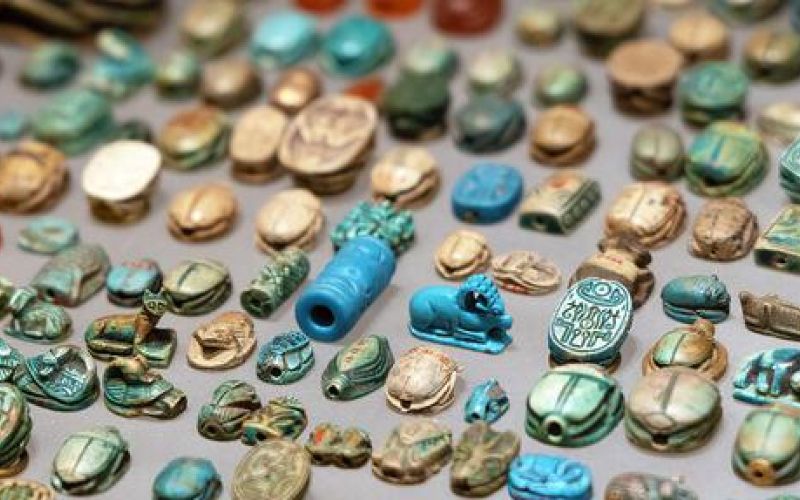
Ancient Egyptian amulets were small objects believed to provide magical protection, health, strength, good fortune, and renewal. Egyptians wore them as jewelry, carried them as charms, and placed them with the dead. Famous examples include the Eye of Horus, scarab beetle, ankh, djed pillar, and tyet knot. Their meanings depended on their shapes, materials, inscriptions, religious associations, and intended purposes.
A tiny blue scarab could represent the daily rebirth of the sun. A golden ankh expressed the power of life. A red knot evoked the protection of Isis, while a carefully inscribed heart scarab could help its owner face judgment in the afterlife.
These objects were far more than ancient accessories. They reveal how Egyptians understood danger, illness, childbirth, death, divine protection, and the possibility of living again.
Some amulets were inexpensive enough for ordinary people. Others were crafted from gold, lapis lazuli, carnelian, and carefully glazed faience. The same symbol might appear on a child’s necklace, in royal jewelry, or among the linen wrappings of a mummy, although its precise function could differ.
For visitors exploring Egypt in 2027, recognizing these objects adds another level of meaning to museum collections and archaeological sites. A small amulet can reveal just as much about Egyptian beliefs as a monumental temple.
What Were Ancient Egyptian Amulets?
Ancient Egyptian amulets were protective or beneficial objects whose shapes, symbols, materials, or inscriptions were thought to possess supernatural power.
Their main purpose was to help a person obtain or preserve something desirable. That might be physical safety, health, fertility, divine assistance, strength, longevity, or renewed existence after death.
An amulet did not have to be elaborate.
It could be a carved stone, a glazed ceramic pendant, a shell, a miniature animal, a small image of a deity, or a piece of folded material containing protective words.
Many ancient Egyptian amulets had holes for suspension, allowing them to be worn around the neck or incorporated into bracelets and other ornaments.
Others were placed directly against the body or secured within mummy bandages.
The distinction between decoration and religious protection was not always sharp. A beautiful necklace could also carry a spiritual purpose.
What Does Amulet Mean in Ancient Egypt?
The modern English word amulet is used by archaeologists to describe objects believed to confer protective or beneficial powers.
Ancient Egyptians did not necessarily classify all these objects under one perfectly equivalent term. Their uses were understood through religious symbols, ritual practices, and the power of heka, often translated as magic.
In ancient Egyptian thought, magic was not automatically considered separate from religion or medicine.
Protective rituals, prayers, and sacred objects could work together.
A person facing illness might seek practical treatment while also relying on supernatural protection. Families could use symbolic objects to express hopes for a safe childbirth or healthy child.
These traditions reflected the worldview of the people who used them. The objects are historical evidence of those beliefs, not proof that supernatural protection occurred.
Were Amulets Different From Talismans and Charms?
The terms amulet, talisman, and charm overlap in modern English.
An amulet is generally understood as an object used for protection or benefit. A talisman may be associated with a desired power or outcome, while a charm can mean either an object or a spoken formula.
For ancient Egypt, these modern distinctions are not always useful.
An Egyptian scarab might function as a decorative pendant, an administrative seal, and a protective object simultaneously.
The most reliable way to understand an artifact is to examine its archaeological context rather than assign a meaning based only on its shape.
Why Were Amulets So Important in Ancient Egypt?
Ancient Egyptian amulets mattered because Egyptians understood the world as a place influenced by both visible events and invisible divine forces.
People faced familiar human concerns: injury, sickness, dangerous animals, pregnancy, childbirth, uncertainty, and death.
Religious protection offered a way to respond to those concerns.
Protection During Everyday Life
Many ancient Egyptians wore amulets to reduce the perceived threat of illness, accidents, or hostile influences.
An Eye of Horus might be associated with restoring health. A protective deity could guard a household, while a symbol of life might express hopes for continued vitality.
The practical significance lay partly in the comfort and religious meaning these objects offered.
Protection was not limited to the wealthy.
Faience, relatively inexpensive compared with precious metals and gemstones, allowed many small amulets to be manufactured in recognizable colors and designs.
Protection During Pregnancy and Childhood
Pregnancy and early childhood involved considerable uncertainty in the ancient world.
Protective figures associated with mothers and children therefore held particular importance.
Bes, Taweret, and other divine figures could appear on household objects and personal amulets.
Their sometimes intimidating appearances had a protective purpose: frightening away threatening forces.
A small figure representing such a deity was not simply a miniature statue. Its religious identity gave it meaning.
Power in the Afterlife
Egyptians believed death did not necessarily end personal existence.
However, the deceased had to undergo transformation, restoration, and sometimes judgment before enjoying continued life.
Amulets helped express and support those expectations.
They might protect a specific body part, symbolize regeneration, invoke a deity, or assist in the preservation of the deceased’s identity.
This explains why archaeological excavations frequently discover amulets in funerary settings.
The Religious Power of Heka
Heka was an important concept in ancient Egyptian religion.
It referred to a power associated with divine creation and the ability to bring about effects through sacred words, actions, and objects.
A protective object could derive its effectiveness, in the ancient Egyptian understanding, from several elements working together:
- Its recognizable sacred form.
- Its particular material or color.
- A written name or magical formula.
- Its association with a deity or myth.
- A ritual performed during its preparation or use.
- Its placement on the body or within a burial.
This combination helps explain why two visually similar amulets could have different religious functions.
Ancient Egyptian Amulets and Their Meanings: At a Glance
The following comparison identifies important Egyptian amulet symbols and their commonly documented associations.
| Ancient Egyptian amulet | Principal meaning | Important association |
| Eye of Horus (Wedjat) | Protection, healing, restoration | Horus |
| Scarab beetle | Transformation, renewal, rebirth | Khepri |
| Ankh | Life and vitality | Divine life |
| Djed pillar | Stability and endurance | Osiris |
| Tyet knot | Protection and restoration | Isis |
| Heart scarab | Protection during afterlife judgment | Heart, Ma’at |
| Frog | Fertility, birth, renewal | Heqet |
| Cat | Protection and prosperity | Bastet |
| Bes figure | Protection of families and children | Bes-image deities |
| Taweret figure | Protection in pregnancy and childbirth | Taweret |
| Two-finger amulet | Restoration of the embalmed body | Funerary practices |
| Shen ring | Encircling protection and eternity | Royal and divine imagery |
| Uraeus cobra | Protective divine authority | Wadjet, kingship |
| Papyrus or wadj symbol | Freshness, renewal, flourishing | Plant imagery |
| Headrest amulet | Protection and revival of the head | Funerary rebirth |
| Sa symbol | Protection | Protective deities |
| Menat counterpoise | Divine protection and renewal | Hathor |
| Heart-shaped amulet | Preservation of the heart and identity | Afterlife beliefs |
| Isis amulet | Protection through divine maternal power | Isis |
| Osiris amulet | Regeneration and continued life | Osiris |
These are general meanings, not universal rules. The same symbol could acquire additional associations through its inscription, date, material, or archaeological context.
The Eye of Horus Amulet: Protection, Health and Restoration
The Eye of Horus is one of the most recognizable ancient Egyptian amulets.
It is also called the Wedjat or Udjat eye.
The symbol combines elements of a human eye with markings associated with a falcon, reflecting the identity of Horus, a major deity closely linked with kingship and the sky.
What Does the Eye of Horus Amulet Mean?
The Eye of Horus represents protection, restoration, healing, and wholeness.
Its meaning comes partly from mythology.
In stories about the conflict between Horus and Seth, Horus’s eye was injured or lost. The eye was subsequently restored, often through the intervention of Thoth.
This restoration became a powerful religious model for recovering what had been damaged.
An ancient Egyptian Eye of Horus amulet could therefore represent the hope that health, safety, or completeness would be preserved or renewed.
The Egyptian name wedjat is associated with the idea of being sound or whole.
Why Was the Eye of Horus Used for Protection?
The eye was a meaningful symbol because sight itself suggested awareness and vigilance.
Combined with its mythology of restoration, it became appropriate for both personal and funerary protection.
Wedjat amulets were made from materials including faience and various stones.
They were incorporated into jewelry and funerary assemblages. The symbol also appeared in decorative and religious settings beyond personal amulets.
The Eye of Horus was not restricted to royal use.
Its widespread appearance helps explain why it remains among the most familiar ancient Egyptian protective symbols.
How Can You Recognize a Wedjat Eye?
A typical Wedjat has an outlined eye, an extended cosmetic line, and distinctive markings below.
Those lower markings create a highly stylized appearance different from an ordinary eye.
Some amulets include additional decorative features or appear as part of larger compositions.
When identifying an object in a museum, consider its label and context rather than relying entirely on whether the eye faces left or right.
Ancient Egyptian eye imagery is more varied than simplified modern charts sometimes suggest.
Eye of Horus vs Eye of Ra Amulet
The Eye of Horus is especially associated with restoration and healing.
The Eye of Ra refers to the power of the sun god and can represent a formidable protective or destructive divine force.
The Eye of Ra may also be personified by goddesses, including Hathor, Sekhmet, and others in different religious traditions.
Modern jewelry explanations sometimes treat the Eye of Horus as a left eye and the Eye of Ra as a right eye. Although solar and lunar eye associations exist in Egyptian religion, orientation alone is not a dependable method of identifying every ancient artifact.
The two concepts also overlap in some religious contexts.
For a deeper comparison, explore the Eye of Horus vs Eye of Ra in Egyptian mythology.
Is the Eye of Horus the Same as the Hamsa?
No. The Eye of Horus and the Hamsa are different symbols with different historical traditions.
The Hamsa commonly takes the shape of a hand, sometimes incorporating an eye, and appears in several Middle Eastern and North African cultural and religious contexts.
The Wedjat is an ancient Egyptian eye symbol associated with Horus.
Both can be used as protective symbols, but that similarity does not make them historically identical.
The Scarab Beetle Amulet: Rebirth and Transformation
The scarab beetle is another exceptionally important symbol in ancient Egyptian culture.
Its significance came partly from the behavior of dung beetles.
Ancient Egyptians observed beetles rolling balls of dung and associated this activity with the movement of the sun across the sky.
The connection encouraged the idea of continual renewal.
What Does the Egyptian Scarab Amulet Mean?
An Egyptian scarab amulet commonly symbolizes transformation, regeneration, life, and rebirth.
The name of the god Khepri is closely associated with the Egyptian verb meaning to come into being or become.
Khepri represented the emerging or morning sun.
The scarab was therefore an appropriate symbol for existence repeatedly renewed.
Ancient Egyptian ideas about scarab reproduction also contributed to the beetle’s religious significance. The animal could appear to emerge mysteriously from the earth, encouraging associations with self-generation.
This was an ancient interpretation, not a scientifically accurate description of beetle reproduction.
Were Scarab Beetle Amulets Used for Good Luck?
Some scarabs functioned as protective charms, and the modern phrase Egyptian good luck charm loosely reflects this use.
However, describing every scarab as a luck symbol misses much of its historical meaning.
A scarab could express renewal, identify an owner, carry an inscription, mark an administrative document, or serve a funerary function.
The meaning becomes clearer when its specific design is examined.
Scarab Amulets as Administrative Seals
Many Egyptian scarabs had flat undersides engraved with names, titles, symbols, or short inscriptions.
Some were used as seals.
When the engraved surface was pressed into clay, it left an impression that could identify a person or help secure an item or document.
This dual function makes scarabs particularly interesting archaeological objects.
They connect personal identity, administrative practices, artistic craftsmanship, and religious symbolism.
A small scarab found in a settlement may tell a different story from one discovered among mummy wrappings.
Winged Scarab Amulets
Winged scarabs became important funerary symbols.
Their spread wings emphasized the beetle’s association with solar transformation and regeneration.
Some larger examples were sewn onto mummy coverings or incorporated into decorative bead nets.
The wings and body could be manufactured as separate pieces.
When examining a winged scarab in a museum, look for holes along its edges. These may indicate how the pieces were attached to textile or beadwork.
What Is the Difference Between an Ordinary Scarab and a Heart Scarab?
An ordinary scarab amulet may have been worn during life, used as a seal, or placed in a burial.
A heart scarab had a more specialized funerary purpose related to judgment after death.
Heart scarabs were frequently larger and could carry passages from the Book of the Dead.
The two should not be treated as interchangeable merely because both represent beetles.
The Ankh Amulet: The Egyptian Symbol of Life
The ankh is among the most widely recognized ancient Egyptian symbols.
Its distinctive shape resembles a cross topped by a loop.
The hieroglyph means life or to live.
What Does the Ankh Amulet Mean?
An ancient Egyptian ankh amulet represents life, vitality, and the continuation of existence.
The symbol appears throughout Egyptian religious art.
Gods and goddesses are frequently depicted holding ankhs or presenting them toward rulers.
In these contexts, the symbol expresses the relationship between divine power and life.
The ankh also appears in funerary imagery, where continuing existence was a central concern.
Why Did Ancient Egyptians Wear Ankh Amulets?
Ankh-shaped pendants could evoke the idea of sustaining life.
The symbol’s meaning made it appropriate for jewelry, sacred imagery, and certain funerary contexts.
However, historians should not assume that every surviving ankh was worn for the same individual reason.
An object’s material, size, suspension hole, and archaeological setting help determine its likely use.
An ankh painted on a temple wall is not functioning in exactly the same way as a pendant worn around someone’s neck.
What Was the Original Shape of the Ankh Based On?
The physical origin of the ankh’s shape remains debated.
Various explanations have been proposed, including associations with knots, straps, and other objects.
There is no need to choose one speculative explanation as an established fact.
What is securely understood is the symbol’s long-standing Egyptian meaning: life.
Ankh, Djed and Was Scepter
The ankh often appears alongside two other important signs.
The djed represents stability, while the was scepter is associated with dominion or power.
Together, these symbols could express important qualities of divine or royal existence.
A traveler who learns to recognize these three forms will begin noticing them in temple reliefs, inscriptions, and decorated objects across Egypt.
The Djed Pillar Amulet: Stability and Eternal Endurance
The djed pillar is a distinctive ancient Egyptian symbol formed like a vertical column with several horizontal crossbars near the top.
It represents stability, permanence, and endurance.
What Does the Djed Pillar Mean?
The djed is closely associated with the idea of being stable or enduring.
Over time, it became strongly connected with Osiris, the god of the dead and regeneration.
In later religious interpretation, the djed could be identified with the backbone of Osiris.
This connection gave the symbol particular relevance in funerary religion.
If the deceased hoped to be restored like Osiris, stability was more than a political or architectural ideal.
It was also a condition for continuing existence.
Why Was the Djed Amulet Placed on Mummies?
Djed amulets were used to provide symbolic stability and support the hope of renewal.
Some were placed among mummy bandages, and examples are known from the chest area.
Their color and material could reinforce their association with life.
Blue and green faience were especially appropriate because they could evoke water, vegetation, and regeneration.
When several djed symbols appear together, they can form part of a larger protective arrangement.
Did the Djed Represent a Real Pillar?
The exact original inspiration for the djed form is not completely settled.
Scholars have suggested several explanations for its appearance.
Its later connection with Osiris is clearer than its earliest physical origin.
The important point is that Egyptians treated the sign as a symbol of stability with religious significance beyond any ordinary structural object.
The djed is closely related to broader Egyptian ideas about death and renewed existence. These ideas also appear in ancient Egyptian creation myths, where emergence, order, and divine power help explain the world.
The Tyet Amulet: The Sacred Knot of Isis
The tyet is also called the tit, tjet, or Knot of Isis.
Its shape resembles a looped piece of material with side elements that distinguish it from the ankh.
At a glance, the two symbols may look related, but they have different religious associations.
What Does the Tyet Amulet Mean?
The tyet is particularly associated with the goddess Isis and her protective power.
In funerary religion, it could help protect and restore the deceased.
Isis was central to the mythology of Osiris, acting to preserve and revive her husband after his death.
Her divine power also extended to the protection of Horus.
The tyet therefore evokes a tradition of protection, restoration, and divine assistance.
Why Was the Tyet Sometimes Red?
Some Egyptian funerary texts specify a red stone for the tyet.
Chapter 156 of the Book of the Dead describes a protective knot of red jasper placed at the neck of the deceased.
The color was associated with the blood of Isis in Egyptian religious interpretation.
That does not mean every surviving tyet amulet was made of red jasper.
Museum collections include examples made from different materials, including glass.
The relevant lesson is that color and material could reinforce a symbol’s intended meaning.
Tyet vs Ankh: How Are They Different?
The ankh primarily signifies life.
The tyet is especially associated with Isis and protection in the afterlife.
Their visual resemblance is useful for beginners because it encourages close examination.
Look at the shape of the side elements, the lower section, and the context in which the symbol appears.
A museum label identifying an artifact as a tyet is generally a better guide than a modern necklace advertisement using the word ankh for every looped Egyptian design.
Egyptian Heart Scarabs: Protection During Final Judgment
Heart scarabs reveal one of the most important aspects of ancient Egyptian beliefs about death.
Egyptians regarded the heart as fundamental to personal identity, thought, and moral responsibility.
The heart was therefore important in the journey after death.
What Was a Heart Scarab?
A heart scarab was a specialized funerary amulet, often made from stone, shaped like a scarab beetle.
Many examples have flat undersides inscribed with a funerary spell.
These inscriptions were intended to protect the deceased during the judgment of the heart.
Some heart scarabs were suspended from necklaces, while others were placed within funerary arrangements.
They are particularly well documented from the Middle Kingdom onward and became prominent in later elite burials.
The Weighing of the Heart
In well-known Egyptian funerary traditions, the deceased faced judgment before entering the blessed afterlife.
The heart was weighed against the feather of Ma’at, associated with truth, justice, and cosmic order.
A favorable outcome was essential.
The deceased did not want the heart to testify against its owner.
This fear helps explain the purpose of heart-scarab inscriptions.
What Was Written on a Heart Scarab?
Many heart scarabs carry versions of Chapter 30 of the Book of the Dead, particularly Spell 30B.
The spell appeals to the heart not to oppose or betray the deceased during judgment.
This is a specific religious function rather than a general wish for luck.
A heart scarab is therefore best understood as a carefully designed funerary object combining the imagery of rebirth with the desire for a favorable judgment.
Did the Heart Scarab Replace the Real Heart?
Not ordinarily.
The widespread claim that heart scarabs simply replaced the removed heart is misleading.
In Egyptian mummification practice, the heart was commonly preserved in the body because of its importance in the afterlife.
Heart scarabs were additional protective objects, not generally substitutes for the actual organ.
This is a useful distinction when comparing heart scarabs with other funerary equipment.
Readers interested in embalming practices can explore ancient Egyptian mummification and funerary traditions.
Why Are Some Heart Scarabs So Large?
Heart scarabs could be considerably larger than everyday scarab seals.
Their larger size provided space for inscriptions and helped establish them as significant funerary objects.
The material could also matter.
Examples survive in dark stone and other durable substances.
The size alone is not sufficient to identify an object as a heart scarab, however. Its inscription and context are especially useful evidence.
Frog Amulets and Heqet: Fertility, Birth and Renewal
Frog-shaped amulets appeared in ancient Egypt over many centuries.
Their symbolism was connected with life, fertility, and regeneration.
What Does an Egyptian Frog Amulet Mean?
A frog amulet could represent fertility, creation, birth, or the renewal of life.
Frogs were associated with the Nile environment and the appearance of new life.
Their abundance during periods of increased water helped make them meaningful images of fertility and regeneration.
The goddess Heqet was particularly associated with childbirth and was commonly represented with frog characteristics.
Were Frog Amulets Used During Pregnancy?
Frog imagery could be relevant to birth and the protection of new life.
However, not every archaeological frog amulet can be linked to an identifiable pregnant owner.
An artifact’s discovery in a burial, house, or other setting may support different interpretations.
The connection between frogs and fertility is historically meaningful, but a specific personal use should not be invented where evidence is absent.
Why Do Museums Display Tiny Frog Amulets?
Some surviving frog amulets are extremely small.
Their miniature size is part of what makes them interesting.
Craftspeople could communicate a recognizable animal form with relatively few details.
Faience allowed such figures to be made in vivid colors, sometimes with a glossy finish.
A frog amulet illustrates how the Egyptians transformed an ordinary animal into a symbol carrying religious meaning.
Cat Amulets and Bastet: Protection and Prosperity
Cats were closely associated with Bastet, an important protective goddess.
Bastet had connections with Lower Egypt and was represented in feline forms, including as a cat or a woman with a cat’s head.
What Did an Ancient Egyptian Cat Amulet Mean?
An Egyptian cat amulet could invoke the protective qualities associated with Bastet.
The goddess was connected with protection, prosperity, and other divine functions that changed over time.
Her feline imagery also emphasized vigilance.
The alert posture of a seated cat could suggest a guardian ready to respond to danger.
Were All Ancient Egyptian Cat Figures Amulets?
No.
Egyptian cat objects could serve different purposes.
Some were personal amulets, while others were statuettes dedicated to temples or deposited in religious contexts.
Larger sculptures might be votive offerings rather than wearable charms.
This distinction matters when assessing an object advertised as an ancient Egyptian cat amulet.
A small figure is not automatically a personal pendant.
Why Were Cats Important in Egyptian Religion?
Cats were associated with particular deities, including Bastet, and acquired religious significance through those associations.
The relationship between animals and gods was complex.
The animal was not always considered literally identical to the deity in every situation.
A feline figure might represent divine protection, an offering, or a religious relationship expressed through sacred imagery.
Understanding these distinctions provides a more accurate view than the popular claim that Egyptians simply worshipped every cat.
Bes and Taweret Amulets: Guardians of Home and Family
Some of the most expressive protective objects in ancient Egypt represented deities associated with household safety.
Bes and Taweret are especially important examples.
Bes Amulets
Bes is commonly represented with a broad face, prominent features, and a distinctive posture.
The term Bes-image is useful because similar representations could refer to a group of related protective deities.
These figures were associated with the protection of households, mothers, and children.
Some imagery includes musical instruments or threatening gestures intended to drive away hostile forces.
A Bes amulet offers a fascinating contrast with the calm appearance of many other Egyptian symbols.
Its unusual face and strong expression could form part of its protective function.
Taweret Amulets
Taweret is commonly depicted with features associated with a hippopotamus, along with other animal and human characteristics.
Her name is generally translated as the Great One.
She was particularly associated with safeguarding pregnant women and childbirth.
The combination of powerful animal characteristics presented a guardian capable of confronting danger.
In Egyptian belief, a protective deity did not always need to appear gentle.
An intimidating image could communicate strength.
What Is the Sa Amulet?
The sa symbol is associated with protection and appears in the iconography of protective deities, including Taweret and Bes-related figures.
Its recognizable form can sometimes be seen in the hands or near the bodies of these figures.
An amulet showing Taweret together with a sa symbol reinforces the broader theme of safeguarding vulnerable people.
This is another example of ancient Egyptian symbolism becoming more specific when several elements appear together.
The Two-Finger Amulet: A Special Funerary Protection
The Egyptian two-finger amulet is one of the more unusual objects found in funerary contexts.
It represents two extended fingers.
Its meaning is closely connected with the treatment of the body during mummification.
What Did the Two-Finger Amulet Protect?
Two-finger amulets were used to protect and symbolically heal the embalming incision.
During mummification, an incision was commonly made in the lower left side of the torso to remove internal organs.
Some two-finger amulets were placed near this location.
Their purpose was associated with restoring the physical integrity of the deceased.
When Did Two-Finger Amulets Appear?
This amulet type is particularly associated with the Late Period.
The earliest known examples date to Dynasty 26.
They were often made from dark materials, including obsidian or similarly colored stones and glass.
Unlike many other symbols, the two-finger amulet is understood as a specifically funerary form.
It was not a general everyday protective charm.
Why Is This Amulet Historically Important?
It demonstrates how precise ancient Egyptian funerary protection could be.
The Egyptians did not simply place a random collection of sacred objects around the dead.
Certain amulet types could address particular parts of the body or aspects of the journey after death.
The two-finger amulet shows this connection between anatomy, embalming, ritual, and religious symbolism with unusual clarity.
Other Important Ancient Egyptian Amulets
Not every recognizable amulet belongs to the most famous group.
Many less familiar objects reveal additional dimensions of Egyptian religion.
The Shen Ring
The shen is a circular or oval sign with a distinctive base.
It is commonly associated with encircling protection and eternity.
The form is related to the symbolic idea of surrounding or encompassing something.
It also has connections with royal imagery and the development of the cartouche.
When seen on an amulet, the shen can represent protective enclosure rather than simply decoration.
The Uraeus Cobra
The uraeus is the rearing cobra associated with divine protection and royal authority.
It is especially connected with the goddess Wadjet.
Cobras frequently appear on royal headdresses, where their imagery emphasizes the ruler’s supernatural protection and authority.
Small cobra-shaped amulets could also invoke protective divine power.
The uraeus should not be confused with the Wedjat eye merely because both involve the name Wadjet in religious interpretation.
The Papyrus or Wadj Amulet
The papyrus plant and associated wadj sign could represent freshness, flourishing, and renewal.
The plant’s ability to grow in the Nile environment helped connect it with vitality.
Miniature papyrus-form amulets and related signs expressed these ideas.
Their meaning demonstrates that not every Egyptian protective object depicted a god or animal.
Plants could also communicate important religious concepts.
The Headrest Amulet
Ancient Egyptian headrests were practical objects used to support the head during sleep.
Miniature headrest amulets had a specialized funerary purpose.
They were associated with protecting and raising the head of the deceased.
The idea of lifting the head also carried symbolic connections with awakening and rebirth.
Some were placed beneath the neck of a mummy.
This placement shows how an object associated with everyday life could acquire a carefully defined afterlife function.
The Menat Counterpoise
A menat was associated with a type of necklace or ritual adornment, particularly in traditions connected with Hathor.
Its counterpoise was an important visual and physical component.
Miniature representations could serve as amulets invoking beneficial divine qualities.
Menat imagery appears in religious settings where music, ritual, and divine favor were significant.
Heart-Shaped Amulets
Not all heart-related amulets were scarabs.
Egyptian heart-shaped amulets could refer to the heart as a center of personal identity and vital importance.
Their specific use depended on period and context.
They are helpful for understanding why the heart was so important in Egyptian religion, medicine, and funerary thought.
Amulets Representing Isis and Osiris
Small representations of deities could invoke qualities associated with those gods.
Isis was known for protective and restorative power, while Osiris was central to ideas of death and regeneration.
The specific meaning of a deity amulet was not necessarily limited to one function.
Egyptian gods could have several roles, and those roles changed or developed throughout Egypt’s long religious history.
Royal Cartouche Amulets
A cartouche is an elongated enclosure that surrounds a royal name.
When used on small objects, it could communicate a relationship with kingship, a particular ruler, or the protective qualities associated with the enclosed name.
However, a modern souvenir shaped like a cartouche is not automatically a reconstruction of a specific ancient ritual object.
The name and context matter.
What Materials Were Ancient Egyptian Amulets Made From?
The material of an Egyptian amulet was not necessarily chosen for appearance alone.
Color, durability, rarity, and symbolic associations could contribute to its meaning.
Egyptian craftspeople used a surprisingly wide range of substances.
Egyptian Faience
Faience was one of the most important materials used for amulets.
Despite sometimes being described as glazed pottery, Egyptian faience is a quartz-rich, glazed composition rather than ordinary clay ceramic.
It could produce striking blue and green surfaces.
These colors were particularly meaningful because they could evoke water, vegetation, growth, and regeneration.
Faience also offered practical advantages.
It allowed craftspeople to create recognizable small shapes without the expense of precious stones.
Molds could be used for certain forms, although individual finishing, glazing, and manufacturing methods varied.
The widespread use of faience helps explain why museum collections contain many tiny, brilliantly colored Egyptian amulets.
Gold
Gold had strong associations with durability and divinity in ancient Egypt.
It was especially important in elite and royal objects.
Its resistance to ordinary corrosion made it suitable for expressing ideas of permanence.
Gold amulets could appear in elaborate jewelry or funerary arrangements.
However, not every ancient Egyptian amulet was golden, and the prestige of gold should not obscure the significance of more modest materials.
Lapis Lazuli
Lapis lazuli was prized for its deep blue color.
Its appearance made it suitable for luxury jewelry and certain protective objects.
Lapis was a valuable imported stone, making it particularly prestigious.
Its color could evoke celestial and divine associations.
In museum displays, it is important to distinguish actual lapis lazuli from faience or glass designed to imitate a similar blue appearance.
Carnelian and Red Jasper
Carnelian and jasper could be selected for their red or reddish tones.
Red was not a symbol with just one meaning.
It could be associated with danger and powerful forces while also functioning protectively.
This apparent contradiction makes sense within a religious tradition in which a dangerous power might also be used to repel threats.
The red tyet associated with Isis is an especially clear example of color becoming part of a prescribed funerary practice.
Turquoise, Feldspar and Green Stones
Blue-green stones could evoke freshness and regeneration.
Different materials produced different shades and levels of durability.
For a particular ancient object, the museum’s material identification is more reliable than interpreting color alone.
A turquoise-looking amulet is not necessarily made from turquoise.
Glass
Glass became important for a variety of luxury and decorative objects, including amulets.
Its range of possible colors made it useful for reproducing established symbolic forms.
Glass amulets could imitate stones and offer visual qualities that were difficult to achieve using some natural materials.
Ancient glass should not be confused with ordinary modern souvenir glass, although modern craftspeople may reproduce similar colors.
Stone, Shell, Bone and Natural Objects
Some protective objects were not manufactured into elaborate symbolic forms.
Natural shells and other materials could have amuletic significance.
Small stone objects might be carved, pierced, polished, or inscribed.
The study of such artifacts requires care because a simple natural object may be difficult to identify securely as an amulet if its original archaeological context has been lost.
Did the Color of an Egyptian Amulet Change Its Meaning?
Yes. Color could contribute to the intended significance of an ancient Egyptian amulet.
However, color should be considered alongside shape, material, inscription, and archaeological context.
| Color | Common associations | Important qualification |
| Blue | Water, celestial imagery, regeneration | Meaning depends on object and material |
| Green | Vegetation, renewal, life | Not every green object had the same purpose |
| Red | Vital power, danger, protection | Could express several contrasting ideas |
| Gold | Divinity, endurance, permanence | Also a prestigious material |
| Black | Fertility, renewal, funerary associations | Context determines interpretation |
| White | Purity and other symbolic qualities | Not a universal sign of one meaning |
An artifact’s color cannot always be reconstructed from its present appearance.
Glazes may have changed, objects may have been damaged, and some materials can weather substantially.
Museum conservation and scientific analysis can therefore provide information that a photograph alone cannot reveal.
How Were Ancient Egyptian Amulets Made?
The manufacturing process depended on the material and design.
A simple stone pendant required different skills from an elaborate gold amulet or glazed faience figure.
Carving Stone Amulets
A stone amulet began with the selection of an appropriate piece of material.
The craftsperson shaped and refined it using tools and abrasive materials suitable for the stone.
Fine details could then be added.
If the object was intended to hang from a necklace, a hole or suspension feature might be created.
Some stones could be polished to produce a smooth surface.
Engraving was particularly important for certain scarabs and inscribed plaques.
Producing Faience Amulets
Faience production involved preparing a quartz-rich composition and developing a glazed surface through specialized firing techniques.
Small objects could be shaped individually or produced using molds.
The glazing technique and composition varied across periods and workshops.
Some objects had details refined before firing.
The finished surface could create a bright color and glossy appearance that made a small protective symbol visually prominent.
Making Metal Amulets
Metal amulets could be formed using different techniques, depending on their shape and construction.
Goldsmiths could produce small pendants and other decorative elements.
More complex pieces might combine metals with gemstone or glass inlays.
In elite jewelry, several symbolic components could be assembled into a single composition.
An ankh, scarab, solar disk, or divine image might become part of a necklace or pectoral with a wider religious meaning.
Were Amulets Mass-Produced?
Some amulet forms were made using molds or other techniques that allowed repeated production.
This does not mean all Egyptian amulets were standardized or identical.
Objects from different workshops could vary substantially in quality, form, detail, and material.
Some pieces were carefully finished luxury objects.
Others were simple, inexpensive examples whose religious function did not depend on exceptional craftsmanship.
How Did Ancient Egyptians Wear and Use Amulets?
Ancient Egyptian amulets were used in several ways.
Their physical placement often helps archaeologists understand their function.
Necklaces and Pendants
Many small amulets had suspension holes or loops.
They could be threaded onto cords or incorporated into necklaces.
The necklace might include several amulets with different symbolic meanings.
An eye, animal, or ankh could therefore be worn as part of a larger arrangement.
Bracelets and Personal Jewelry
Protective symbols could also appear in bracelets, rings, and other ornaments.
Some objects combined an identifying or administrative function with personal decoration.
Scarab seals are an important example.
Egyptian jewelry frequently blended craftsmanship with religious and social meaning.
A detailed overview is available in ancient Egyptian jewelry and its symbolic designs.
Amulets Carried in Cloth
Not every amulet had a suspension hole.
Some protective objects or written formulas could be wrapped in cloth and attached to the body.
Folded texts containing protective words could also function as amuletic objects.
This demonstrates that the power of an amulet was not necessarily dependent on a recognizable carved symbol.
Written language and ritual could be central.
Household Protection
Religious imagery was not confined to personal necklaces.
Protective figures and symbols could appear on objects used around the home.
Bes-related imagery, for example, was associated with domestic protection.
Some objects represented hopes for the safety of children and mothers.
It is important, however, to distinguish a small wearable amulet from larger protective household equipment.
Funerary Placement
When a person died, certain amulets could be placed on or close to the body.
Some were inserted among linen wrappings.
Others were worn as part of the deceased’s jewelry or attached to funerary coverings.
Their position could reflect particular religious requirements.
This is why archaeological records describing where an object was found can be as important as the object itself.
Ancient Egyptian Funerary Amulets: Protection After Death
Funerary amulets were closely linked with the ancient Egyptian understanding of the body and afterlife.
Mummification aimed to preserve the deceased, while burial rituals and sacred objects helped prepare the person for continued existence.
Not every burial included the same collection of objects.
Practices differed across periods, regions, and social circumstances.
Why Were Amulets Placed Inside Mummy Wrappings?
Mummy bandages provided places where protective objects could be secured near the body.
The use of certain amulets followed symbolic relationships between object and location.
For example, a headrest amulet could be positioned near the neck.
A two-finger amulet could be placed near the embalming incision.
Djed amulets might appear around the chest area.
The placement mattered because some objects were designed for specific restorative functions.
Were There Rules for Funerary Amulets?
Some ancient religious texts provided guidance about amulet materials, spoken formulas, and placement.
The Book of the Dead is an important source for understanding these practices.
However, the Book of the Dead was not one uniform volume followed identically by everyone.
It was a collection of funerary spells whose selection and arrangement varied.
It is therefore misleading to imagine a single checklist followed in every Egyptian burial.
Did Every Mummy Have Amulets?
No.
Burials differed greatly in wealth, date, preservation, and religious practices.
Some people were buried with relatively elaborate collections of funerary objects.
Others had far fewer surviving possessions.
The absence of a particular amulet does not automatically prove the deceased lacked religious beliefs.
Objects might have been lost, stolen, decayed, or omitted for reasons that cannot now be reconstructed.
Did Amulets Protect Against Tomb Robbers?
Some funerary objects were intended to protect the deceased from supernatural harm or support continued existence.
That is different from being a physical security system against thieves.
Ancient tombs could contain architectural barriers, seals, and other measures intended to deter intrusion.
An amulet’s religious purpose should not be confused with the practical function of a locked doorway.
King Tutankhamun’s Amulets and Royal Funerary Jewelry
Tutankhamun is one of the most famous rulers associated with Egyptian funerary treasures.
His tomb, KV62, was discovered in the Valley of the Kings in 1922 by Howard Carter’s team.
Its contents provided extraordinary evidence of royal burial practices during the Eighteenth Dynasty.
Why Did Tutankhamun Have Amulets?
Tutankhamun’s burial equipment reflected the religious expectations associated with royal death and rebirth.
Amuletic jewelry and other sacred objects formed part of the protective arrangements surrounding the king.
Royal funerary material could combine valuable craftsmanship with religious images expressing life, renewal, divine protection, and legitimacy.
The presence of gold did not make the symbols merely decorative.
What Do Tutankhamun’s Amulets Reveal?
They reveal the importance of religious imagery in the presentation of the dead king.
They also demonstrate the skill of royal craftspeople.
Precious materials, intricate inlays, symbolic motifs, and careful construction could appear together.
At the same time, Tutankhamun’s burial should not be treated as typical of every Egyptian household.
Royal wealth provided resources far beyond those available to most people.
Comparing royal jewelry with modest faience amulets produces a more balanced understanding of ancient Egyptian society.
Are Tutankhamun’s Amulets Still in His Tomb?
A visitor should not expect the original collection of royal jewelry and portable funerary objects to remain in the tomb.
Artifacts from Tutankhamun’s burial entered museum collections and conservation programs.
Museum displays and object availability can change.
For a 2027 visit, consult current institutional information before planning a museum day around one particular small object.
Travelers can explore the broader history and setting through the Valley of the Kings in Luxor.
How Egyptian Amulets Changed Throughout History
Ancient Egyptian amulet traditions developed over thousands of years.
They were not identical in every dynasty.
Changes in religious practice, material technology, artistic preferences, and burial customs shaped the forms that survive.
Predynastic Egypt
Protective objects were already present before the establishment of the pharaonic state.
Early amuletic forms could include natural materials and small animal representations.
These objects demonstrate that ideas about symbolic protection developed before the monumental temples and royal tombs most travelers associate with ancient Egypt.
Old Kingdom
During the Old Kingdom, Egyptian symbolic traditions included forms that would remain recognizable for centuries.
The ankh, djed, and various animal images became part of a developing repertoire.
However, their precise dates of appearance and patterns of use are not uniform.
A particular artifact type may be absent in one early context and common in another later setting.
Middle Kingdom
Scarab seals became particularly significant during the Middle Kingdom.
Their inscriptions could communicate names, titles, or other designs.
Their use in administrative practices is an important reminder that objects commonly described as amulets also belonged to everyday systems of identification and control.
Protective and funerary uses developed alongside these practical functions.
New Kingdom
The New Kingdom saw extensive use of religious imagery in jewelry, monuments, and funerary equipment.
Deity amulets, colorful materials, and complex compositions were important during this period.
Royal burials provide especially rich evidence.
The reigns of rulers such as Amenhotep III and Tutankhamun are associated with notable examples of Egyptian decorative and religious craftsmanship.
Third Intermediate Period
During the Third Intermediate Period, amuletic forms remained important in funerary and religious practices.
Collections from Theban burials include combinations of eyes, scarabs, djed pillars, and other symbols.
Objects found together are particularly valuable because they reveal how different kinds of protection could be combined.
Late Period
Funerary amulets became especially prominent during the Late Period.
A wide range of recognizable forms appeared, including specialized objects such as two-finger amulets.
Many surviving faience amulets belong to this broad period.
Their abundance has contributed to the modern image of Egyptian protective jewelry.
Ptolemaic and Roman Egypt
Egyptian religious imagery continued under Greek and Roman rule.
Traditional forms remained in use, although their meaning and cultural setting could evolve.
Amulets also circulated beyond Egypt.
Egyptian-style objects appeared in other Mediterranean communities, but the adoption of a recognizable Egyptian symbol did not necessarily mean every user understood it exactly as an Egyptian priest would have.
This is an important distinction between an artifact’s origin and its later reception.
How to Identify an Ancient Egyptian Amulet
A museum visitor can learn a great deal by asking a few specific questions while examining a small artifact.
The most useful approach is to combine visual recognition with historical evidence.
Start With the Shape
First, identify the object being represented.
Is it a scarab, eye, knot, pillar, animal, deity, or piece of furniture?
Recognizing the shape provides an initial clue.
It should not be the final conclusion.
A scarab with an inscribed base may have served as a seal. A much larger scarab with a funerary inscription may have served a different purpose.
Look for Suspension Holes
A pierced opening or loop may indicate that an object was designed to be worn.
Some artifacts have holes through the body.
Others have loops at the top.
However, not every amulet was suspended, and holes can serve other functions.
Examine the Material
Color and material can be significant.
A bright blue object might be faience, while a dark heart scarab could be carved from stone.
Museum labels often provide a more precise identification than appearance alone.
Two objects of similar color may be made from completely different materials.
Consider the Inscription
Written signs can transform the meaning of an artifact.
A scarab engraved with an owner’s name may provide evidence of identity or administrative use.
A heart scarab containing a funerary spell has a different purpose.
The text is sometimes the most important part of the object.
Read the Archaeological Context
An amulet found in a house may help researchers understand domestic religious practices.
An object recovered from mummy wrappings may provide evidence of funerary beliefs.
A scarab seal found in a settlement may contribute to administrative history.
Context is often the difference between a plausible interpretation and an unsupported assumption.
Check the Date
Egyptian amulets were used for thousands of years.
A shape may have remained familiar while manufacturing techniques and religious associations changed.
A museum label dating an object to the New Kingdom or Late Period is not merely background information.
It helps explain the artifact’s historical setting.
Where Can Travelers See Ancient Egyptian Amulets in Egypt in 2027?
Visitors can encounter Egyptian amulets through museum collections and archaeological interpretation.
Museums generally provide the best opportunity to examine small objects closely.
Tombs and temples offer a complementary experience by showing the larger religious world in which these symbols operated.
The Grand Egyptian Museum, Giza
The Grand Egyptian Museum is a major destination for visitors interested in pharaonic objects and the wider history of Egyptian civilization.
Its setting near the Giza Pyramids makes it a useful part of a Cairo and Giza itinerary.
For amulet enthusiasts, the main objective should be to study small-scale objects, religious imagery, and jewelry within their historical contexts.
Do not assume that a specific artifact will always be displayed.
Exhibitions, gallery arrangements, conservation work, and museum access may change.
A guided visit can help visitors understand connections between small symbols and larger themes of kingship, religion, and burial.
See the Grand Egyptian Museum visitor guide when organizing a museum-focused day.
The Egyptian Museum in Tahrir Square
The Egyptian Museum in central Cairo is historically important for its collections of pharaonic antiquities.
It offers another opportunity to study ancient materials and object types.
For travelers especially interested in amulets, the important question is not simply how many artifacts a museum contains.
It is whether the current displays make relevant objects accessible and clearly labeled.
The museum’s location also makes it practical to combine with other central Cairo attractions.
Explore the Egyptian Museum of Antiquities in Cairo for broader visitor information.
The National Museum of Egyptian Civilization
The National Museum of Egyptian Civilization in Cairo presents Egyptian history across a long chronological span.
It can help travelers place protective amulets within the larger development of religious, artistic, and funerary traditions.
The most valuable approach is to compare artifacts across periods rather than looking only for one famous symbol.
The museum is also relevant for visitors interested in mummification and how Egyptians understood the body after death.
Saqqara Necropolis
Saqqara is a major archaeological landscape south of Cairo.
Its tombs and funerary monuments provide historical context for many beliefs associated with amulets.
Visitors should not expect to discover ancient protective objects lying around archaeological areas.
Movable artifacts are generally preserved through archaeological documentation and museum collections.
The value of visiting Saqqara lies in seeing how funerary architecture, inscriptions, and religious imagery formed part of a broader system of beliefs.
A useful introduction is the Saqqara Necropolis archaeological guide.
Luxor and the Valley of the Kings
Luxor is one of the most important destinations for understanding Egyptian funerary religion.
The Valley of the Kings contains royal tombs with religious texts and imagery associated with protection, transformation, and the afterlife.
The original portable treasures from these tombs are not generally what visitors see during an ordinary tomb visit.
Instead, the architecture and decoration help explain why protective amulets mattered.
A temple or tomb scene showing Osiris, Isis, Horus, or other deities can illuminate the symbolism of small objects seen earlier in a museum.
Karnak and Luxor Temples
Temple complexes provide a different perspective from museums.
They show how religious symbols functioned in monumental architecture and ritual imagery.
Visitors may encounter ankhs, royal cobras, djed-related symbolism, and other familiar signs in carved or painted compositions.
The relationship between small objects and monumental art is one of the most rewarding themes to explore.
A design that fits in the palm of a hand can share its religious meaning with an image carved into a temple wall.
How to Plan a Museum Visit Around Amulets
If ancient Egyptian amulets are a major interest, a museum visit should include enough time to read object labels and compare similar pieces.
A single display case may contain several centuries of artistic development.
Consider approaching the collection in this order:
- Identify examples of the ankh, djed, scarab, and Wedjat eye.
- Compare faience amulets with stone and metal examples.
- Look for inscriptions, especially on scarabs.
- Distinguish jewelry from funerary objects.
- Note any recorded archaeological findspots.
- Compare everyday protection with royal and funerary symbolism.
The goal is not to photograph every item.
It is to understand how Egyptians used visual symbols to express different needs and beliefs.
For additional museum options, see the Egyptian museums travel guide.
Ancient Egyptian Amulets for Sale: What Travelers Should Know
Ancient Egyptian-style jewelry remains popular among travelers.
Ankh pendants, Eye of Horus necklaces, scarab bracelets, and cat-shaped charms are available in many contemporary designs.
However, a modern souvenir and a genuine archaeological artifact are fundamentally different purchases.
Buying a Modern Egyptian Amulet Replica
For most visitors, a clearly identified modern reproduction is the most appropriate souvenir.
It allows travelers to enjoy Egyptian-inspired craftsmanship without entering the antiquities market.
Modern pieces may use silver, brass, glass, stone, or contemporary decorative materials.
A reproduction does not become historically authentic merely because it uses a traditional symbol.
Its value should be assessed according to craftsmanship, materials, design, and seller transparency.
Where to Shop in Cairo
Khan El-Khalili is a familiar destination for visitors interested in Egyptian-style jewelry and traditional souvenirs.
The market offers opportunities to compare different designs and materials.
Some pieces are simple tourist souvenirs.
Others may reflect more specialized craftsmanship.
Travelers should ask questions about the material and whether an item is handmade or manufactured.
The Khan El-Khalili Bazaar guide provides additional context for planning a shopping visit.
Can Tourists Buy Real Ancient Egyptian Amulets?
Genuine archaeological objects are not equivalent to modern souvenirs.
Antiquities trade and export are subject to legal restrictions, and the origin of an object matters greatly.
Travelers should avoid purchasing unprovenanced objects presented as genuine ancient artifacts.
A seller’s verbal assurance is not reliable evidence of lawful ownership or export eligibility.
If the purpose is to bring home a meaningful reminder of Egypt, a modern reproduction from a reputable seller is the safer and more practical choice.
How Do You Recognize a Replica?
A modern piece may display recognizable Egyptian symbols without reproducing an ancient artifact exactly.
Its packaging or seller description should make its contemporary origin clear.
Claims such as 3,000-year-old original scarab deserve particular caution.
Age cannot be established reliably from color, surface wear, or sales stories alone.
Authenticating an archaeological object requires specialized knowledge, provenance research, and sometimes scientific analysis.
Choosing a Meaningful Symbol
If you want a modern amulet inspired by ancient Egyptian culture, choose one based on the historical idea that interests you.
An ankh reflects life.
A scarab evokes renewal.
The Wedjat expresses restoration and protection.
The djed represents stability.
A tyet recalls the protective power associated with Isis.
These associations make the jewelry personally meaningful without requiring claims that the modern object has supernatural powers.
Travelers can compare other traditional and contemporary gift ideas in the Egyptian souvenirs guide.
How to Make an Ancient Egyptian Amulet Out of Clay
Making a replica is a useful educational activity for families, students, or anyone interested in Egyptian symbolism.
The goal is to reproduce a recognizable shape while learning its historical meaning.
This modern craft exercise does not recreate every ancient manufacturing technique.
Materials You Need
- Air-dry modeling clay
- A flat working surface
- A small modeling tool or blunt stick
- A plastic straw for making a hanging hole
- Water for smoothing
- Acrylic paint, if desired
- A paintbrush
- String or cord
Adult supervision is appropriate for young children, particularly when using tools or small components.
Step 1: Choose an Amulet Symbol
Begin with a simple design such as an ankh, scarab, djed pillar, or Wedjat eye.
The ankh and djed are particularly suitable for beginners because their general outlines are relatively easy to reproduce.
Before starting, discuss what the chosen symbol meant in ancient Egyptian culture.
Step 2: Shape the Clay
Flatten a small piece of clay or roll it into a form suited to the selected symbol.
For an ankh, shape the upper loop and crossbar carefully.
For a djed, begin with a central vertical section and add the horizontal elements.
If making a scarab, form an oval body and add simple lines indicating the beetle’s main features.
Step 3: Add a Suspension Hole
If the object will be worn as a pendant, create a small hole near the top while the clay is soft.
Make sure the hole is large enough for the intended cord.
Do not position it too close to the edge, where the clay might break.
Step 4: Add Details
Use a small blunt tool to mark lines or other recognizable features.
A Wedjat eye requires attention to its distinctive shape.
A scarab can include a dividing line along the back and stylized body details.
Keep the design clear rather than adding decoration unrelated to the chosen symbol.
Step 5: Allow the Clay to Dry
Follow the clay manufacturer’s instructions.
Drying time depends on the particular material and thickness.
Do not assume air-dry clay can be placed in a household oven.
Step 6: Paint the Amulet
Once dry, the object can be painted.
Blue and green are useful colors for discussing the visual qualities of Egyptian faience.
Red can introduce the symbolism of the tyet and Isis.
Explain that painted air-dry clay is not the same material as ancient Egyptian faience.
Step 7: Add a Cord and Explain the Meaning
Thread a cord through the completed pendant.
The finished object becomes both a craft project and a way to remember an aspect of Egyptian history.
For children, the most important educational outcome is understanding why the ancient Egyptians used the symbol.
A simple amulet made carefully and explained accurately is more valuable as a learning exercise than an elaborate design with an invented meaning.
Common Misconceptions About Ancient Egyptian Amulets
Several modern interpretations oversimplify Egyptian religious objects.
Recognizing these misconceptions can make museum visits and historical reading more rewarding.
Every Amulet Was a Good Luck Charm
Protection and good fortune were important concerns, but different amulets served different purposes.
A heart scarab could assist with funerary judgment.
A two-finger amulet related to the restoration of an embalming incision.
A seal scarab might identify an owner and also carry amuletic meaning.
Calling all of them lucky charms removes important historical distinctions.
Every Egyptian Amulet Had One Fixed Meaning
Symbols could carry several associations.
A scarab might refer to renewal, solar transformation, or a particular owner’s identity.
A deity could have multiple religious roles.
The meaning depended partly on context.
The Eye of Horus and Eye of Ra Are Identical
The two concepts overlap but are not simply identical.
The restored Eye of Horus is particularly associated with healing and wholeness.
The Eye of Ra can represent a powerful solar force expressed through several divine forms.
Their relationship is more complex than modern diagrams suggesting one permanently means peace and the other aggression.
All Amulets Were Made From Gold
Faience and other relatively modest materials were extremely important.
Many Egyptian amulets were small and inexpensive compared with royal jewelry.
A tiny blue faience object can be just as informative about religious belief as a golden pendant.
Every Amulet Found in a Tomb Was Worn During Life
Some funerary amulets were made specifically for burial.
Others had wider uses.
Certain objects could be placed in positions determined by funerary practice rather than personal fashion.
Every Cat Figure Was a Protective Necklace
Cat-shaped objects included amulets, votive figures, and other religious items.
Their functions differed.
The archaeological setting is often essential to understanding the object.
Ancient Egyptian Amulets Prove the Existence of Magical Powers
Amulets provide evidence about ancient beliefs and practices.
They do not scientifically establish the supernatural effects that their users expected.
Historical explanation should distinguish between what Egyptians believed and what can be independently demonstrated.
Ancient Egyptian Amulets vs Ancient Egyptian Jewelry
The distinction between jewelry and amulets is useful but not absolute.
Jewelry refers broadly to objects worn for adornment.
An amulet is identified primarily by its intended protective or beneficial function.
An object could belong to both categories.
| Feature | Jewelry | Amulet |
| Primary definition | Personal adornment | Object believed to provide a benefit |
| Could be worn? | Yes | Often, but not always |
| Could contain religious imagery? | Yes | Frequently |
| Could be made of gold? | Yes | Yes |
| Could be placed in a tomb? | Yes | Yes |
| Could be used as a seal? | Sometimes | Certain amulet types could |
| Must be decorative? | Usually designed for adornment | No |
| Meaning depends on context? | Yes | Especially important |
A necklace containing a scarab may be decorative, religious, and socially meaningful at the same time.
The strongest historical interpretation considers all these possibilities.
What Can Egyptian Amulets Tell Us About Ordinary People?
Royal tombs attract considerable attention, but the small objects used by ordinary people are equally important for understanding Egyptian history.
An amulet may preserve evidence of concerns that appear less clearly in monumental royal texts.
Families Wanted Protection
Objects associated with Bes and Taweret reveal the importance of pregnancy, childbirth, and childhood.
They show that religious protection was relevant to domestic life.
The concern for children was not limited to royal households.
People Wanted Health and Safety
The widespread use of protective eye imagery reflects hopes for health, restoration, and security.
These hopes were practical as well as religious.
They belonged to a world in which illness and injury could be frightening and difficult to control.
Individuals Had Names and Identities
Scarab seals could carry names and titles.
Such inscriptions connect an object to a particular person or administrative role.
They can therefore preserve evidence about identity that goes beyond religious symbolism.
People Thought Carefully About Death
Funerary amulets reveal how Egyptians prepared for continued existence.
The concern was not simply preserving possessions.
It involved protecting the body, maintaining identity, facing judgment, and achieving renewal.
Craftsmanship Was Part of Everyday Culture
Many small objects required precise work.
The ability to create a recognizable miniature eye, beetle, or protective deity illustrates the skill of Egyptian makers.
Studying inexpensive objects also helps correct the impression that Egyptian artistic achievement belonged only to kings and monumental builders.
A Practical Ancient Egyptian Symbol Guide for Travelers
When visiting an Egyptian museum, it can be useful to have a simple framework for interpreting the most familiar forms.
| If you see… | Think about… | Ask this question |
| An ankh | Life | Was it worn or part of a religious scene? |
| Wedjat eye | Healing and protection | Is it jewelry or funerary equipment? |
| Scarab | Renewal and transformation | Is the underside inscribed? |
| Djed pillar | Stability | Is it associated with Osiris? |
| Tyet knot | Isis and protection | What material and color were chosen? |
| Heart scarab | Afterlife judgment | Does it carry a funerary spell? |
| Frog | Fertility and renewal | Is Heqet specifically identified? |
| Cat | Bastet | Was it an amulet or a votive object? |
| Bes image | Household protection | Is the object connected with children or birth? |
| Taweret figure | Childbirth protection | Are other protective symbols present? |
| Two fingers | Bodily restoration | Was it found near an embalming incision? |
| Headrest | Funerary revival | Where was it placed on the mummy? |
This approach works particularly well when comparing objects from different periods.
Instead of memorizing a single meaning for each symbol, look at how materials, inscriptions, and religious contexts interact.
Suggested Egypt Itinerary for Ancient Amulet Enthusiasts in 2027
Travelers interested in ancient Egyptian protective symbolism can build a cultural itinerary around museums, archaeological sites, and temple imagery.
A journey of approximately six days offers time for both portable artifacts and the monuments that explain their context.
Day 1: Cairo Museum Exploration
Begin with a major museum in Cairo.
Focus on collections presenting jewelry, religious objects, and funerary material.
Pay special attention to scarabs, Wedjat eyes, and the differences between materials.
Day 2: Giza and the Grand Egyptian Museum
Explore the Giza Plateau and allow substantial time for the Grand Egyptian Museum.
Use the museum visit to examine royal objects and broader cultural traditions.
The pyramids provide historical context for Egypt’s long development of royal funerary beliefs.
Day 3: Saqqara
Visit Saqqara to understand how burial practices developed over time.
Focus on tomb decoration, funerary beliefs, and the relationship between architecture and continued existence.
This day complements the portable objects studied in museums.
Day 4: Travel to Luxor
Travel from Cairo to Luxor using a suitable current transport option.
Visit Luxor Temple if time and access arrangements permit.
Look for religious symbols represented at monumental scale.
Day 5: Valley of the Kings
Explore the West Bank and selected royal tombs open to visitors.
Use the tomb decoration to understand the concerns addressed by funerary amulets.
Pay attention to divine figures and scenes related to regeneration.
Day 6: Karnak and Religious Symbolism
Visit Karnak Temple and examine the use of sacred signs in temple reliefs and inscriptions.
Compare these larger representations with the smaller amulets seen in museums.
The six-day schedule is an editorial itinerary suggestion, not a confirmation of particular 2027 exhibition displays or opening arrangements.
Travelers who want help combining museums and archaeological sites can contact Touring In Egypt to discuss a privately arranged itinerary with a knowledgeable guide.
Frequently Asked Questions About Ancient Egyptian Amulets
What were ancient Egyptian amulets used for?
Ancient Egyptian amulets were used for religious protection and other hoped-for benefits, including health, fertility, strength, and renewal after death. Some were worn as personal jewelry, while others were placed with the dead. Their function depended on their shape, inscription, material, and archaeological context. They could also serve additional practical functions, such as acting as seals.
What is the most famous ancient Egyptian amulet?
The Eye of Horus and scarab beetle are among the most recognizable ancient Egyptian amulets. The Eye of Horus is associated with protection and restoration, while the scarab is linked with renewal and rebirth. The ankh, symbolizing life, is another extremely famous Egyptian sign. There is no single universally documented ranking establishing one amulet as the most popular in all ancient periods.
Which Egyptian amulet represents rebirth?
The scarab beetle is one of the clearest Egyptian symbols of rebirth and regeneration. Its religious significance is connected with Khepri and the emergence of the sun. The djed pillar is also related to renewal through its associations with Osiris. The most appropriate interpretation depends on the particular object and its context.
What did ancient Egyptian amulets protect against?
Ancient Egyptians believed amulets could help protect against illness, dangerous forces, misfortune, and threats to the body or continued existence. Some were intended to safeguard mothers and children. Others were used in funerary rituals to support rebirth or successful judgment. These are documented historical beliefs rather than scientifically established supernatural effects.
Were Egyptian amulets worn by ordinary people?
Yes. Amulets were not limited to pharaohs or wealthy elites. Many were made using comparatively accessible materials such as faience. Ordinary Egyptians could use small protective objects, although the surviving archaeological evidence varies by period and setting. Elite jewelry was often more expensive and elaborate, but religious symbolism appeared across a wide range of social contexts.
What is the meaning of the Egyptian scarab amulet?
An Egyptian scarab amulet commonly represents transformation, renewal, and regeneration. Its significance is connected with the sun and the god Khepri. Some scarabs also functioned as seals, with names or designs engraved on their bases. Heart scarabs were specialized funerary objects intended to protect the deceased during judgment.
What is the difference between the ankh and the djed pillar?
The ankh is a hieroglyphic sign meaning life or to live. The djed pillar represents stability and endurance and became strongly associated with Osiris. Both could appear in religious imagery and as amulets. Their distinct forms and meanings make them useful symbols for understanding Egyptian ideas about life, divine power, and regeneration.
What is a tyet amulet?
A tyet amulet is a protective symbol associated with the goddess Isis. Also known as the Knot of Isis, it appears in funerary contexts and is linked with protection and restoration. Certain Egyptian funerary texts specify a red material, particularly red jasper, for the tyet. Surviving examples were nevertheless made from different substances.
Were ancient Egyptian amulets placed inside mummies?
Some amulets were positioned between mummy bandages or directly on the deceased. Their locations could reflect their functions. Headrest amulets could be placed near the neck, while two-finger amulets were associated with the embalming incision. The number, type, and arrangement of amulets differed across periods and individual burials.
Can you buy authentic ancient Egyptian amulets in Egypt?
Tourists should not treat alleged ancient artifacts as ordinary souvenirs. Antiquities ownership, sale, and export are subject to legal requirements, and reliable provenance is essential. A modern replica from a reputable seller is a more appropriate purchase for most visitors. Be cautious of anyone offering an unprovenanced object claimed to be thousands of years old.
How can I make an ancient Egyptian amulet?
You can make a simple educational replica using air-dry clay, a modeling tool, and paint. Choose a recognizable symbol such as an ankh, scarab, djed, or Eye of Horus. Shape the clay, add a hole if you want a pendant, let it dry according to the manufacturer’s instructions, and decorate it. Explain the historical meaning of the chosen symbol when displaying the finished craft.
Where can I see ancient Egyptian amulets today?
Egyptian museums provide important opportunities to study amulets, jewelry, and related funerary artifacts. Major museum destinations include institutions in Cairo and Giza. Archaeological sites such as Saqqara and the Valley of the Kings help explain the religious context behind these objects. Specific displays and visitor arrangements should be checked before a 2027 trip.
Conclusion: Why Ancient Egyptian Amulets Still Matter
Ancient Egyptian amulets preserve an unusually personal dimension of a civilization often remembered for its enormous monuments.
An ankh expressed life. A djed represented stability. A scarab carried associations with renewal. A Wedjat eye offered the hope of healing and protection, while a heart scarab addressed the fear of judgment after death.
Their importance came not simply from beautiful materials or complicated craftsmanship, but from the beliefs attached to them.
Some objects reflected the hopes of ordinary families. Others belonged to royal ceremonies or carefully planned burials.
Together, they show how Egyptians understood the relationship between the body, the gods, life, and the afterlife.
For travelers exploring Egypt in 2027, these objects reward close attention. Look beyond the size of the artifact, read the museum label, examine the material, and consider the setting in which it was used.
A tiny protective charm can reveal an entire worldview.
SEO Metadata
Recommended SEO Title: Ancient Egyptian Amulets: Types & Meanings
Alternative SEO Titles
- Ancient Egyptian Amulets: Symbols and History
- Ancient Egyptian Amulets and Their Meanings
- Ancient Egyptian Amulets: Complete 2027 Guide
- Egyptian Amulets: Scarabs, Ankh, Djed and Tyet
- Ancient Egyptian Amulets: Protection and Rebirth
Recommended Meta Description: Discover ancient Egyptian amulets, their meanings, sacred symbols, and protective roles. Explore scarabs, ankhs, the Eye of Horus, and more.
Alternative Meta Description 2: Learn the meanings of ancient Egyptian amulets, including scarabs, ankhs, djed pillars, and the Eye of Horus, plus where to see them in Egypt.
Alternative Meta Description 3: Explore ancient Egyptian amulets and their history, from protective jewelry to funerary charms. Discover their symbols and museum significance.
Primary Focus Keyword: Ancient Egyptian Amulets