

Quick Answer: What is Dendera Temple in Egypt?
Dendera Temple is one of Egypt’s best-preserved ancient religious monuments, located near Qena, approximately 60–80 kilometers north of Luxor, depending on the route. Dedicated primarily to Hathor, the goddess of music, love, joy, and motherhood, the temple is famous for its brilliantly decorated ceilings, astronomical carvings, mysterious-looking crypt reliefs, ceremonial staircases, and connections to Cleopatra VII. The surviving main temple dates largely to the Ptolemaic and Roman periods.
At Dendera Temple, ancient Egyptian ceilings are still covered with extraordinary blue, gold, and red decorations. Enormous columns carry the face of Hathor, astronomical figures stretch across the stone overhead, and beautifully carved passages reveal how Egyptian priests understood the relationship between religion, the heavens, kingship, and rebirth.
Unlike many archaeological sites where only foundations and damaged walls survive, the Temple of Hathor retains much of its monumental structure. Visitors can enter imposing halls, study intricate reliefs, explore accessible parts of the temple complex, and discover an unusually complete example of ancient Egyptian sacred architecture.
For travelers planning a trip to Egypt in 2027, Dendera offers something different from the famous monuments of Luxor. It combines remarkable preservation, relatively manageable visiting distances, and a fascinating religious history in one memorable archaeological experience.
The most important practical detail is that Dendera is near Qena, not inside Luxor itself. Most international visitors explore it on a road excursion from Luxor, either independently with arranged transportation or as part of a private guided tour.
Dendera Temple Egypt: Essential Facts at a Glance
Feature | Essential information |
Official monument name | Temple of Dendera |
Other names | Dendera Temple, Dendara Temple, Temple of Hathor |
Location | Dendera village, Qena Governorate, Upper Egypt |
Nearest major tourist city | Luxor |
Main dedication | Hathor |
Historical periods | Mainly Ptolemaic and Roman |
Earlier religious history | Evidence of activity reaching back to the Old Kingdom |
Main attractions | Hathor columns, painted ceilings, sanctuaries, crypts, roof chapels, astronomical reliefs |
Famous artwork | Dendera Zodiac |
Cleopatra connection | Reliefs depicting Cleopatra VII and Caesarion |
Typical time inside | Approximately 2–3 hours |
Typical travel time from Luxor | Around 1–1.5 hours each way |
Suitable for | History enthusiasts, photographers, architecture lovers, and culturally curious travelers |
Best planning base | Luxor |
Recommended season | October through April for more comfortable temperatures |
2027 planning note: Opening hours, admission fees, access to crypts, and rooftop arrangements can change. The practical information below reflects officially published details available before 2027 and should be reconfirmed when arranging your visit.
Where Is Dendera Temple Located in Egypt?

Dendera Temple stands near the modern city of Qena in Upper Egypt, north of Luxor and west of the Nile River.
The archaeological site belongs to the ancient religious landscape of the Nile Valley, where temples, settlements, agricultural fields, and sacred processional routes developed over thousands of years.
Today, the journey to Dendera provides an interesting contrast with the monumental environment of Luxor. Instead of traveling between closely grouped tourist attractions, visitors pass through towns and agricultural landscapes that remain closely connected to the Nile.
Is Dendera Temple in Luxor?
No. Although Dendera is frequently included in Luxor excursions, it is located in Qena Governorate.
The confusion is understandable because Luxor serves as the most convenient tourism base for visiting the temple.
Travelers staying in Luxor can generally reach Dendera by road without changing hotels or arranging an overnight stay.
A Dendera excursion can therefore be a practical addition to a longer visit focused on Luxor’s ancient monuments and attractions.
How Far Is Dendera Temple From Luxor?
Dendera lies roughly 60–80 kilometers north of Luxor by road, depending on the starting point and route.
Allow approximately 1–1.5 hours of driving each way under typical conditions, although the journey can take longer.
Travel times depend on:
- Your accommodation’s location in Luxor.
- The selected road.
- Local traffic.
- Security and traffic procedures.
- Weather and road conditions.
- Additional stops.
Do not plan the excursion around the shortest possible online driving estimate.
For a comfortable visit, allow enough time to explore the interior rather than rushing through the most important rooms.
Is Dendera Close to the Nile?
Yes. Dendera belongs to the Nile Valley’s historic religious landscape.
However, the temple is not a standard stop on most Luxor–Aswan Nile cruise itineraries.
Travelers arriving by cruise generally need a separate land excursion from Luxor if they want to visit Dendera.
The distinction matters when organizing sightseeing days, because many standard cruise itineraries concentrate on temples farther south.
Why Is Dendera Temple Famous?
Dendera Temple is especially famous for its remarkable preservation, decorated ceilings, astronomical imagery, and religious connection to Hathor.
Its significance extends beyond its impressive appearance.
The temple preserves evidence of ancient Egyptian religious traditions during a period when Egypt was ruled first by the Ptolemaic dynasty and then by Roman emperors.
Although Egypt’s rulers changed, the temple’s religious imagery remained deeply Egyptian.
Visitors can see traditional gods, sacred symbols, hieroglyphic inscriptions, and ritual scenes created under foreign-born rulers who presented themselves through established Egyptian religious traditions.
Five Reasons Dendera Is Worth Visiting
- Exceptional ceiling colors
Dendera preserves extensive painted decoration, including striking blue astronomical ceilings that help visitors imagine how colorful ancient temples once appeared.
- The architecture is unusually complete
The major halls, columns, and many architectural features survive in a condition that makes the building’s original religious layout comparatively easy to understand.
- The temple connects religion with astronomy
Dendera’s celestial imagery reveals how the Egyptians represented the sky, divine time, seasonal cycles, and religious rebirth.
- Its walls preserve royal history
Scenes involving Cleopatra VII and Caesarion connect the sanctuary with the final decades of Ptolemaic Egypt.
- It offers a different experience from central Luxor
Travelers can study a major temple from the later periods of Egyptian history rather than seeing only the New Kingdom monuments that dominate many Luxor itineraries.
Dendera is particularly rewarding for people interested in the evolution of ancient Egyptian temples, because its surviving decoration explains many ideas that are less visible at more heavily damaged sites.
Dendera Temple History: When Was the Temple Built?

The surviving Temple of Hathor at Dendera was constructed mainly during the late Ptolemaic period, with significant additions and decorations continuing under Roman rule.
Its religious history, however, is much older.
Archaeological and historical evidence indicates that Dendera served as a sacred location long before the present monumental building was completed.
Dendera Before the Ptolemies
The ancient settlement associated with Dendera was known as Iunet, while the later Greco-Roman world knew the area by names including Tentyris.
Hathor’s worship at Dendera developed over a long period, and the sanctuary became one of the goddess’s principal religious centers.
Evidence points to activity at the site during the Old Kingdom.
Egypt’s Ministry of Tourism and Antiquities associates the earlier history of the sanctuary with King Pepi I of the Sixth Dynasty.
This is an important distinction.
It does not mean that the large temple visitors see today was built during Pepi I’s reign. Rather, the present structure occupies a religious location with a much longer history.
Over time, sacred buildings could be restored, expanded, rebuilt, or replaced while the religious identity of the location continued.
Construction During the Ptolemaic Period
The Ptolemaic dynasty ruled Egypt after the conquests of Alexander the Great.
Its kings were of Macedonian Greek origin, but they adopted Egyptian royal imagery and supported traditional temples.
Dendera provides a particularly clear example of this cultural and political relationship.
The main surviving sanctuary belongs to the late Ptolemaic building program, with scholarship placing a major foundation stage around 54 BCE during the reign of Ptolemy XII.
The monument’s decorative history continued under his successors, including Cleopatra VII.
The large temple cannot be attributed to a single ruler as though it were completed in one uninterrupted construction project.
Different parts were built, decorated, and modified over time.
Dendera Under Roman Rule
After Cleopatra VII’s death in 30 BCE, Egypt became a province of the Roman Empire.
Roman emperors continued to appear in Egyptian temple reliefs as pharaohs performing traditional rituals.
At Dendera, the architectural and decorative program continued into the Roman period.
This explains why the site can appear thoroughly Egyptian while belonging partly to an era of Roman political control.
For travelers, the most interesting point is the continuity.
Egyptian religious art did not immediately disappear when Roman rule began. The temples remained important places where priests maintained complex traditions, rituals, and sacred knowledge.
From Ancient Sanctuary to Archaeological Monument
Over the following centuries, Egypt’s religious landscape changed substantially.
Traditional temples gradually lost their original roles, and Christianity became increasingly established.
The wider Dendera complex contains evidence of later religious activity, including the remains of a Coptic church.
During the nineteenth century, European scholars and travelers helped bring Dendera’s monuments to international attention.
The temple’s astronomical decorations became especially famous.
The removal of the original circular Dendera Zodiac to France also became an important episode in the history of Egyptian antiquities.
Today, Dendera remains a protected archaeological monument and an important destination for visitors interested in Egypt’s ancient religious traditions.
Dendera Temple Historical Timeline
Period | What happened |
Old Kingdom | Evidence indicates earlier religious activity at Dendera |
Later pharaonic periods | Hathor’s sanctuary remained important in Egyptian religious tradition |
Ptolemaic period | Construction of the principal surviving temple |
First century BCE | Major building and decorative activity under the later Ptolemies |
Cleopatra VII’s reign | Royal reliefs connect the temple with the final Ptolemaic rulers |
Roman period | Continued construction, decoration, and religious use |
Late antiquity | Religious and cultural transformations affected the complex |
Nineteenth century | Dendera received major international scholarly attention |
Modern period | Archaeological conservation and visitor management help protect the surviving monument |
Who Was Hathor, the Goddess of Dendera Temple?
Hathor was one of ancient Egypt’s most widely worshipped goddesses.
She was associated with love, music, dance, joy, motherhood, fertility, and protection.
Her religious identity also included powerful celestial and solar associations.
She was not simply a gentle goddess of affection. Egyptian religion connected Hathor with kingship, divine protection, the sky, and the continuing cycles of life.
Dendera was among the most important centers of her worship.
What Does Hathor Look Like?
Hathor frequently appears as a woman wearing a sun disk between cow horns.
She can also appear in bovine form or as a human-faced goddess with distinctive cow ears.
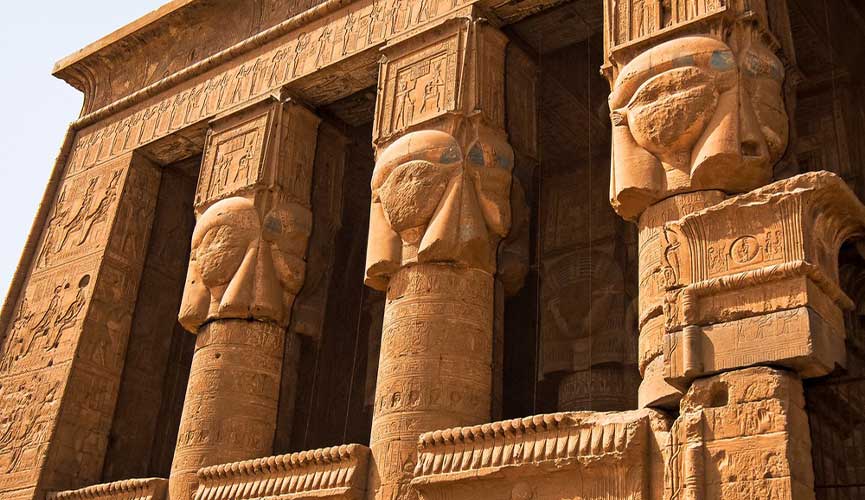
At Dendera, her face is particularly prominent on the capitals of monumental columns.
These Hathor-headed capitals are among the temple’s most recognizable architectural features.
The imagery makes the identity of the sacred building immediately visible.
A visitor entering the main hall does not need to understand hieroglyphics to recognize that the goddess was central to the monument.
Why Was Hathor Associated With Music?
Music and ritual performance were important features of Hathor’s worship.
One of her characteristic symbols was the sistrum, a ritual musical instrument that produced a rattling sound.
Sistrums were associated with religious ceremonies and the worship of deities including Hathor.
At Dendera, architectural decorations incorporate imagery connected with the goddess and her sacred instrument.
The relationship between music and religion helps explain why the temple was more than a place containing statues.
It was an environment for controlled ritual activity involving sound, movement, offerings, sacred objects, and ceremonial processions.
Hathor, Horus, and Their Divine Family
Hathor was closely associated with Horus, the falcon god worshipped at Edfu.
Their relationship formed part of the religious traditions linking the two sanctuaries.
An important festival celebrated their divine reunion.
During the Feast of the Beautiful Meeting, Hathor’s sacred image traveled from Dendera to Edfu to meet Horus.
The festival expressed renewal, fertility, divine harmony, and the relationship between sacred places.
The divine child Ihy was also associated with this religious family.
Travelers interested in the broader story can compare Dendera with the Temple of Horus at Edfu.
The two monuments were not merely independent attractions. They belonged to a connected religious geography.
Hathor and the Eye of Ra
Hathor also belonged to the group of goddesses associated with the Eye of Ra.
In Egyptian mythology, the Eye of Ra could represent divine power, protection, and the dangerous force of the sun.
This association adds complexity to Hathor’s identity.
Her religious character combined nurturing and protective qualities with formidable divine authority.
Understanding that complexity helps visitors interpret Dendera’s carvings more accurately.
What Can You See Inside Dendera Temple?
The main Temple of Hathor contains monumental halls, offering spaces, decorated chambers, sanctuaries, staircases, and crypts.
Its architectural sequence reflects the movement from more accessible outer spaces toward increasingly sacred inner areas.
The most important experience is not simply entering the building.
It is noticing how architecture, light, decoration, and religious meaning change as you move deeper inside.
1. The Monumental Entrance and Hathor Columns
The temple’s façade is one of its defining features.
Six prominent columns topped with Hathor-headed capitals create a distinctive entrance.
Their decorated surfaces introduce the religious symbolism repeated throughout the building.
Look at the faces of the goddess and the architectural forms surrounding them.
The capitals do more than support the building.
They transform the temple’s structure into an expression of divine presence.
The entrance also demonstrates the enormous scale of the ancient building program.
For photography, the façade offers one of the best opportunities to show the relationship between the temple’s architectural proportions and its elaborate carved surfaces.
2. The Great Hypostyle Hall
The great hypostyle hall is one of the most impressive spaces at Dendera.
It contains 24 monumental columns supporting an extensively decorated ceiling.
Each column contributes to the rhythm of the interior, while the decorated ceiling creates a powerful visual impression above.
The hall is especially memorable because so much of the original artistic program remains visible.
The space can be appreciated in two different ways.
From a distance, the repeating columns create a monumental architectural composition.
Up close, visitors discover individual hieroglyphic inscriptions, religious figures, sacred objects, and intricate carved details.
A guided explanation is particularly useful here because the decoration is not random.
Images of gods, kings, ritual actions, and celestial symbols form part of a coordinated religious environment.
3. The Famous Blue Ceiling of Dendera
The ceiling is one of the strongest reasons to visit.
Sections contain rich blue decoration, astronomical scenes, religious figures, and symbolic arrangements connected with the sky.
The colors give visitors a sense of the visual impact that ancient Egyptian sacred interiors could possess.
Egypt’s surviving monuments are often associated with pale stone.
Dendera challenges that impression.
Ancient Egyptian temples were originally decorated with pigments, and Dendera preserves enough color to make that fact immediately apparent.
Some ceilings remained obscured by accumulated deposits and soot for long periods.
Conservation work has made important decorative details easier to see.
The Egyptian Ministry of Tourism and Antiquities has documented cleaning, pigment stabilization, and restoration work in the temple’s halls and other areas.
The surviving paintings should therefore be understood as ancient decorations whose modern visibility also reflects conservation efforts.
They are not simply modern decorative additions.
4. The Astronomical Ceiling Panels
Dendera contains a remarkable collection of celestial imagery.
The decorative program includes representations associated with the sun, moon, stars, constellations, and divisions of time.
These scenes were closely connected with Egyptian religious beliefs.
The sky was not merely a physical environment.
It was the domain of important divine powers and a setting for ideas concerning creation, death, rebirth, and cosmic order.
The astronomical ceiling is especially important because it preserves religious imagery from a period when Egyptian and Hellenistic astronomical traditions interacted.
Visitors should not interpret every astronomical figure as an attempt to produce a modern scientific diagram.
Some images have astronomical associations, while others express ritual and theological meanings.
The temple’s ceilings combine these different forms of knowledge.
5. The Goddess Nut and the Egyptian Sky
One of the important divine figures associated with Egyptian celestial imagery is Nut, the sky goddess.
Nut could be represented as a woman arching across the heavens.
Her body symbolized the sky and the cosmic space through which the sun and stars moved.
In ancient Egyptian religious thought, Nut was closely associated with the recurring cycle of the sun.
The sun’s disappearance and return could be understood through the language of divine renewal.
At Dendera, imagery connected with the heavens helps explain why the temple’s decoration includes so many references to cosmic cycles.
When examining the ceiling, look for the relationship between human-shaped divine figures and the astronomical symbols around them.
This combination is characteristic of ancient Egyptian religious art.
6. The Hall of Offerings
Beyond the monumental outer hall, the temple contains spaces associated with ceremonial offerings.
Offerings played an important role in ancient Egyptian religion.
Priests presented food, drink, incense, flowers, and other ritual objects as part of the temple’s religious services.
These ceremonies were understood as helping maintain the relationship between the human and divine worlds.
Scenes showing rulers presenting offerings also expressed the religious responsibilities of kingship.
At Dendera, this relationship appears repeatedly in the decoration.
The ruler is often represented performing an action before a deity, reinforcing the idea that political authority and divine order were connected.
For visitors, these scenes reveal how the temple functioned rather than simply how it looked.
7. The Inner Sanctuary
The central sanctuary represented the most sacred part of the temple.
In the original religious system, access to such spaces was restricted.
Ordinary members of the public did not move through the entire building in the way modern tourists may do.
The innermost rooms belonged to a carefully regulated sacred environment.
The central sanctuary was associated with the principal divine image and the ceremonies performed around it.
Architecture reinforced this increasing sacredness.
Visitors move from larger outer spaces into more enclosed, controlled rooms.
Even without the original cult furnishings, the arrangement communicates the hierarchy of the ancient religious building.
8. Side Chambers and Ritual Rooms
The temple contains numerous chambers surrounding the main sanctuary.
Different rooms were associated with particular religious functions, divine images, offerings, ritual objects, and aspects of temple worship.
Some chambers were connected with purification and preparation.
Others had specific theological identities reflected in their inscriptions.
Their importance is easy to overlook because they are less monumental than the principal hall.
However, these smaller spaces often contain particularly detailed carvings.
Spend time examining the relationship between the decoration and the room’s position within the building.
The architectural plan itself provides clues about ritual function.
9. Dendera Temple Crypts
One of Dendera’s most unusual features is its system of crypts.
These enclosed spaces were associated with the protection and storage of sacred objects and divine images.
Some are particularly famous for their detailed religious reliefs.
The crypts form an important part of understanding how the temple operated.
Sacred objects were not necessarily kept permanently on public display.
They could be preserved in protected locations and brought out for particular ceremonies.
The crypt reliefs reflect ideas about divine creation, ritual renewal, and the religious identities of the temple’s gods.
Important for visitors: Access to crypt areas may be restricted or subject to a separate ticket. Do not assume that every chamber shown in online photographs will be available during your visit.
Check current permission and ticket arrangements before entering restricted sections.
10. The Ceremonial Staircases
Dendera’s staircases are among its most fascinating architectural features.
They connect the main temple with its rooftop religious spaces.
The staircases were not designed simply for ordinary movement between floors.
They also formed part of the temple’s ceremonial arrangements.
Religious processions involving sacred images could move between the interior and upper areas during important rituals.
The decoration associated with these routes emphasizes their ritual importance.
One particularly interesting feature is the contrast between different staircase arrangements, including a more direct stairway and a turning route.
The stairs have also attracted attention because of their worn appearance.
Their religious purpose is far more important than sensational claims about the shape of the stone.
11. The Rooftop Chapels
The roof of Dendera played a significant part in the religious life of the temple.
Rooftop spaces were associated with important rituals, including ceremonies connected with renewal and the sacred relationship between divine images and the sun.
The complex also contains chapels associated with Osiris.
These spaces are especially important because one of them originally held the famous circular Dendera Zodiac.
The relationship between Hathor’s temple and the worship of Osiris reflects the interconnected character of Egyptian religion.
Deities had distinct identities, but their mythologies and ritual functions often overlapped.
Visitor access note: Rooftop access can be subject to separate ticketing, restricted routes, conservation work, or local operating decisions.
Confirm the current arrangements rather than assuming unrestricted access.
12. The Exterior Reliefs
The exterior walls deserve more attention than they often receive.
Their carved scenes reveal royal and religious connections that may be missed by visitors concentrating exclusively on the painted ceilings.
Among the most important are representations involving Cleopatra VII and her son Caesarion.
These images link the sanctuary with the final generation of the Ptolemaic dynasty.
The exterior reliefs also demonstrate how later Egyptian rulers continued to present themselves through traditional pharaonic conventions.
Spend time examining the walls after leaving the main interior.
The outside of the temple is an essential part of its historical narrative.
Dendera Temple Ceiling: What Do the Colors and Symbols Mean?

The painted ceilings at Dendera combine religious imagery, astronomical references, and symbolic expressions of cosmic order.
Their meaning cannot be reduced to a single interpretation.
Different sections belong to different ritual and theological programs.
However, several major themes help visitors understand what they are seeing.
Blue and the Celestial World
Blue is particularly prominent in Dendera’s ceiling decoration.
In Egyptian art, blue could be associated with the heavens, water, fertility, and divine renewal.
The use of color was not purely decorative.
Pigments contributed to the symbolic language of sacred architecture.
A painted ceiling could transform an enclosed stone room into a representation of the divine sky.
Stars and Celestial Order
The representation of stars and celestial figures reflects the importance of astronomical observation and symbolic timekeeping.
Egyptian religious traditions connected certain stars and constellations with the afterlife and the recurring cycles of nature.
These ideas developed over many centuries.
At Dendera, later astronomical influences appear alongside traditional Egyptian religious imagery.
The result is a particularly valuable source for understanding the intellectual and religious culture of late ancient Egypt.
Solar Symbols
The sun was central to Egyptian concepts of cosmic order.
Its daily movement could represent regeneration and the triumph of life over darkness.
Religious scenes involving solar disks, solar deities, and associated symbols express these ideas.
At Dendera, solar imagery also helps explain Hathor’s relationship with divine protection and celestial power.
The Moon and Sacred Time
Lunar cycles were important in Egyptian religious calendars.
The moon’s phases could be connected with ritual timing, renewal, and divine symbolism.
Certain Dendera scenes combine celestial imagery with a carefully structured religious framework.
This is one reason why interpreting the temple requires more than identifying recognizable stars or zodiac signs.
The ancient viewers understood these images within a much larger system of beliefs.
Why Do the Colors Still Look So Bright?
Some of Dendera’s pigments survived because painted surfaces remained protected within the temple’s enclosed architecture.
Other decorations became obscured by deposits accumulated over time.
Conservation work has helped reveal their appearance.
Cleaning and stabilization require specialist techniques because the goal is to protect surviving ancient material rather than create a visually new monument.
The Ministry of Tourism and Antiquities has described work involving soot removal, cleaning, and stabilization of painted surfaces.
This helps explain why different photographs of the same ceiling may show noticeably different color intensity.
Lighting, photographic editing, camera settings, and the stage of conservation can all influence how the decorations appear in pictures.
Visitors should expect the actual monument to contain both vividly colored sections and more weathered or less visible decoration.
The Dendera Zodiac: Egypt’s Famous Ancient Star Map
The Dendera Zodiac is one of the most famous astronomical artworks associated with ancient Egypt.
It was originally carved on the ceiling of an Osiris chapel on the roof of the Temple of Hathor.
Unlike the long rectangular astronomical compositions familiar from some Egyptian monuments, the Dendera Zodiac presents an elaborate circular arrangement of celestial figures.
The artwork combines Egyptian religious symbolism with astronomical imagery associated with the wider Hellenistic world.
What Does the Dendera Zodiac Show?
The circular composition includes representations of the twelve zodiacal constellations, additional celestial figures, and symbols associated with the heavens.
It also incorporates Egyptian astronomical and mythological imagery.
The circular composition is supported by divine figures and forms part of a carefully organized decorative program.
Its meaning is connected with the relationship between the cosmos, religious beliefs, and time.
The Zodiac is important not because it proves a mysterious lost technology existed, but because it documents how different astronomical and religious traditions were represented together.
How Old Is the Dendera Zodiac?
The famous circular Zodiac dates to approximately 50 BCE.
That places it in the final decades of Ptolemaic rule.
Its historical context is particularly interesting because Egypt was experiencing major political changes while its temples continued to preserve and develop complex religious traditions.
The Zodiac belongs to this late phase of ancient Egyptian temple art.
It should not be confused with astronomical representations made during much earlier periods of Egyptian history.
Egyptian interest in the heavens was considerably older than the surviving circular Zodiac itself.
Is the Original Dendera Zodiac Still in Egypt?
No.
The original circular Dendera Zodiac is held by the Louvre Museum in Paris.
It was removed from the temple in 1821 and transported to France.
The Louvre records the ancient relief as a sandstone artwork measuring approximately 255 by 253 centimeters.
The original remains part of the museum’s Egyptian antiquities collection.
Visitors to Dendera should therefore distinguish between the surviving ancient temple and the original circular Zodiac, which is no longer in its original position.
A reproduction is associated with the chapel, but the availability of the relevant rooftop area should be confirmed locally.
Is the Dendera Zodiac an Ancient Horoscope?
Not in the modern popular sense.
Although the artwork includes zodiacal constellations, it should not be treated as an ordinary modern horoscope or evidence that the ancient Egyptians used today’s personal astrology systems in exactly the same way.
The image belongs to a complex religious and astronomical environment.
Its significance includes the representation of celestial order and its relationship with the religious ideas of the period.
Scholars study the Zodiac in connection with ancient astronomy, mythology, ritual, and the transmission of ideas between Egyptian and Hellenistic cultures.
Why Is the Dendera Zodiac Important?
Its importance comes from several interconnected features.
It preserves a sophisticated celestial composition.
It illustrates the interaction of Egyptian and Hellenistic traditions.
It provides evidence for astronomical imagery during the final phase of Ptolemaic Egypt.
And it has an important place in the history of Egyptology because its discovery attracted considerable scholarly attention.
For travelers, the Zodiac offers a useful reminder that ancient Egyptian temples were not simply religious buildings.
They also preserved detailed systems of symbolism, calendars, ritual knowledge, and cosmological ideas.
Cleopatra at Dendera Temple: What Is Her Connection?

Dendera Temple contains important reliefs depicting Cleopatra VII and her son, Ptolemy XV Caesarion.
These carvings are among the site’s most historically significant features.
They connect the temple directly with the final ruling family of Ptolemaic Egypt.
Did Cleopatra Build Dendera Temple?
Cleopatra VII was associated with the temple’s late Ptolemaic decorative history, but it would be inaccurate to describe the entire surviving monument as a building created solely by her.
Construction began before her reign.
Major architectural and decorative activity continued through different royal administrations.
The temple also received Roman-period additions.
Cleopatra’s importance lies partly in the historical and political meaning of her representations at the site.
Who Was Caesarion?
Caesarion was Cleopatra VII’s son, also known as Ptolemy XV.
He was the son of Julius Caesar and was associated with Cleopatra’s final period of rule in Egypt.
The reliefs at Dendera show Cleopatra and Caesarion within traditional Egyptian royal religious imagery.
The depiction of the queen and her son reflects a political world in which the Ptolemaic dynasty continued to use Egyptian traditions to express legitimacy.
The University of Memphis’s Institute of Egyptian Art and Archaeology identifies their representation on the western section of the temple’s south exterior wall.
What Makes the Cleopatra Reliefs Special?
The reliefs are historically interesting because they combine recognizable historical rulers with highly traditional Egyptian artistic conventions.
Cleopatra does not appear as a modern portrait subject.
She participates in the religious visual language of Egyptian kingship.
The image presents the royal family in relation to the divine order represented by the sanctuary.
For visitors, this creates a direct link between the monumental temple and the political events that ended Ptolemaic rule.
A useful comparison is with the reliefs of earlier pharaohs at sites such as Karnak Temple, where rulers similarly used temple decoration to express their religious and political roles.
The Dendera Temple Light Bulb Mystery Explained
One of the most frequently discussed Dendera carvings is sometimes called the Dendera light.
The relief shows a serpent-like figure associated with a lotus and an elongated surrounding form.
To modern eyes, the arrangement can resemble an electric light bulb.
That visual resemblance has inspired popular claims that ancient Egyptians possessed electrical lighting technology.
However, the accepted Egyptological interpretation is religious rather than technological.
What Does the Dendera Light Relief Actually Represent?
The relevant scenes are associated with Harsomtus, a divine figure whose imagery includes a serpent emerging from a lotus.
The lotus had strong associations with creation and rebirth in Egyptian mythology.
The serpent and associated objects belong to a religious composition.
The inscriptions and the surrounding temple theology provide the essential context.
Rather than representing electrical engineering instructions, the scenes communicate ideas about divine manifestation and cosmic creation.
Did Ancient Egyptians Have Electric Light Bulbs?
There is no credible archaeological evidence that the Dendera reliefs depict functioning electric light bulbs.
The popular theory is based largely on perceived similarities between the ancient carved forms and modern electrical equipment.
A resemblance in appearance is not proof of shared function.
The interpretation also does not establish the existence of an ancient electrical infrastructure, practical lighting devices, or associated technological remains.
The religious explanation is supported by the inscriptions and the wider iconography of the temple.
Why Does the Relief Look Like a Bulb?
Modern viewers naturally interpret unfamiliar images using objects they already recognize.
The elongated shape surrounding the serpent can resemble the outline of a glass bulb.
The serpent may suggest a filament.
Other ritual objects can be compared visually with modern technical components.
However, these similarities do not override the original religious context.
To understand an ancient image, it is important to examine the accompanying text, comparable imagery, and the meaning of its individual symbols.
The Dendera light relief is a good example of why archaeological interpretation requires more than visual comparison.
Dendera Temple Staircases: Why Do They Look Melted?
Images of the temple’s worn staircases have attracted unusual attention online.
Some photographs show rounded, irregular stone surfaces that have been described as melted steps.
This has led to speculation about mysterious heat sources, unexplained construction techniques, and lost technology.
There is no credible evidence that the stairs were melted by an ancient technological event.
What Were the Stairs Used For?
The staircases formed part of the temple’s ceremonial architecture.
They connected the principal religious spaces with the roof.
Religious processions could move along these routes during important festivals and rituals.
The stairs therefore had a specific religious function.
Their location and decorative context make sense within Egyptian temple architecture.
Why Is the Stone So Worn?
Stone surfaces can become rounded or irregular through combinations of long-term use, physical abrasion, environmental exposure, deterioration, and historical changes to the monument.
The precise condition of an individual step should not be attributed to one cause without archaeological or conservation evidence.
At Dendera, the worn surfaces are better approached as a conservation and architectural question than as proof of extraordinary technology.
The temple’s ceremonial staircases are fascinating enough without attaching unsupported explanations to them.
Can Visitors Walk on Dendera’s Ancient Stairs?
Access depends on the areas currently open to visitors.
Some routes may be restricted for conservation or safety reasons.
When stairs are accessible, follow the designated route and avoid touching decorated walls or standing on restricted surfaces.
Ancient stone can be uneven, polished, or slippery.
Visitors with mobility limitations should not assume that rooftop access will be suitable.
Is There a Stargate at Dendera Temple?
There is no archaeological evidence of a functioning or historically documented technological stargate at Dendera Temple.
The expression “Dendera Temple stargate” is primarily associated with modern internet speculation and fictional ideas.
Ancient Egyptian religious imagery frequently includes symbolic doors, gateways, divine passages, and representations of the relationship between different cosmic realms.
These are important religious concepts.
They should not be confused with modern claims about physical portals or science-fiction technology.
What About the Dendera Temple Helicopter?
Claims involving an ancient helicopter are more commonly associated with disputed interpretations of carved reliefs at Abydos rather than Dendera.
The famous Abydos imagery involves overlapping and altered inscriptions that can produce shapes resembling modern machines.
It is not evidence that ancient Egyptians built helicopters.
Dendera has its own distinctive astronomical and ritual imagery, including the Zodiac and the Harsomtus reliefs.
Keeping these sites and their different artworks separate makes the archaeological history easier to understand.
Is Dendera a Temple of Time?
The expression “Dendera Temple of Time” is not the standard archaeological name for the monument.
It is sometimes used informally because of the temple’s extraordinary astronomical imagery.
Dendera certainly contains important representations of celestial cycles and sacred time.
However, its principal dedication was to Hathor.
The proper historical identity of the surviving main building is the Temple of Hathor at Dendera.
Exploring the Wider Dendera Temple Complex
The Temple of Hathor is the centerpiece of a larger sacred complex.
Visitors should not assume that everything of interest is contained inside the principal hypostyle hall.
The surrounding archaeological remains help explain how the sanctuary functioned as a wider religious institution.
The Mammisi: Ancient Egyptian Birth Houses
A mammisi was a temple birth house associated with divine birth and related religious celebrations.
Dendera contains important birth-house remains, including structures associated with the later phases of Egyptian history.
These buildings expressed ideas concerning divine childhood, renewal, and the legitimacy of kingship.
The religious imagery associated with divine birth could also reinforce the relationship between the ruling king and the gods.
Dendera’s mammisi buildings are particularly useful for understanding the significance of Hathor and the divine child in local religious traditions.
The Sacred Lake
The Dendera complex contains a sacred lake.
Sacred lakes were important features of several major Egyptian temple complexes.
They were associated with ritual purification and the religious symbolism of water.
Water also played a significant role in Egyptian creation traditions.
The primeval waters from which creation emerged were a recurring theme in Egyptian religious thought.
A sacred lake should therefore be understood within both a practical ritual context and a broader symbolic framework.
Today, visitors may see the surviving architectural remains rather than a picturesque filled lake.
The Sanatorium
Dendera also preserves remains associated with a structure commonly described as a sanatorium.
It is often discussed in connection with healing practices and the religious importance of sacred spaces.
The precise nature of ancient healing activities should not be oversimplified.
Religious healing traditions were not equivalent to a modern hospital or medical clinic.
The site’s importance lies in the relationship between sacred ritual, healing beliefs, and the wider temple environment.
For visitors interested in everyday religious life, this is an intriguing reminder that ancient sanctuaries served diverse social and spiritual functions.
The Temple of Isis
The wider complex includes a smaller sanctuary associated with Isis.
Isis was one of the most important goddesses in Egyptian religion, particularly in traditions involving Osiris and Horus.
Her presence at Dendera illustrates the interconnected religious identities of Egyptian deities.
The Temple of Hathor was the dominant monument, but the complex included spaces dedicated to other sacred figures.
Understanding these relationships makes the site more meaningful.
Readers interested in the broader mythological background can explore ancient Egyptian creation myths.
The Coptic Church
The surviving complex includes remains associated with a church from the Christian period.
This is a significant part of Dendera’s later history.
It demonstrates that the location continued to be part of Egypt’s changing religious landscape after the era of traditional temple worship.
The presence of Christian remains within the archaeological complex makes Dendera relevant to more than one historical period.
Visitors can observe how different religious traditions occupied and transformed the same wider landscape.
How to Read the Dendera Temple Plan
Understanding the layout before arriving helps visitors appreciate the building more effectively.
The principal temple follows an architectural progression from its monumental entrance toward increasingly sacred interior spaces.
Its religious arrangement was not the same as a modern public building.
Different spaces had different ceremonial functions and levels of access.
A Simplified Layout of Dendera Temple
Area | Original significance | What visitors should notice |
Main entrance | Monumental ceremonial approach | Hathor-headed columns and façade decoration |
Great hypostyle hall | Important architectural and ritual space | Twenty-four columns and elaborate painted ceilings |
Interior halls | Preparation, offerings, and ceremonial functions | Reliefs showing gods, kings, and sacred actions |
Sanctuary | Principal sacred center | Increasingly enclosed architectural arrangement |
Side chambers | Specialized ritual functions | Religious inscriptions and detailed decoration |
Crypts | Protected sacred objects and cult images | Unusual iconography and confined spaces |
Staircases | Ceremonial movement toward the roof | Processional design and worn stone surfaces |
Rooftop chapels | Important religious ceremonies | Osirian imagery and the Zodiac’s original context |
Exterior walls | Royal and religious statements | Cleopatra VII and Caesarion reliefs |
Surrounding complex | Additional religious institutions | Birth houses, sacred lake, and later remains |
Why Does the Temple Become More Enclosed Toward the Center?
Ancient Egyptian temples were organized according to religious ideas about sacred space.
The outer areas were generally more accessible, while the innermost sanctuary represented a more restricted environment.
The architectural progression reinforced the idea of approaching the divine.
Changes in the scale of rooms, lighting, decoration, and movement contributed to this experience.
Modern visitors may be able to enter spaces that would once have been reserved for priests and specific ceremonial participants.
This creates an unusual opportunity to understand how the ancient sacred building was organized.
Why Are There So Many Small Rooms?
The temple supported a wide range of ceremonies and ritual requirements.
Different objects and divine images needed appropriate locations.
Priests performed purification rites, offerings, and other religious activities.
Some chambers were associated with particular deities or mythological ideas.
The variety of rooms therefore reflects a complex institution rather than an unusually complicated architectural preference.
What Is the Best Way to Explore Dendera Temple?
The most rewarding approach is to begin with the monumental architecture, then move gradually toward the smaller decorative details.
Visitors who rush directly toward the Zodiac or famous crypt reliefs may miss the features that make Dendera historically exceptional.
A structured visit allows enough time for both the principal monuments and less obvious details.
A Recommended Two-to-Three-Hour Walking Sequence
First 15–20 minutes: The entrance and surroundings
Begin with the exterior composition.
Examine the façade, the Hathor-headed capitals, and the relationship between the main temple and the surrounding complex.
This is also a good moment to understand the orientation of the building.
Next 30–40 minutes: The great hypostyle hall
Spend time beneath the decorated ceiling.
Look at the different ceiling panels rather than treating the entire roof as one image.
Compare the columns, carved figures, and painted surfaces.
Next 25–35 minutes: Interior chambers and sanctuary
Move into the inner areas that are open to visitors.
Examine offering scenes, sacred figures, and the transition from large halls to smaller chambers.
Next 20–30 minutes: Specialized features
If access is permitted, explore the relevant crypt or rooftop areas.
If these areas are closed, use the time to examine the interior reliefs more closely.
Next 20–25 minutes: Exterior royal reliefs
Look for the Cleopatra and Caesarion scenes.
Notice how royal imagery continues the temple’s wider religious program.
Final 20–30 minutes: Surrounding complex
Visit accessible outer remains and take time to appreciate the archaeological setting.
The exact sequence should follow local visitor routes and current access restrictions.
What Should You Prioritize If You Have Only One Hour?
If time is limited, focus on:
- The monumental entrance.
- The great hypostyle hall.
- The painted astronomical ceiling.
- The most accessible inner sanctuary areas.
- The Cleopatra and Caesarion exterior reliefs.
A one-hour visit can provide an impressive introduction, but it will not allow careful study of the full complex.
Dendera deserves more time if your schedule permits.
Dendera Temple Tickets and Entrance Fees for 2027
Visitors planning for 2027 should check the latest official ticket arrangements before traveling.
Egypt’s official monument listing, consulted before 2027, publishes the following prices.
These are published reference prices, not guaranteed 2027 rates.
Ticket category | Published reference price |
Foreign adult admission | EGP 300 |
Foreign student admission | EGP 150 |
Egyptian adult admission | EGP 20 |
Egyptian student admission | EGP 10 |
Temple panorama — foreign visitor | EGP 100 |
Temple serdab/crypt — foreign visitor | EGP 100 |
Temple panorama — Egyptian visitor | EGP 20 |
Temple serdab/crypt — Egyptian visitor | EGP 50 |
Vehicle entry fees may also apply according to vehicle category.
Special access and additional ticket categories should be confirmed before purchase.
Are the Crypts Included in the Standard Dendera Ticket?
Do not assume they are.
The official monument listing identifies a separate serdab ticket category.
Whether a particular crypt is open, how it is accessed, and what ticket is required can depend on site management.
Ask about the exact available areas before purchasing optional tickets.
Is Rooftop Access Included?
Do not assume unrestricted rooftop access is included with basic entry.
The official listing also identifies a temple panorama ticket.
Confirm what that ticket currently covers and whether the rooftop route is available on your visit date.
Restrictions may change as conservation work and visitor management requirements develop.
Where Should You Buy Dendera Temple Tickets?
Use Egypt’s authorized monument ticketing arrangements or official on-site procedures.
Check the accepted payment methods and whether tickets can be purchased electronically.
Avoid relying exclusively on a third-party website that may reproduce older entrance fees.
If you book a guided excursion, ask whether the price includes the standard admission ticket, optional access charges, and any other relevant fees.
Are Student Discounts Available?
The official listing includes a foreign student category.
Eligibility and documentation rules should be checked before arrival.
Carry valid proof of student status if you intend to request a reduced ticket.
A student discount should not be assumed simply because the traveler is young.
Dendera Temple Opening Hours in 2027
The official Egyptian monument listing currently publishes the regular schedule as:
7:00 AM to 5:00 PM daily.
The Ministry’s site-information guidance also states that the last admission is generally one hour before closing, making 4:00 PM the important reference point under the published schedule.
However, these hours should not be treated as an advance guarantee for every day in 2027.
Holiday arrangements, Ramadan, conservation work, security procedures, or temporary operating changes can affect access.
When Should You Arrive?
For most visitors, morning is the most comfortable choice.
Arriving earlier can provide more time to examine the decorations and reduces the risk of rushing toward the end of the day.
It can also be particularly helpful in warmer months.
A late-afternoon visit may offer pleasant exterior lighting, but it leaves less flexibility if transportation is delayed or a particular section closes early.
How Long Before Closing Should You Enter?
If you want to see the temple properly, plan to arrive several hours before the published closing time.
Do not treat the last admission time as the recommended arrival time.
A site that is technically open for another hour may not provide enough time for its principal interior halls, exterior carvings, and optional areas.
Does Dendera Open During Ramadan?
Operating arrangements can vary by monument and period.
Check the specific official schedule for Dendera rather than assuming that opening hours at another Egyptian attraction apply here.
The wider Ministry guidance identifies special Ramadan arrangements for some sites.
Advance confirmation is particularly useful during religious holidays and periods when published schedules may be adjusted.
How to Get From Luxor to Dendera Temple
Road transportation is the usual choice for international travelers based in Luxor.
Dendera’s position north of the city makes it practical as a day excursion without changing accommodation.
The best transportation option depends on your budget, available time, travel style, and interest in historical interpretation.
Option 1: Private Guided Tour
A private guided excursion is often the most convenient arrangement for visitors who want to understand the temple in detail.
A typical itinerary may include hotel collection, private vehicle transportation, the temple visit, and a return transfer.
However, the exact inclusions vary by provider.
Ask whether the quoted price includes:
- Transportation from your accommodation.
- A licensed guide.
- Dendera admission.
- Optional crypt or rooftop tickets.
- Any additional stops.
- Meals and drinks.
- Return transportation.
The value of a guide is particularly strong at Dendera because the decoration contains numerous historical and religious references.
Visitors interested in a privately arranged excursion can explore Luxor tours and excursions.
Option 2: Private Driver Without a Guide
A private driver may be appropriate for travelers who prefer to explore independently.
This can provide flexibility in departure times and time spent inside the monument.
However, a driver should not automatically be assumed to provide specialist archaeological explanations.
Confirm the transportation details in advance.
Agree on the return journey, waiting arrangements, total price, and included services before departure.
If you plan to visit restricted sections, remember that transportation arrangements do not guarantee access.
Option 3: Organized Group Excursion
A shared excursion may provide a more economical way to visit.
The main limitation is reduced flexibility.
Travelers may have to follow a fixed departure time and spending limit at the site.
Before booking, check whether the itinerary genuinely includes enough time at Dendera.
A tour that spends most of the day in transit or includes too many stops may leave little time for the most important decorations.
Option 4: Public Transportation
Independent public transportation to Qena may be possible, but it is less straightforward than traveling directly to the monument.
The archaeological site is outside the principal tourist areas, so additional local transportation may be needed.
Schedules, connections, and arrangements can change.
For visitors unfamiliar with the region, a prearranged vehicle is generally the more predictable choice.
Public transport is better suited to travelers comfortable handling local logistics and allowing additional time.
Dendera and Abydos Temples From Luxor: Can You Visit Both in One Day?
Yes. Dendera and Abydos can be combined into a full-day road excursion from Luxor.
This is one of the most appealing alternatives for travelers who have already explored Luxor’s main monuments or have a special interest in Egyptian religious history.
The two temples represent different historical periods and religious traditions.
Dendera is especially associated with Hathor and late Ptolemaic–Roman architecture.
Abydos is particularly famous for the Temple of Seti I, its remarkable New Kingdom reliefs, and the site’s long-standing connection with Osiris.
How Far Apart Are Dendera and Abydos?
Dendera is the closer of the two temples to Luxor.
Abydos lies considerably farther north.
A combined route involves multiple substantial road journeys, so it should not be planned as a quick half-day outing.
Allow approximately 10–12 hours for a relaxed full-day itinerary, depending on departure location, traffic, route, and time spent at both monuments.
Some itineraries may be shorter or longer.
Dendera vs. Abydos: Which Should You Visit?
Feature | Dendera | Abydos |
Main religious association | Hathor | Osiris |
Principal surviving temple period | Ptolemaic and Roman | New Kingdom |
Famous features | Painted ceilings, astronomical imagery, Hathor columns | Seti I reliefs, chapels, royal inscriptions |
Strongest appeal | Color, architecture, astronomy | Religious history, royal reliefs, early sacred traditions |
Distance from Luxor | Closer | Farther |
Typical visit duration | 2–3 hours | 2–3 hours |
Best for | First-time visitors seeking a well-preserved temple | Travelers particularly interested in New Kingdom art and Osirian religion |
For travelers who can visit both, the historical contrast is a major advantage.
Dendera reveals the continued richness of Egyptian religious art in the later periods.
Abydos provides a different perspective through its New Kingdom monuments and much older sacred associations.
Explore the background of the Temple of Seti I at Abydos before deciding whether to combine the sites.
Should You Visit Abydos or Dendera First?
Both sequences can work.
Visiting Abydos first may be useful because it is the more distant destination.
This allows the longest initial journey to be completed early and places Dendera on the return route.
However, the best order depends on road conditions, temple opening arrangements, weather, and the specific tour.
A good itinerary should prioritize time inside both monuments rather than following a rigid sequence without considering the travel day.
Who Should Avoid Combining Both Temples?
A combined excursion may not be ideal for travelers who:
- Prefer short sightseeing days.
- Are uncomfortable with long road journeys.
- Have limited time remaining in Luxor.
- Need frequent rest breaks.
- Are traveling with children who struggle with extended transfers.
- Want several hours for slow photography at each site.
For these visitors, a dedicated Dendera excursion may be more enjoyable.
Dendera Temple vs. Karnak Temple: Which Is Better?
Dendera and Karnak provide very different experiences.
Karnak is a vast temple complex famous for monumental New Kingdom architecture, huge columns, obelisks, courtyards, and centuries of royal building activity.
Dendera is smaller in scale but particularly remarkable for its preserved architecture and decorated ceilings.
Choose Dendera If You Want:
- An unusually intact ancient temple.
- Extensive surviving ceiling decoration.
- A strong focus on Hathor.
- Astronomical reliefs and the Zodiac’s history.
- Late Ptolemaic and Roman religious art.
- A road excursion beyond central Luxor.
Choose Karnak If You Want:
- Monumental architecture on a much larger scale.
- Famous New Kingdom pharaonic structures.
- Major royal inscriptions.
- Extensive temple courts and sacred precincts.
- An essential introduction to ancient Thebes.
For most first-time visitors with limited time, Karnak remains a priority because of its central importance to Luxor’s historical landscape.
Dendera becomes especially attractive when an additional sightseeing day is available.
The temples complement each other rather than offering interchangeable experiences.
Dendera Temple vs. Esna Temple
Dendera and Esna are both valuable for travelers interested in painted temple decoration and ancient astronomy.
The main difference is their location and architectural character.
Dendera lies north of Luxor.
Esna lies to the south.
Esna is especially known for its decorated temple hall and important conservation work that has revealed previously obscured colors.
Dendera preserves a more extensive monumental temple complex, including major interior spaces, rooftop chapels, and surrounding remains.
Visitors interested in comparing astronomical imagery can explore the Temple of Esna.
The comparison demonstrates how later Egyptian religious architecture maintained elaborate artistic and theological traditions in different parts of Upper Egypt.
Best Time to Visit Dendera Temple in 2027
The most comfortable months for visiting Dendera generally fall between October and April.
Upper Egypt experiences very hot summers, making the timing of outdoor excursions important.
Dendera contains substantial covered interior areas, but visitors still spend time outside and must account for transportation and walking.
Visiting Dendera in Winter
December, January, and February generally offer more comfortable daytime conditions for exploring archaeological sites in Upper Egypt.
These months are particularly suitable for travelers sensitive to heat.
However, early mornings can be cool.
A light jacket may be useful before temperatures rise.
Winter also coincides with a popular travel season in Egypt.
For travelers considering a broader winter itinerary, the most important benefit is the ability to spend more time outdoors comfortably.
Visiting in Spring
March and April can be rewarding months for temple visits.
Daytime temperatures may become warmer, especially later in spring.
Occasional dusty or windy conditions can occur.
Travelers should maintain some flexibility and prepare for changing weather.
Morning sightseeing is usually preferable to an extended visit during the warmest part of the day.
Visiting in Summer
May through September can be extremely hot in Upper Egypt.
Although Dendera remains a worthwhile attraction, midday outdoor exposure can be uncomfortable.
Visitors should consider an early departure, adequate drinking water, and a realistic sightseeing schedule.
The enclosed halls offer some shelter, but they should not be assumed to provide modern climate-controlled conditions.
If you are organizing multiple temple visits, prioritize the most exposed outdoor sites during the cooler hours.
Visiting in Autumn
October and November are generally attractive months for exploring archaeological attractions.
Temperatures often become more comfortable as the season progresses.
For travelers planning a longer Upper Egypt itinerary, autumn provides a useful balance between sightseeing conditions and travel flexibility.
For more destination-wide seasonal guidance, consult the best time to visit Egypt.
Is Dendera Temple Worth Visiting in 2027?
Yes. Dendera is particularly worthwhile for travelers who enjoy ancient Egyptian history, detailed reliefs, symbolic decoration, and well-preserved temple architecture.
Its strongest attraction is the opportunity to experience a largely surviving sacred building whose painted surfaces remain an essential part of the visitor experience.
However, the temple is not necessarily the right priority for every itinerary.
Dendera Is Especially Worth Visiting If:
You are spending several days in Luxor.
You want to see a temple outside the most familiar tourist circuit.
You enjoy ancient Egyptian astronomy and mythology.
You are interested in Cleopatra’s historical period.
You want to study architectural decoration closely.
You have already visited Karnak and Luxor Temple and want to expand your understanding of Egyptian religious history.
You are considering a longer excursion combining Dendera and Abydos.
When Might You Skip Dendera?
If you have only one short day in Luxor, your time may be better spent exploring the city’s principal archaeological sites.
Dendera requires a road transfer that reduces the time available for other activities.
Travelers with little interest in inscriptions or religious imagery may also find a carefully selected selection of Luxor’s major attractions more satisfying.
The decision should be based on your travel interests rather than the assumption that every famous Egyptian monument must be included in one holiday.
What Makes Dendera Different From Other Temples?
Dendera’s particular strength lies in the combination of architectural preservation, surviving pigment, sophisticated astronomical imagery, and late Egyptian historical context.
Many visitors know Egypt through pyramids, royal tombs, and colossal stone monuments.
Dendera reveals a different aspect of ancient civilization: the detailed intellectual and religious environment of an active sanctuary.
This makes the temple especially useful for travelers who want to understand how Egyptian religious ideas developed and continued into the Greco-Roman world.
Dendera Temple Photography: What Should You Know?
Dendera offers excellent opportunities for architectural and historical photography.
Its colorful interiors, repeating columns, detailed carvings, and impressive exterior walls create a wide range of compositions.
However, photography rules and access arrangements can change.
Always follow the instructions displayed at the monument.
Best Photography Subjects
The façade
The entrance is ideal for showing the temple’s monumental form and Hathor-headed capitals.
The hypostyle hall
Photograph the relationship between the columns and ceiling rather than concentrating only on isolated details.
The astronomical ceiling
Look for sections that show the balance between blue painted areas, religious figures, and hieroglyphic decoration.
The Hathor capitals
Close architectural compositions can illustrate the distinctive identity of the temple.
The exterior royal scenes
The Cleopatra and Caesarion reliefs provide an important historical subject.
The staircases
When access is permitted, their architecture and surviving decoration can be more informative than close-ups intended to suggest an unexplained mystery.
Can You Use a Tripod or Professional Equipment?
Do not assume that all photographic equipment is permitted under standard visitor rules.
Professional photography, tripods, lighting equipment, and commercial filming may require additional permission.
Confirm the applicable rules before arrival.
Avoid using equipment that could obstruct narrow passages or damage ancient surfaces.
How Can You Photograph the Ceiling Clearly?
Ceiling photography can be challenging because of low light and differences in illumination.
A smartphone with suitable low-light capability may be sufficient for personal photographs.
Keep the device steady and avoid excessive digital zoom.
Photographs made with extreme processing can misrepresent the actual colors.
For a more realistic result, preserve the relationship between the painted surfaces and their surrounding stone.
Are Dendera Temple Photos Always Accurate?
Not necessarily.
Online photographs may differ because of editing, lighting, and restoration progress.
Some show especially vivid blue ceilings, while others show darker surfaces or areas where pigments are less visible.
Different images may also depict different rooms.
It is worth examining the monument as a complete architectural environment rather than expecting every section to match one widely shared photograph.
Accessibility at Dendera Temple
Dendera is an ancient archaeological monument, not a modern purpose-built accessible attraction.
Although the exterior approach and some ground-level areas may be more manageable than narrow interior spaces, accessibility can vary significantly throughout the complex.
Uneven stone, steps, changing floor levels, narrow passages, and restricted spaces may present difficulties.
The staircases and crypt areas are particularly important considerations.
Is Dendera Suitable for Wheelchair Users?
Some portions of the visit may be challenging for wheelchair users, and full accessibility should not be assumed.
The availability of assistance, suitable pathways, and access to specific spaces should be confirmed locally.
A private visit can sometimes provide greater scheduling flexibility, but it cannot remove the monument’s physical limitations.
Before arranging transportation, communicate your exact mobility requirements.
Ask for current information about the accessible route rather than relying on a general statement that the site is wheelchair-friendly.
Is Dendera Suitable for Older Travelers?
Many older travelers may enjoy Dendera comfortably, particularly if they can walk moderate distances and use uneven steps.
A slower pace is advisable.
Allow time for rest and avoid attempting every optional area simply because it is available.
The most impressive ceiling decorations can be appreciated from the principal hall without necessarily visiting more demanding spaces.
Is Dendera Suitable for Children?
Dendera can be a fascinating attraction for children interested in mythology, unusual architecture, and colorful historical art.
The Hathor faces, celestial figures, and large columns can be particularly engaging.
However, the site is not designed as an interactive children’s museum.
Parents should consider travel time, heat, and attention span.
A shorter visit focused on the most visually impressive areas may work better than a detailed exploration of every inscription.
For family travel planning, see additional advice about visiting Egypt with kids.
What Should You Wear to Dendera Temple?
Comfortable, practical clothing is more important than formal dress.
The monument is an archaeological attraction, but visitors should still dress respectfully and prepare for Upper Egypt’s climate.
Recommended items include:
- Comfortable walking shoes with good grip.
- Lightweight, breathable clothing.
- A hat for outdoor areas.
- Sunscreen.
- Drinking water.
- A light extra layer in cooler months.
- Any required medication or personal essentials.
- A charged phone or camera.
Avoid footwear that becomes unstable on uneven stone.
Visitors entering confined or steep areas should be especially careful.
A small day bag is generally more convenient than bulky luggage.
Should You Bring Water?
Yes.
Upper Egypt’s climate makes hydration particularly important, even outside the summer months.
Do not assume that drinking-water facilities will be available at every point within the archaeological complex.
Carry enough water for the road journey and the visit.
Are There Restaurants at Dendera Temple?
Food and refreshment arrangements can change.
Do not plan your day around the assumption that a full-service restaurant will be available at the monument.
If food is important to your itinerary, arrange a suitable stop through your driver or tour organizer.
For a combined Abydos and Dendera excursion, a planned lunch break is especially useful.
How Much Does a Dendera Temple Tour Cost?
The total cost depends on far more than the admission ticket.
A traveler arranging independent transport may pay a different amount from someone booking a guided private excursion.
Rather than relying on an unsupported standard package price, calculate the trip from its actual components.
Typical Cost Components
Expense | What affects the price? |
Standard admission | Official visitor category and published ticket rate |
Optional access | Separate crypt, panorama, or other permitted areas |
Transportation | Vehicle type, departure point, and journey length |
Guide | Language, qualifications, duration, and included services |
Additional attractions | Whether Abydos or another stop is included |
Food and drinks | Restaurant choice and meal arrangements |
Tips | Personal preference and local service arrangements |
Special photography | Applicable permissions and equipment requirements |
Is a Private Dendera Tour Worth the Additional Cost?
For visitors interested in the details of the reliefs, a knowledgeable guide can add substantial value.
The main benefit is interpretation.
A guide can explain the relationships between Hathor, Horus, Osiris, and the astronomical imagery.
Private transport can also make the excursion more convenient.
However, travelers who prefer slow independent exploration may be satisfied with a driver and reliable background reading.
The best option depends on whether convenience, specialist explanation, flexibility, or budget is your main priority.
How to Add Dendera Temple to an Egypt Itinerary
Dendera works best as an addition to a Luxor-based itinerary rather than as a stand-alone destination requiring a separate hotel stay.
The temple is especially suitable for travelers spending at least two or three days in the Luxor region.
Option 1: Dendera Half-Day Excursion
Best for: Travelers with a limited schedule who want to visit only Dendera.
Suggested outline:
- Depart Luxor in the morning.
- Travel north to Dendera.
- Spend approximately 2–3 hours at the temple.
- Return to Luxor.
- Keep the remainder of the day flexible.
Allow roughly 4–6 hours overall, depending on road conditions, your starting point, and the time spent inside the complex.
This option provides enough time to appreciate the main building without turning the visit into an exhausting full-day journey.
Option 2: Dendera and Abydos Full-Day Excursion
Best for: Travelers with a strong interest in Egyptian religious history.
Suggested outline:
- Depart Luxor early.
- Travel toward Abydos.
- Explore the Temple of Seti I.
- Continue to Dendera.
- Visit the Temple of Hathor.
- Return to Luxor.
This itinerary involves considerable driving.
It is particularly suitable for visitors who want to compare New Kingdom religious art with later Ptolemaic architecture.
Option 3: Dendera as an Extra Luxor Sightseeing Day
Best for: Travelers staying in Luxor for three or more nights.
Keep the main Luxor sightseeing attractions on separate days, then use an additional day for Dendera.
This reduces pressure on the schedule and allows the temple to receive the attention it deserves.
Visitors staying longer can choose between a dedicated Dendera excursion and the more extensive Abydos combination.
Option 4: Dendera During a Longer Private Egypt Tour
Dendera can be incorporated into a customized land itinerary that includes Luxor and other Egyptian destinations.
This works particularly well when travel plans can be adjusted around archaeological interests.
If your primary interest is ancient religion, astronomy, or temple architecture, Dendera may deserve more attention than an additional general sightseeing stop.
Travelers organizing a flexible route can consider tailor-made Egypt holidays that allow extra time for less conventional archaeological excursions.
Should You Add Dendera to a Nile Cruise?
It depends on your cruise schedule.
Most classic Nile cruise itineraries concentrate on the monuments between Luxor and Aswan.
Dendera lies north of Luxor, so visiting usually requires additional road transportation.
A pre-cruise or post-cruise stay in Luxor can be a practical solution.
Avoid scheduling the excursion so close to a cruise departure that traffic delays create unnecessary stress.
Common Mistakes to Avoid When Visiting Dendera
A successful visit depends on realistic expectations and basic preparation.
Mistake 1: Assuming Dendera Is in Central Luxor
The temple requires a separate journey north.
Always include transportation time in your sightseeing schedule.
Mistake 2: Planning Only 30 Minutes at the Site
Dendera contains far more than one famous ceiling.
Allow time for the architecture, inner rooms, exterior carvings, and surrounding complex.
Mistake 3: Assuming Every Chamber Is Open
Crypts, rooftops, staircases, and other areas may have access restrictions.
Confirm availability before the visit.
Mistake 4: Using an Old Ticket Price
Admission prices can change.
This is particularly important when planning for 2027.
Check the latest official rate rather than relying on an undated blog post or social media image.
Mistake 5: Confusing Dendera With Abydos
The sites are different monuments with different histories.
Dendera is especially associated with Hathor and Ptolemaic–Roman religious art.
Abydos is closely associated with Osiris and important New Kingdom temples.
Mistake 6: Treating Internet Mysteries as Archaeological Facts
Claims about stargates, helicopters, ancient light bulbs, and melted stone should be examined critically.
The temple’s documented history and religious imagery are more interesting than unsupported technological theories.
Mistake 7: Ignoring the Exterior Reliefs
The Cleopatra and Caesarion scenes are among the monument’s most important historical features.
Do not leave immediately after photographing the ceiling.
Mistake 8: Scheduling Too Many Attractions
A combined Dendera and Abydos journey already requires substantial travel time.
Adding several unrelated sightseeing stops can make the day unnecessarily tiring.
Mistake 9: Visiting Without Understanding Hathor
Knowing the goddess’s associations with music, joy, motherhood, and celestial symbolism makes the decoration more meaningful.
Even a short introduction to the religious context will improve the visit.
Mistake 10: Planning Around Perfect Photography Conditions
Interior lighting varies.
Access arrangements change.
Conservation work may affect individual areas.
Enjoy the monument as a historic place rather than measuring the visit against photographs found online.
Fascinating Facts About Dendera Temple
Dendera offers several historical details that make it distinctive among Egypt’s archaeological attractions.
The Temple Is Younger Than the Great Pyramids
The main surviving temple belongs primarily to the Ptolemaic and Roman eras.
The Great Pyramid of Khufu was constructed more than two thousand years earlier.
The enormous chronological difference demonstrates how long Egyptian religious and architectural traditions survived.
Its Sacred History Is Older Than Its Surviving Building
Although the present structure is comparatively late, Dendera was a sacred location for centuries before the surviving temple was built.
This distinction is essential for understanding Egyptian temple chronology.
Hathor’s Face Appears in the Architecture
The goddess is not represented only on carved walls.
Her image forms part of the capitals supporting the monumental entrance.
Architecture and religious symbolism are combined into a unified visual design.
The Temple Preserves a Remarkable Painted Interior
Dendera’s decorated ceiling demonstrates the importance of color in Egyptian temple art.
It challenges the assumption that ancient Egyptian monuments were originally dominated by bare stone surfaces.
The Original Zodiac Is in Paris
The circular Zodiac once formed part of the rooftop chapel decoration.
Its original stone relief is now in the Louvre.
The artwork remains central to discussions of ancient Egyptian astronomy and the history of antiquities collecting.
Cleopatra Appears on the Temple Walls
The exterior scenes depicting Cleopatra VII and Caesarion provide a direct connection with the final Ptolemaic royal family.
The Crypts Had Religious Functions
The enclosed spaces were associated with sacred objects and divine imagery.
Their unusual reliefs should be understood in that context.
Dendera Was Connected to Edfu
The festival celebrating the meeting of Hathor and Horus linked the sanctuaries through religious procession and mythology.
The Stairs Were Part of Sacred Rituals
They were not merely architectural conveniences.
Their design relates to the ceremonial relationship between the temple’s inner spaces and the roof.
The Complex Preserves Evidence of Historical Change
Later religious remains show that the site continued to belong to Egypt’s changing cultural landscape beyond the age of the pharaohs.
Frequently Asked Questions About Dendera Temple Egypt
1. What is Dendera Temple famous for?
Dendera Temple is famous for its remarkably preserved Temple of Hathor, colorful astronomical ceilings, monumental Hathor-headed columns, elaborate reliefs, and the original location of the Dendera Zodiac. The temple also contains important depictions of Cleopatra VII and Caesarion. Its surviving architecture offers one of Egypt’s clearest examples of a late ancient religious sanctuary.
2. Where is the Temple of Hathor at Dendera?
The Temple of Hathor is located near Dendera village in Qena Governorate, Upper Egypt. It lies north of Luxor, making Luxor the most convenient major tourist base for visiting. Travelers normally reach the temple by road, with the journey taking approximately one to one and a half hours from central Luxor under typical conditions.
3. When was Dendera Temple built?
The main surviving Temple of Hathor was constructed during the Ptolemaic period, with substantial work associated with the first century BCE and later Roman additions. Major construction is associated with the reign of Ptolemy XII. However, the religious site itself is much older, with evidence of activity reaching back to the Old Kingdom.
4. Why was Dendera Temple built?
Dendera Temple was built primarily as a sacred center for the worship of Hathor. It provided spaces for religious ceremonies, offerings, the protection of divine images, and important festivals. The sanctuary also expressed connections between kingship, religion, cosmic order, and renewal. Its complex decoration reflects the theological traditions maintained by ancient Egyptian priests.
5. Is Dendera Temple worth visiting from Luxor?
Yes, especially for travelers interested in ancient Egyptian religion, architecture, astronomy, and well-preserved painted decoration. Dendera provides a different experience from the principal monuments inside Luxor. A dedicated excursion generally requires several hours, including transportation, making it a worthwhile addition when your itinerary has enough flexibility.
6. How much is the Dendera Temple entrance ticket?
The Egyptian government’s official monument listing consulted before 2027 publishes a standard foreign adult ticket of EGP 300 and a foreign student ticket of EGP 150. Separate fees are listed for optional panorama and crypt access. These are reference prices only; visitors planning for 2027 should check the latest official ticket rates before traveling.
7. What are Dendera Temple’s opening hours?
The officially published regular visiting schedule is 7:00 AM to 5:00 PM daily, with the Ministry’s site guidance indicating that last admission is generally one hour before closing. Special schedules or temporary changes may apply. Travelers should reconfirm the opening hours for their specific visit date, particularly during Ramadan, holidays, or conservation activity.
8. Where is the original Dendera Zodiac?
The original circular Dendera Zodiac is in the Louvre Museum in Paris. It was removed from its original position in a rooftop Osiris chapel in 1821. The ancient sandstone relief dates to approximately 50 BCE and contains an important representation of zodiacal and other celestial imagery. Visitors to Dendera see the original architectural setting rather than the original Zodiac relief.
9. Did Cleopatra visit or build Dendera Temple?
Dendera contains important reliefs depicting Cleopatra VII and Caesarion, but the entire surviving monument should not be attributed to Cleopatra alone. Its construction began before her reign and continued through several periods. The reliefs demonstrate the temple’s connection with late Ptolemaic royal ideology. Their presence does not, by itself, establish a documented personal visit by Cleopatra.
10. What is the Dendera light bulb?
The Dendera light bulb is a modern nickname for an ancient religious relief associated with Harsomtus. The scene includes a serpent emerging from a lotus within an elongated form. Although the composition can resemble a modern electric lamp, the Egyptological interpretation connects it with religious imagery concerning creation and divine manifestation. There is no credible evidence that it depicts ancient electrical lighting.
11. Why do the Dendera Temple stairs look melted?
Some staircase surfaces have rounded and irregular forms that can appear unusual in photographs. Claims that they were melted by mysterious technology are unsupported. The condition of ancient stone can reflect long-term wear, deterioration, environmental influences, and historical use. Determining the exact cause of damage to a particular surface requires appropriate archaeological and conservation evidence.
12. Can you visit Dendera and Abydos in one day?
Yes. Dendera and Abydos can be combined into a full-day road excursion from Luxor. The itinerary is especially attractive for travelers interested in Egyptian religious history because the two sites represent different periods and sacred traditions. Allow approximately 10–12 hours for the overall journey, depending on travel conditions and the time spent exploring each temple.
13. Can visitors go inside Dendera Temple?
Yes. Visitors can explore the main temple areas open under the site’s current arrangements. These generally include impressive architectural spaces and decorated chambers. However, access to individual crypts, rooftop sections, staircases, or restricted rooms may require additional tickets or may be temporarily unavailable. Check the permitted route when you arrive.
14. Is Dendera Temple suitable for tourists visiting Egypt for the first time?
Yes, although it is most practical as an additional excursion from Luxor. First-time visitors who have several days in Upper Egypt may find Dendera particularly rewarding because its architecture is well preserved and its ceiling decoration is exceptional. Travelers with very limited time should first consider their main Luxor priorities before adding the road journey.
Final Thoughts: Should You Visit Dendera Temple in 2027?
Dendera Temple deserves attention not because of sensational internet theories, but because of what survives within its ancient walls.
Its monumental Hathor columns, remarkably preserved painted ceilings, astronomical imagery, ceremonial staircases, and royal reliefs reveal a sophisticated religious world that continued to develop through the final centuries of ancient Egyptian temple culture.
The temple also provides an important historical contrast.
While the pyramids represent the architectural achievements of Egypt’s Old Kingdom and the monuments of Luxor reveal the power of the New Kingdom, Dendera demonstrates the endurance of Egyptian religious traditions during Ptolemaic and Roman rule.
For travelers who value history, art, mythology, and detailed archaeological experiences, it is one of the most rewarding excursions beyond central Luxor.
Plan approximately two to three hours for the temple itself, check the latest official entrance and access arrangements, and allow sufficient time for the journey from Luxor.
If your schedule permits, combine Dendera with Abydos to explore two extraordinary but very different chapters of ancient Egyptian religion.
A visit arranged around your specific interests can provide more meaningful time at the monument than a tightly scheduled general tour.
For travelers interested in a flexible experience, Touring In Egypt’s private Egypt tours can form the basis of an itinerary designed around individual sightseeing priorities.
Dendera is a place where ancient Egyptian architecture, religion, astronomy, and artistic craftsmanship can still be understood together—and that combination makes it an exceptional destination for a carefully planned journey through Upper Egypt.
Quick Answer: What is Dendera Temple in Egypt?
Dendera Temple is one of Egypt’s best-preserved ancient religious monuments, located near Qena, approximately 60–80 kilometers north of Luxor, depending on the route. Dedicated primarily to Hathor, the goddess of music, love, joy, and motherhood, the temple is famous for its brilliantly decorated ceilings, astronomical carvings, mysterious-looking crypt reliefs, ceremonial staircases, and connections to Cleopatra VII. The surviving main temple dates largely to the Ptolemaic and Roman periods.
At Dendera Temple, ancient Egyptian ceilings are still covered with extraordinary blue, gold, and red decorations. Enormous columns carry the face of Hathor, astronomical figures stretch across the stone overhead, and beautifully carved passages reveal how Egyptian priests understood the relationship between religion, the heavens, kingship, and rebirth.
Unlike many archaeological sites where only foundations and damaged walls survive, the Temple of Hathor retains much of its monumental structure. Visitors can enter imposing halls, study intricate reliefs, explore accessible parts of the temple complex, and discover an unusually complete example of ancient Egyptian sacred architecture.
For travelers planning a trip to Egypt in 2027, Dendera offers something different from the famous monuments of Luxor. It combines remarkable preservation, relatively manageable visiting distances, and a fascinating religious history in one memorable archaeological experience.
The most important practical detail is that Dendera is near Qena, not inside Luxor itself. Most international visitors explore it on a road excursion from Luxor, either independently with arranged transportation or as part of a private guided tour.
Dendera Temple Egypt: Essential Facts at a Glance
Feature | Essential information |
Official monument name | Temple of Dendera |
Other names | Dendera Temple, Dendara Temple, Temple of Hathor |
Location | Dendera village, Qena Governorate, Upper Egypt |
Nearest major tourist city | Luxor |
Main dedication | Hathor |
Historical periods | Mainly Ptolemaic and Roman |
Earlier religious history | Evidence of activity reaching back to the Old Kingdom |
Main attractions | Hathor columns, painted ceilings, sanctuaries, crypts, roof chapels, astronomical reliefs |
Famous artwork | Dendera Zodiac |
Cleopatra connection | Reliefs depicting Cleopatra VII and Caesarion |
Typical time inside | Approximately 2–3 hours |
Typical travel time from Luxor | Around 1–1.5 hours each way |
Suitable for | History enthusiasts, photographers, architecture lovers, and culturally curious travelers |
Best planning base | Luxor |
Recommended season | October through April for more comfortable temperatures |
2027 planning note: Opening hours, admission fees, access to crypts, and rooftop arrangements can change. The practical information below reflects officially published details available before 2027 and should be reconfirmed when arranging your visit.
Where Is Dendera Temple Located in Egypt?
Dendera Temple stands near the modern city of Qena in Upper Egypt, north of Luxor and west of the Nile River.
The archaeological site belongs to the ancient religious landscape of the Nile Valley, where temples, settlements, agricultural fields, and sacred processional routes developed over thousands of years.
Today, the journey to Dendera provides an interesting contrast with the monumental environment of Luxor. Instead of traveling between closely grouped tourist attractions, visitors pass through towns and agricultural landscapes that remain closely connected to the Nile.
Is Dendera Temple in Luxor?
No. Although Dendera is frequently included in Luxor excursions, it is located in Qena Governorate.
The confusion is understandable because Luxor serves as the most convenient tourism base for visiting the temple.
Travelers staying in Luxor can generally reach Dendera by road without changing hotels or arranging an overnight stay.
A Dendera excursion can therefore be a practical addition to a longer visit focused on Luxor’s ancient monuments and attractions.
How Far Is Dendera Temple From Luxor?
Dendera lies roughly 60–80 kilometers north of Luxor by road, depending on the starting point and route.
Allow approximately 1–1.5 hours of driving each way under typical conditions, although the journey can take longer.
Travel times depend on:
- Your accommodation’s location in Luxor.
- The selected road.
- Local traffic.
- Security and traffic procedures.
- Weather and road conditions.
- Additional stops.
Do not plan the excursion around the shortest possible online driving estimate.
For a comfortable visit, allow enough time to explore the interior rather than rushing through the most important rooms.
Is Dendera Close to the Nile?
Yes. Dendera belongs to the Nile Valley’s historic religious landscape.
However, the temple is not a standard stop on most Luxor–Aswan Nile cruise itineraries.
Travelers arriving by cruise generally need a separate land excursion from Luxor if they want to visit Dendera.
The distinction matters when organizing sightseeing days, because many standard cruise itineraries concentrate on temples farther south.
Why Is Dendera Temple Famous?
Dendera Temple is especially famous for its remarkable preservation, decorated ceilings, astronomical imagery, and religious connection to Hathor.
Its significance extends beyond its impressive appearance.
The temple preserves evidence of ancient Egyptian religious traditions during a period when Egypt was ruled first by the Ptolemaic dynasty and then by Roman emperors.
Although Egypt’s rulers changed, the temple’s religious imagery remained deeply Egyptian.
Visitors can see traditional gods, sacred symbols, hieroglyphic inscriptions, and ritual scenes created under foreign-born rulers who presented themselves through established Egyptian religious traditions.
Five Reasons Dendera Is Worth Visiting
- Exceptional ceiling colors
Dendera preserves extensive painted decoration, including striking blue astronomical ceilings that help visitors imagine how colorful ancient temples once appeared.
- The architecture is unusually complete
The major halls, columns, and many architectural features survive in a condition that makes the building’s original religious layout comparatively easy to understand.
- The temple connects religion with astronomy
Dendera’s celestial imagery reveals how the Egyptians represented the sky, divine time, seasonal cycles, and religious rebirth.
- Its walls preserve royal history
Scenes involving Cleopatra VII and Caesarion connect the sanctuary with the final decades of Ptolemaic Egypt.
- It offers a different experience from central Luxor
Travelers can study a major temple from the later periods of Egyptian history rather than seeing only the New Kingdom monuments that dominate many Luxor itineraries.
Dendera is particularly rewarding for people interested in the evolution of ancient Egyptian temples, because its surviving decoration explains many ideas that are less visible at more heavily damaged sites.
Dendera Temple History: When Was the Temple Built?
The surviving Temple of Hathor at Dendera was constructed mainly during the late Ptolemaic period, with significant additions and decorations continuing under Roman rule.
Its religious history, however, is much older.
Archaeological and historical evidence indicates that Dendera served as a sacred location long before the present monumental building was completed.
Dendera Before the Ptolemies
The ancient settlement associated with Dendera was known as Iunet, while the later Greco-Roman world knew the area by names including Tentyris.
Hathor’s worship at Dendera developed over a long period, and the sanctuary became one of the goddess’s principal religious centers.
Evidence points to activity at the site during the Old Kingdom.
Egypt’s Ministry of Tourism and Antiquities associates the earlier history of the sanctuary with King Pepi I of the Sixth Dynasty.
This is an important distinction.
It does not mean that the large temple visitors see today was built during Pepi I’s reign. Rather, the present structure occupies a religious location with a much longer history.
Over time, sacred buildings could be restored, expanded, rebuilt, or replaced while the religious identity of the location continued.
Construction During the Ptolemaic Period
The Ptolemaic dynasty ruled Egypt after the conquests of Alexander the Great.
Its kings were of Macedonian Greek origin, but they adopted Egyptian royal imagery and supported traditional temples.
Dendera provides a particularly clear example of this cultural and political relationship.
The main surviving sanctuary belongs to the late Ptolemaic building program, with scholarship placing a major foundation stage around 54 BCE during the reign of Ptolemy XII.
The monument’s decorative history continued under his successors, including Cleopatra VII.
The large temple cannot be attributed to a single ruler as though it were completed in one uninterrupted construction project.
Different parts were built, decorated, and modified over time.
Dendera Under Roman Rule
After Cleopatra VII’s death in 30 BCE, Egypt became a province of the Roman Empire.
Roman emperors continued to appear in Egyptian temple reliefs as pharaohs performing traditional rituals.
At Dendera, the architectural and decorative program continued into the Roman period.
This explains why the site can appear thoroughly Egyptian while belonging partly to an era of Roman political control.
For travelers, the most interesting point is the continuity.
Egyptian religious art did not immediately disappear when Roman rule began. The temples remained important places where priests maintained complex traditions, rituals, and sacred knowledge.
From Ancient Sanctuary to Archaeological Monument
Over the following centuries, Egypt’s religious landscape changed substantially.
Traditional temples gradually lost their original roles, and Christianity became increasingly established.
The wider Dendera complex contains evidence of later religious activity, including the remains of a Coptic church.
During the nineteenth century, European scholars and travelers helped bring Dendera’s monuments to international attention.
The temple’s astronomical decorations became especially famous.
The removal of the original circular Dendera Zodiac to France also became an important episode in the history of Egyptian antiquities.
Today, Dendera remains a protected archaeological monument and an important destination for visitors interested in Egypt’s ancient religious traditions.
Dendera Temple Historical Timeline
Period | What happened |
Old Kingdom | Evidence indicates earlier religious activity at Dendera |
Later pharaonic periods | Hathor’s sanctuary remained important in Egyptian religious tradition |
Ptolemaic period | Construction of the principal surviving temple |
First century BCE | Major building and decorative activity under the later Ptolemies |
Cleopatra VII’s reign | Royal reliefs connect the temple with the final Ptolemaic rulers |
Roman period | Continued construction, decoration, and religious use |
Late antiquity | Religious and cultural transformations affected the complex |
Nineteenth century | Dendera received major international scholarly attention |
Modern period | Archaeological conservation and visitor management help protect the surviving monument |
Who Was Hathor, the Goddess of Dendera Temple?
Hathor was one of ancient Egypt’s most widely worshipped goddesses.
She was associated with love, music, dance, joy, motherhood, fertility, and protection.
Her religious identity also included powerful celestial and solar associations.
She was not simply a gentle goddess of affection. Egyptian religion connected Hathor with kingship, divine protection, the sky, and the continuing cycles of life.
Dendera was among the most important centers of her worship.
What Does Hathor Look Like?
Hathor frequently appears as a woman wearing a sun disk between cow horns.
She can also appear in bovine form or as a human-faced goddess with distinctive cow ears.
At Dendera, her face is particularly prominent on the capitals of monumental columns.
These Hathor-headed capitals are among the temple’s most recognizable architectural features.
The imagery makes the identity of the sacred building immediately visible.
A visitor entering the main hall does not need to understand hieroglyphics to recognize that the goddess was central to the monument.
Why Was Hathor Associated With Music?
Music and ritual performance were important features of Hathor’s worship.
One of her characteristic symbols was the sistrum, a ritual musical instrument that produced a rattling sound.
Sistrums were associated with religious ceremonies and the worship of deities including Hathor.
At Dendera, architectural decorations incorporate imagery connected with the goddess and her sacred instrument.
The relationship between music and religion helps explain why the temple was more than a place containing statues.
It was an environment for controlled ritual activity involving sound, movement, offerings, sacred objects, and ceremonial processions.
Hathor, Horus, and Their Divine Family
Hathor was closely associated with Horus, the falcon god worshipped at Edfu.
Their relationship formed part of the religious traditions linking the two sanctuaries.
An important festival celebrated their divine reunion.
During the Feast of the Beautiful Meeting, Hathor’s sacred image traveled from Dendera to Edfu to meet Horus.
The festival expressed renewal, fertility, divine harmony, and the relationship between sacred places.
The divine child Ihy was also associated with this religious family.
Travelers interested in the broader story can compare Dendera with the Temple of Horus at Edfu.
The two monuments were not merely independent attractions. They belonged to a connected religious geography.
Hathor and the Eye of Ra
Hathor also belonged to the group of goddesses associated with the Eye of Ra.
In Egyptian mythology, the Eye of Ra could represent divine power, protection, and the dangerous force of the sun.
This association adds complexity to Hathor’s identity.
Her religious character combined nurturing and protective qualities with formidable divine authority.
Understanding that complexity helps visitors interpret Dendera’s carvings more accurately.
What Can You See Inside Dendera Temple?
The main Temple of Hathor contains monumental halls, offering spaces, decorated chambers, sanctuaries, staircases, and crypts.
Its architectural sequence reflects the movement from more accessible outer spaces toward increasingly sacred inner areas.
The most important experience is not simply entering the building.
It is noticing how architecture, light, decoration, and religious meaning change as you move deeper inside.
1. The Monumental Entrance and Hathor Columns
The temple’s façade is one of its defining features.
Six prominent columns topped with Hathor-headed capitals create a distinctive entrance.
Their decorated surfaces introduce the religious symbolism repeated throughout the building.
Look at the faces of the goddess and the architectural forms surrounding them.
The capitals do more than support the building.
They transform the temple’s structure into an expression of divine presence.
The entrance also demonstrates the enormous scale of the ancient building program.
For photography, the façade offers one of the best opportunities to show the relationship between the temple’s architectural proportions and its elaborate carved surfaces.
2. The Great Hypostyle Hall
The great hypostyle hall is one of the most impressive spaces at Dendera.
It contains 24 monumental columns supporting an extensively decorated ceiling.
Each column contributes to the rhythm of the interior, while the decorated ceiling creates a powerful visual impression above.
The hall is especially memorable because so much of the original artistic program remains visible.
The space can be appreciated in two different ways.
From a distance, the repeating columns create a monumental architectural composition.
Up close, visitors discover individual hieroglyphic inscriptions, religious figures, sacred objects, and intricate carved details.
A guided explanation is particularly useful here because the decoration is not random.
Images of gods, kings, ritual actions, and celestial symbols form part of a coordinated religious environment.
3. The Famous Blue Ceiling of Dendera
The ceiling is one of the strongest reasons to visit.
Sections contain rich blue decoration, astronomical scenes, religious figures, and symbolic arrangements connected with the sky.
The colors give visitors a sense of the visual impact that ancient Egyptian sacred interiors could possess.
Egypt’s surviving monuments are often associated with pale stone.
Dendera challenges that impression.
Ancient Egyptian temples were originally decorated with pigments, and Dendera preserves enough color to make that fact immediately apparent.
Some ceilings remained obscured by accumulated deposits and soot for long periods.
Conservation work has made important decorative details easier to see.
The Egyptian Ministry of Tourism and Antiquities has documented cleaning, pigment stabilization, and restoration work in the temple’s halls and other areas.
The surviving paintings should therefore be understood as ancient decorations whose modern visibility also reflects conservation efforts.
They are not simply modern decorative additions.
4. The Astronomical Ceiling Panels
Dendera contains a remarkable collection of celestial imagery.
The decorative program includes representations associated with the sun, moon, stars, constellations, and divisions of time.
These scenes were closely connected with Egyptian religious beliefs.
The sky was not merely a physical environment.
It was the domain of important divine powers and a setting for ideas concerning creation, death, rebirth, and cosmic order.
The astronomical ceiling is especially important because it preserves religious imagery from a period when Egyptian and Hellenistic astronomical traditions interacted.
Visitors should not interpret every astronomical figure as an attempt to produce a modern scientific diagram.
Some images have astronomical associations, while others express ritual and theological meanings.
The temple’s ceilings combine these different forms of knowledge.
5. The Goddess Nut and the Egyptian Sky
One of the important divine figures associated with Egyptian celestial imagery is Nut, the sky goddess.
Nut could be represented as a woman arching across the heavens.
Her body symbolized the sky and the cosmic space through which the sun and stars moved.
In ancient Egyptian religious thought, Nut was closely associated with the recurring cycle of the sun.
The sun’s disappearance and return could be understood through the language of divine renewal.
At Dendera, imagery connected with the heavens helps explain why the temple’s decoration includes so many references to cosmic cycles.
When examining the ceiling, look for the relationship between human-shaped divine figures and the astronomical symbols around them.
This combination is characteristic of ancient Egyptian religious art.
6. The Hall of Offerings
Beyond the monumental outer hall, the temple contains spaces associated with ceremonial offerings.
Offerings played an important role in ancient Egyptian religion.
Priests presented food, drink, incense, flowers, and other ritual objects as part of the temple’s religious services.
These ceremonies were understood as helping maintain the relationship between the human and divine worlds.
Scenes showing rulers presenting offerings also expressed the religious responsibilities of kingship.
At Dendera, this relationship appears repeatedly in the decoration.
The ruler is often represented performing an action before a deity, reinforcing the idea that political authority and divine order were connected.
For visitors, these scenes reveal how the temple functioned rather than simply how it looked.
7. The Inner Sanctuary
The central sanctuary represented the most sacred part of the temple.
In the original religious system, access to such spaces was restricted.
Ordinary members of the public did not move through the entire building in the way modern tourists may do.
The innermost rooms belonged to a carefully regulated sacred environment.
The central sanctuary was associated with the principal divine image and the ceremonies performed around it.
Architecture reinforced this increasing sacredness.
Visitors move from larger outer spaces into more enclosed, controlled rooms.
Even without the original cult furnishings, the arrangement communicates the hierarchy of the ancient religious building.
8. Side Chambers and Ritual Rooms
The temple contains numerous chambers surrounding the main sanctuary.
Different rooms were associated with particular religious functions, divine images, offerings, ritual objects, and aspects of temple worship.
Some chambers were connected with purification and preparation.
Others had specific theological identities reflected in their inscriptions.
Their importance is easy to overlook because they are less monumental than the principal hall.
However, these smaller spaces often contain particularly detailed carvings.
Spend time examining the relationship between the decoration and the room’s position within the building.
The architectural plan itself provides clues about ritual function.
9. Dendera Temple Crypts
One of Dendera’s most unusual features is its system of crypts.
These enclosed spaces were associated with the protection and storage of sacred objects and divine images.
Some are particularly famous for their detailed religious reliefs.
The crypts form an important part of understanding how the temple operated.
Sacred objects were not necessarily kept permanently on public display.
They could be preserved in protected locations and brought out for particular ceremonies.
The crypt reliefs reflect ideas about divine creation, ritual renewal, and the religious identities of the temple’s gods.
Important for visitors: Access to crypt areas may be restricted or subject to a separate ticket. Do not assume that every chamber shown in online photographs will be available during your visit.
Check current permission and ticket arrangements before entering restricted sections.
10. The Ceremonial Staircases
Dendera’s staircases are among its most fascinating architectural features.
They connect the main temple with its rooftop religious spaces.
The staircases were not designed simply for ordinary movement between floors.
They also formed part of the temple’s ceremonial arrangements.
Religious processions involving sacred images could move between the interior and upper areas during important rituals.
The decoration associated with these routes emphasizes their ritual importance.
One particularly interesting feature is the contrast between different staircase arrangements, including a more direct stairway and a turning route.
The stairs have also attracted attention because of their worn appearance.
Their religious purpose is far more important than sensational claims about the shape of the stone.
11. The Rooftop Chapels
The roof of Dendera played a significant part in the religious life of the temple.
Rooftop spaces were associated with important rituals, including ceremonies connected with renewal and the sacred relationship between divine images and the sun.
The complex also contains chapels associated with Osiris.
These spaces are especially important because one of them originally held the famous circular Dendera Zodiac.
The relationship between Hathor’s temple and the worship of Osiris reflects the interconnected character of Egyptian religion.
Deities had distinct identities, but their mythologies and ritual functions often overlapped.
Visitor access note: Rooftop access can be subject to separate ticketing, restricted routes, conservation work, or local operating decisions.
Confirm the current arrangements rather than assuming unrestricted access.
12. The Exterior Reliefs
The exterior walls deserve more attention than they often receive.
Their carved scenes reveal royal and religious connections that may be missed by visitors concentrating exclusively on the painted ceilings.
Among the most important are representations involving Cleopatra VII and her son Caesarion.
These images link the sanctuary with the final generation of the Ptolemaic dynasty.
The exterior reliefs also demonstrate how later Egyptian rulers continued to present themselves through traditional pharaonic conventions.
Spend time examining the walls after leaving the main interior.
The outside of the temple is an essential part of its historical narrative.
Dendera Temple Ceiling: What Do the Colors and Symbols Mean?
The painted ceilings at Dendera combine religious imagery, astronomical references, and symbolic expressions of cosmic order.
Their meaning cannot be reduced to a single interpretation.
Different sections belong to different ritual and theological programs.
However, several major themes help visitors understand what they are seeing.
Blue and the Celestial World
Blue is particularly prominent in Dendera’s ceiling decoration.
In Egyptian art, blue could be associated with the heavens, water, fertility, and divine renewal.
The use of color was not purely decorative.
Pigments contributed to the symbolic language of sacred architecture.
A painted ceiling could transform an enclosed stone room into a representation of the divine sky.
Stars and Celestial Order
The representation of stars and celestial figures reflects the importance of astronomical observation and symbolic timekeeping.
Egyptian religious traditions connected certain stars and constellations with the afterlife and the recurring cycles of nature.
These ideas developed over many centuries.
At Dendera, later astronomical influences appear alongside traditional Egyptian religious imagery.
The result is a particularly valuable source for understanding the intellectual and religious culture of late ancient Egypt.
Solar Symbols
The sun was central to Egyptian concepts of cosmic order.
Its daily movement could represent regeneration and the triumph of life over darkness.
Religious scenes involving solar disks, solar deities, and associated symbols express these ideas.
At Dendera, solar imagery also helps explain Hathor’s relationship with divine protection and celestial power.
The Moon and Sacred Time
Lunar cycles were important in Egyptian religious calendars.
The moon’s phases could be connected with ritual timing, renewal, and divine symbolism.
Certain Dendera scenes combine celestial imagery with a carefully structured religious framework.
This is one reason why interpreting the temple requires more than identifying recognizable stars or zodiac signs.
The ancient viewers understood these images within a much larger system of beliefs.
Why Do the Colors Still Look So Bright?
Some of Dendera’s pigments survived because painted surfaces remained protected within the temple’s enclosed architecture.
Other decorations became obscured by deposits accumulated over time.
Conservation work has helped reveal their appearance.
Cleaning and stabilization require specialist techniques because the goal is to protect surviving ancient material rather than create a visually new monument.
The Ministry of Tourism and Antiquities has described work involving soot removal, cleaning, and stabilization of painted surfaces.
This helps explain why different photographs of the same ceiling may show noticeably different color intensity.
Lighting, photographic editing, camera settings, and the stage of conservation can all influence how the decorations appear in pictures.
Visitors should expect the actual monument to contain both vividly colored sections and more weathered or less visible decoration.
The Dendera Zodiac: Egypt’s Famous Ancient Star Map
The Dendera Zodiac is one of the most famous astronomical artworks associated with ancient Egypt.
It was originally carved on the ceiling of an Osiris chapel on the roof of the Temple of Hathor.
Unlike the long rectangular astronomical compositions familiar from some Egyptian monuments, the Dendera Zodiac presents an elaborate circular arrangement of celestial figures.
The artwork combines Egyptian religious symbolism with astronomical imagery associated with the wider Hellenistic world.
What Does the Dendera Zodiac Show?
The circular composition includes representations of the twelve zodiacal constellations, additional celestial figures, and symbols associated with the heavens.
It also incorporates Egyptian astronomical and mythological imagery.
The circular composition is supported by divine figures and forms part of a carefully organized decorative program.
Its meaning is connected with the relationship between the cosmos, religious beliefs, and time.
The Zodiac is important not because it proves a mysterious lost technology existed, but because it documents how different astronomical and religious traditions were represented together.
How Old Is the Dendera Zodiac?
The famous circular Zodiac dates to approximately 50 BCE.
That places it in the final decades of Ptolemaic rule.
Its historical context is particularly interesting because Egypt was experiencing major political changes while its temples continued to preserve and develop complex religious traditions.
The Zodiac belongs to this late phase of ancient Egyptian temple art.
It should not be confused with astronomical representations made during much earlier periods of Egyptian history.
Egyptian interest in the heavens was considerably older than the surviving circular Zodiac itself.
Is the Original Dendera Zodiac Still in Egypt?
No.
The original circular Dendera Zodiac is held by the Louvre Museum in Paris.
It was removed from the temple in 1821 and transported to France.
The Louvre records the ancient relief as a sandstone artwork measuring approximately 255 by 253 centimeters.
The original remains part of the museum’s Egyptian antiquities collection.
Visitors to Dendera should therefore distinguish between the surviving ancient temple and the original circular Zodiac, which is no longer in its original position.
A reproduction is associated with the chapel, but the availability of the relevant rooftop area should be confirmed locally.
Is the Dendera Zodiac an Ancient Horoscope?
Not in the modern popular sense.
Although the artwork includes zodiacal constellations, it should not be treated as an ordinary modern horoscope or evidence that the ancient Egyptians used today’s personal astrology systems in exactly the same way.
The image belongs to a complex religious and astronomical environment.
Its significance includes the representation of celestial order and its relationship with the religious ideas of the period.
Scholars study the Zodiac in connection with ancient astronomy, mythology, ritual, and the transmission of ideas between Egyptian and Hellenistic cultures.
Why Is the Dendera Zodiac Important?
Its importance comes from several interconnected features.
It preserves a sophisticated celestial composition.
It illustrates the interaction of Egyptian and Hellenistic traditions.
It provides evidence for astronomical imagery during the final phase of Ptolemaic Egypt.
And it has an important place in the history of Egyptology because its discovery attracted considerable scholarly attention.
For travelers, the Zodiac offers a useful reminder that ancient Egyptian temples were not simply religious buildings.
They also preserved detailed systems of symbolism, calendars, ritual knowledge, and cosmological ideas.
Cleopatra at Dendera Temple: What Is Her Connection?
Dendera Temple contains important reliefs depicting Cleopatra VII and her son, Ptolemy XV Caesarion.
These carvings are among the site’s most historically significant features.
They connect the temple directly with the final ruling family of Ptolemaic Egypt.
Did Cleopatra Build Dendera Temple?
Cleopatra VII was associated with the temple’s late Ptolemaic decorative history, but it would be inaccurate to describe the entire surviving monument as a building created solely by her.
Construction began before her reign.
Major architectural and decorative activity continued through different royal administrations.
The temple also received Roman-period additions.
Cleopatra’s importance lies partly in the historical and political meaning of her representations at the site.
Who Was Caesarion?
Caesarion was Cleopatra VII’s son, also known as Ptolemy XV.
He was the son of Julius Caesar and was associated with Cleopatra’s final period of rule in Egypt.
The reliefs at Dendera show Cleopatra and Caesarion within traditional Egyptian royal religious imagery.
The depiction of the queen and her son reflects a political world in which the Ptolemaic dynasty continued to use Egyptian traditions to express legitimacy.
The University of Memphis’s Institute of Egyptian Art and Archaeology identifies their representation on the western section of the temple’s south exterior wall.
What Makes the Cleopatra Reliefs Special?
The reliefs are historically interesting because they combine recognizable historical rulers with highly traditional Egyptian artistic conventions.
Cleopatra does not appear as a modern portrait subject.
She participates in the religious visual language of Egyptian kingship.
The image presents the royal family in relation to the divine order represented by the sanctuary.
For visitors, this creates a direct link between the monumental temple and the political events that ended Ptolemaic rule.
A useful comparison is with the reliefs of earlier pharaohs at sites such as Karnak Temple, where rulers similarly used temple decoration to express their religious and political roles.
The Dendera Temple Light Bulb Mystery Explained
One of the most frequently discussed Dendera carvings is sometimes called the Dendera light.
The relief shows a serpent-like figure associated with a lotus and an elongated surrounding form.
To modern eyes, the arrangement can resemble an electric light bulb.
That visual resemblance has inspired popular claims that ancient Egyptians possessed electrical lighting technology.
However, the accepted Egyptological interpretation is religious rather than technological.
What Does the Dendera Light Relief Actually Represent?
The relevant scenes are associated with Harsomtus, a divine figure whose imagery includes a serpent emerging from a lotus.
The lotus had strong associations with creation and rebirth in Egyptian mythology.
The serpent and associated objects belong to a religious composition.
The inscriptions and the surrounding temple theology provide the essential context.
Rather than representing electrical engineering instructions, the scenes communicate ideas about divine manifestation and cosmic creation.
Did Ancient Egyptians Have Electric Light Bulbs?
There is no credible archaeological evidence that the Dendera reliefs depict functioning electric light bulbs.
The popular theory is based largely on perceived similarities between the ancient carved forms and modern electrical equipment.
A resemblance in appearance is not proof of shared function.
The interpretation also does not establish the existence of an ancient electrical infrastructure, practical lighting devices, or associated technological remains.
The religious explanation is supported by the inscriptions and the wider iconography of the temple.
Why Does the Relief Look Like a Bulb?
Modern viewers naturally interpret unfamiliar images using objects they already recognize.
The elongated shape surrounding the serpent can resemble the outline of a glass bulb.
The serpent may suggest a filament.
Other ritual objects can be compared visually with modern technical components.
However, these similarities do not override the original religious context.
To understand an ancient image, it is important to examine the accompanying text, comparable imagery, and the meaning of its individual symbols.
The Dendera light relief is a good example of why archaeological interpretation requires more than visual comparison.
Dendera Temple Staircases: Why Do They Look Melted?
Images of the temple’s worn staircases have attracted unusual attention online.
Some photographs show rounded, irregular stone surfaces that have been described as melted steps.
This has led to speculation about mysterious heat sources, unexplained construction techniques, and lost technology.
There is no credible evidence that the stairs were melted by an ancient technological event.
What Were the Stairs Used For?
The staircases formed part of the temple’s ceremonial architecture.
They connected the principal religious spaces with the roof.
Religious processions could move along these routes during important festivals and rituals.
The stairs therefore had a specific religious function.
Their location and decorative context make sense within Egyptian temple architecture.
Why Is the Stone So Worn?
Stone surfaces can become rounded or irregular through combinations of long-term use, physical abrasion, environmental exposure, deterioration, and historical changes to the monument.
The precise condition of an individual step should not be attributed to one cause without archaeological or conservation evidence.
At Dendera, the worn surfaces are better approached as a conservation and architectural question than as proof of extraordinary technology.
The temple’s ceremonial staircases are fascinating enough without attaching unsupported explanations to them.
Can Visitors Walk on Dendera’s Ancient Stairs?
Access depends on the areas currently open to visitors.
Some routes may be restricted for conservation or safety reasons.
When stairs are accessible, follow the designated route and avoid touching decorated walls or standing on restricted surfaces.
Ancient stone can be uneven, polished, or slippery.
Visitors with mobility limitations should not assume that rooftop access will be suitable.
Is There a Stargate at Dendera Temple?
There is no archaeological evidence of a functioning or historically documented technological stargate at Dendera Temple.
The expression “Dendera Temple stargate” is primarily associated with modern internet speculation and fictional ideas.
Ancient Egyptian religious imagery frequently includes symbolic doors, gateways, divine passages, and representations of the relationship between different cosmic realms.
These are important religious concepts.
They should not be confused with modern claims about physical portals or science-fiction technology.
What About the Dendera Temple Helicopter?
Claims involving an ancient helicopter are more commonly associated with disputed interpretations of carved reliefs at Abydos rather than Dendera.
The famous Abydos imagery involves overlapping and altered inscriptions that can produce shapes resembling modern machines.
It is not evidence that ancient Egyptians built helicopters.
Dendera has its own distinctive astronomical and ritual imagery, including the Zodiac and the Harsomtus reliefs.
Keeping these sites and their different artworks separate makes the archaeological history easier to understand.
Is Dendera a Temple of Time?
The expression “Dendera Temple of Time” is not the standard archaeological name for the monument.
It is sometimes used informally because of the temple’s extraordinary astronomical imagery.
Dendera certainly contains important representations of celestial cycles and sacred time.
However, its principal dedication was to Hathor.
The proper historical identity of the surviving main building is the Temple of Hathor at Dendera.
Exploring the Wider Dendera Temple Complex
The Temple of Hathor is the centerpiece of a larger sacred complex.
Visitors should not assume that everything of interest is contained inside the principal hypostyle hall.
The surrounding archaeological remains help explain how the sanctuary functioned as a wider religious institution.
The Mammisi: Ancient Egyptian Birth Houses
A mammisi was a temple birth house associated with divine birth and related religious celebrations.
Dendera contains important birth-house remains, including structures associated with the later phases of Egyptian history.
These buildings expressed ideas concerning divine childhood, renewal, and the legitimacy of kingship.
The religious imagery associated with divine birth could also reinforce the relationship between the ruling king and the gods.
Dendera’s mammisi buildings are particularly useful for understanding the significance of Hathor and the divine child in local religious traditions.
The Sacred Lake
The Dendera complex contains a sacred lake.
Sacred lakes were important features of several major Egyptian temple complexes.
They were associated with ritual purification and the religious symbolism of water.
Water also played a significant role in Egyptian creation traditions.
The primeval waters from which creation emerged were a recurring theme in Egyptian religious thought.
A sacred lake should therefore be understood within both a practical ritual context and a broader symbolic framework.
Today, visitors may see the surviving architectural remains rather than a picturesque filled lake.
The Sanatorium
Dendera also preserves remains associated with a structure commonly described as a sanatorium.
It is often discussed in connection with healing practices and the religious importance of sacred spaces.
The precise nature of ancient healing activities should not be oversimplified.
Religious healing traditions were not equivalent to a modern hospital or medical clinic.
The site’s importance lies in the relationship between sacred ritual, healing beliefs, and the wider temple environment.
For visitors interested in everyday religious life, this is an intriguing reminder that ancient sanctuaries served diverse social and spiritual functions.
The Temple of Isis
The wider complex includes a smaller sanctuary associated with Isis.
Isis was one of the most important goddesses in Egyptian religion, particularly in traditions involving Osiris and Horus.
Her presence at Dendera illustrates the interconnected religious identities of Egyptian deities.
The Temple of Hathor was the dominant monument, but the complex included spaces dedicated to other sacred figures.
Understanding these relationships makes the site more meaningful.
Readers interested in the broader mythological background can explore ancient Egyptian creation myths.
The Coptic Church
The surviving complex includes remains associated with a church from the Christian period.
This is a significant part of Dendera’s later history.
It demonstrates that the location continued to be part of Egypt’s changing religious landscape after the era of traditional temple worship.
The presence of Christian remains within the archaeological complex makes Dendera relevant to more than one historical period.
Visitors can observe how different religious traditions occupied and transformed the same wider landscape.
How to Read the Dendera Temple Plan
Understanding the layout before arriving helps visitors appreciate the building more effectively.
The principal temple follows an architectural progression from its monumental entrance toward increasingly sacred interior spaces.
Its religious arrangement was not the same as a modern public building.
Different spaces had different ceremonial functions and levels of access.
A Simplified Layout of Dendera Temple
Area | Original significance | What visitors should notice |
Main entrance | Monumental ceremonial approach | Hathor-headed columns and façade decoration |
Great hypostyle hall | Important architectural and ritual space | Twenty-four columns and elaborate painted ceilings |
Interior halls | Preparation, offerings, and ceremonial functions | Reliefs showing gods, kings, and sacred actions |
Sanctuary | Principal sacred center | Increasingly enclosed architectural arrangement |
Side chambers | Specialized ritual functions | Religious inscriptions and detailed decoration |
Crypts | Protected sacred objects and cult images | Unusual iconography and confined spaces |
Staircases | Ceremonial movement toward the roof | Processional design and worn stone surfaces |
Rooftop chapels | Important religious ceremonies | Osirian imagery and the Zodiac’s original context |
Exterior walls | Royal and religious statements | Cleopatra VII and Caesarion reliefs |
Surrounding complex | Additional religious institutions | Birth houses, sacred lake, and later remains |
Why Does the Temple Become More Enclosed Toward the Center?
Ancient Egyptian temples were organized according to religious ideas about sacred space.
The outer areas were generally more accessible, while the innermost sanctuary represented a more restricted environment.
The architectural progression reinforced the idea of approaching the divine.
Changes in the scale of rooms, lighting, decoration, and movement contributed to this experience.
Modern visitors may be able to enter spaces that would once have been reserved for priests and specific ceremonial participants.
This creates an unusual opportunity to understand how the ancient sacred building was organized.
Why Are There So Many Small Rooms?
The temple supported a wide range of ceremonies and ritual requirements.
Different objects and divine images needed appropriate locations.
Priests performed purification rites, offerings, and other religious activities.
Some chambers were associated with particular deities or mythological ideas.
The variety of rooms therefore reflects a complex institution rather than an unusually complicated architectural preference.
What Is the Best Way to Explore Dendera Temple?
The most rewarding approach is to begin with the monumental architecture, then move gradually toward the smaller decorative details.
Visitors who rush directly toward the Zodiac or famous crypt reliefs may miss the features that make Dendera historically exceptional.
A structured visit allows enough time for both the principal monuments and less obvious details.
A Recommended Two-to-Three-Hour Walking Sequence
First 15–20 minutes: The entrance and surroundings
Begin with the exterior composition.
Examine the façade, the Hathor-headed capitals, and the relationship between the main temple and the surrounding complex.
This is also a good moment to understand the orientation of the building.
Next 30–40 minutes: The great hypostyle hall
Spend time beneath the decorated ceiling.
Look at the different ceiling panels rather than treating the entire roof as one image.
Compare the columns, carved figures, and painted surfaces.
Next 25–35 minutes: Interior chambers and sanctuary
Move into the inner areas that are open to visitors.
Examine offering scenes, sacred figures, and the transition from large halls to smaller chambers.
Next 20–30 minutes: Specialized features
If access is permitted, explore the relevant crypt or rooftop areas.
If these areas are closed, use the time to examine the interior reliefs more closely.
Next 20–25 minutes: Exterior royal reliefs
Look for the Cleopatra and Caesarion scenes.
Notice how royal imagery continues the temple’s wider religious program.
Final 20–30 minutes: Surrounding complex
Visit accessible outer remains and take time to appreciate the archaeological setting.
The exact sequence should follow local visitor routes and current access restrictions.
What Should You Prioritize If You Have Only One Hour?
If time is limited, focus on:
- The monumental entrance.
- The great hypostyle hall.
- The painted astronomical ceiling.
- The most accessible inner sanctuary areas.
- The Cleopatra and Caesarion exterior reliefs.
A one-hour visit can provide an impressive introduction, but it will not allow careful study of the full complex.
Dendera deserves more time if your schedule permits.
Dendera Temple Tickets and Entrance Fees for 2027
Visitors planning for 2027 should check the latest official ticket arrangements before traveling.
Egypt’s official monument listing, consulted before 2027, publishes the following prices.
These are published reference prices, not guaranteed 2027 rates.
Ticket category | Published reference price |
Foreign adult admission | EGP 300 |
Foreign student admission | EGP 150 |
Egyptian adult admission | EGP 20 |
Egyptian student admission | EGP 10 |
Temple panorama — foreign visitor | EGP 100 |
Temple serdab/crypt — foreign visitor | EGP 100 |
Temple panorama — Egyptian visitor | EGP 20 |
Temple serdab/crypt — Egyptian visitor | EGP 50 |
Vehicle entry fees may also apply according to vehicle category.
Special access and additional ticket categories should be confirmed before purchase.
Are the Crypts Included in the Standard Dendera Ticket?
Do not assume they are.
The official monument listing identifies a separate serdab ticket category.
Whether a particular crypt is open, how it is accessed, and what ticket is required can depend on site management.
Ask about the exact available areas before purchasing optional tickets.
Is Rooftop Access Included?
Do not assume unrestricted rooftop access is included with basic entry.
The official listing also identifies a temple panorama ticket.
Confirm what that ticket currently covers and whether the rooftop route is available on your visit date.
Restrictions may change as conservation work and visitor management requirements develop.
Where Should You Buy Dendera Temple Tickets?
Use Egypt’s authorized monument ticketing arrangements or official on-site procedures.
Check the accepted payment methods and whether tickets can be purchased electronically.
Avoid relying exclusively on a third-party website that may reproduce older entrance fees.
If you book a guided excursion, ask whether the price includes the standard admission ticket, optional access charges, and any other relevant fees.
Are Student Discounts Available?
The official listing includes a foreign student category.
Eligibility and documentation rules should be checked before arrival.
Carry valid proof of student status if you intend to request a reduced ticket.
A student discount should not be assumed simply because the traveler is young.
Dendera Temple Opening Hours in 2027
The official Egyptian monument listing currently publishes the regular schedule as:
7:00 AM to 5:00 PM daily.
The Ministry’s site-information guidance also states that the last admission is generally one hour before closing, making 4:00 PM the important reference point under the published schedule.
However, these hours should not be treated as an advance guarantee for every day in 2027.
Holiday arrangements, Ramadan, conservation work, security procedures, or temporary operating changes can affect access.
When Should You Arrive?
For most visitors, morning is the most comfortable choice.
Arriving earlier can provide more time to examine the decorations and reduces the risk of rushing toward the end of the day.
It can also be particularly helpful in warmer months.
A late-afternoon visit may offer pleasant exterior lighting, but it leaves less flexibility if transportation is delayed or a particular section closes early.
How Long Before Closing Should You Enter?
If you want to see the temple properly, plan to arrive several hours before the published closing time.
Do not treat the last admission time as the recommended arrival time.
A site that is technically open for another hour may not provide enough time for its principal interior halls, exterior carvings, and optional areas.
Does Dendera Open During Ramadan?
Operating arrangements can vary by monument and period.
Check the specific official schedule for Dendera rather than assuming that opening hours at another Egyptian attraction apply here.
The wider Ministry guidance identifies special Ramadan arrangements for some sites.
Advance confirmation is particularly useful during religious holidays and periods when published schedules may be adjusted.
How to Get From Luxor to Dendera Temple
Road transportation is the usual choice for international travelers based in Luxor.
Dendera’s position north of the city makes it practical as a day excursion without changing accommodation.
The best transportation option depends on your budget, available time, travel style, and interest in historical interpretation.
Option 1: Private Guided Tour
A private guided excursion is often the most convenient arrangement for visitors who want to understand the temple in detail.
A typical itinerary may include hotel collection, private vehicle transportation, the temple visit, and a return transfer.
However, the exact inclusions vary by provider.
Ask whether the quoted price includes:
- Transportation from your accommodation.
- A licensed guide.
- Dendera admission.
- Optional crypt or rooftop tickets.
- Any additional stops.
- Meals and drinks.
- Return transportation.
The value of a guide is particularly strong at Dendera because the decoration contains numerous historical and religious references.
Visitors interested in a privately arranged excursion can explore Luxor tours and excursions.
Option 2: Private Driver Without a Guide
A private driver may be appropriate for travelers who prefer to explore independently.
This can provide flexibility in departure times and time spent inside the monument.
However, a driver should not automatically be assumed to provide specialist archaeological explanations.
Confirm the transportation details in advance.
Agree on the return journey, waiting arrangements, total price, and included services before departure.
If you plan to visit restricted sections, remember that transportation arrangements do not guarantee access.
Option 3: Organized Group Excursion
A shared excursion may provide a more economical way to visit.
The main limitation is reduced flexibility.
Travelers may have to follow a fixed departure time and spending limit at the site.
Before booking, check whether the itinerary genuinely includes enough time at Dendera.
A tour that spends most of the day in transit or includes too many stops may leave little time for the most important decorations.
Option 4: Public Transportation
Independent public transportation to Qena may be possible, but it is less straightforward than traveling directly to the monument.
The archaeological site is outside the principal tourist areas, so additional local transportation may be needed.
Schedules, connections, and arrangements can change.
For visitors unfamiliar with the region, a prearranged vehicle is generally the more predictable choice.
Public transport is better suited to travelers comfortable handling local logistics and allowing additional time.
Dendera and Abydos Temples From Luxor: Can You Visit Both in One Day?
Yes. Dendera and Abydos can be combined into a full-day road excursion from Luxor.
This is one of the most appealing alternatives for travelers who have already explored Luxor’s main monuments or have a special interest in Egyptian religious history.
The two temples represent different historical periods and religious traditions.
Dendera is especially associated with Hathor and late Ptolemaic–Roman architecture.
Abydos is particularly famous for the Temple of Seti I, its remarkable New Kingdom reliefs, and the site’s long-standing connection with Osiris.
How Far Apart Are Dendera and Abydos?
Dendera is the closer of the two temples to Luxor.
Abydos lies considerably farther north.
A combined route involves multiple substantial road journeys, so it should not be planned as a quick half-day outing.
Allow approximately 10–12 hours for a relaxed full-day itinerary, depending on departure location, traffic, route, and time spent at both monuments.
Some itineraries may be shorter or longer.
Dendera vs. Abydos: Which Should You Visit?
Feature | Dendera | Abydos |
Main religious association | Hathor | Osiris |
Principal surviving temple period | Ptolemaic and Roman | New Kingdom |
Famous features | Painted ceilings, astronomical imagery, Hathor columns | Seti I reliefs, chapels, royal inscriptions |
Strongest appeal | Color, architecture, astronomy | Religious history, royal reliefs, early sacred traditions |
Distance from Luxor | Closer | Farther |
Typical visit duration | 2–3 hours | 2–3 hours |
Best for | First-time visitors seeking a well-preserved temple | Travelers particularly interested in New Kingdom art and Osirian religion |
For travelers who can visit both, the historical contrast is a major advantage.
Dendera reveals the continued richness of Egyptian religious art in the later periods.
Abydos provides a different perspective through its New Kingdom monuments and much older sacred associations.
Explore the background of the Temple of Seti I at Abydos before deciding whether to combine the sites.
Should You Visit Abydos or Dendera First?
Both sequences can work.
Visiting Abydos first may be useful because it is the more distant destination.
This allows the longest initial journey to be completed early and places Dendera on the return route.
However, the best order depends on road conditions, temple opening arrangements, weather, and the specific tour.
A good itinerary should prioritize time inside both monuments rather than following a rigid sequence without considering the travel day.
Who Should Avoid Combining Both Temples?
A combined excursion may not be ideal for travelers who:
- Prefer short sightseeing days.
- Are uncomfortable with long road journeys.
- Have limited time remaining in Luxor.
- Need frequent rest breaks.
- Are traveling with children who struggle with extended transfers.
- Want several hours for slow photography at each site.
For these visitors, a dedicated Dendera excursion may be more enjoyable.
Dendera Temple vs. Karnak Temple: Which Is Better?
Dendera and Karnak provide very different experiences.
Karnak is a vast temple complex famous for monumental New Kingdom architecture, huge columns, obelisks, courtyards, and centuries of royal building activity.
Dendera is smaller in scale but particularly remarkable for its preserved architecture and decorated ceilings.
Choose Dendera If You Want:
- An unusually intact ancient temple.
- Extensive surviving ceiling decoration.
- A strong focus on Hathor.
- Astronomical reliefs and the Zodiac’s history.
- Late Ptolemaic and Roman religious art.
- A road excursion beyond central Luxor.
Choose Karnak If You Want:
- Monumental architecture on a much larger scale.
- Famous New Kingdom pharaonic structures.
- Major royal inscriptions.
- Extensive temple courts and sacred precincts.
- An essential introduction to ancient Thebes.
For most first-time visitors with limited time, Karnak remains a priority because of its central importance to Luxor’s historical landscape.
Dendera becomes especially attractive when an additional sightseeing day is available.
The temples complement each other rather than offering interchangeable experiences.
Dendera Temple vs. Esna Temple
Dendera and Esna are both valuable for travelers interested in painted temple decoration and ancient astronomy.
The main difference is their location and architectural character.
Dendera lies north of Luxor.
Esna lies to the south.
Esna is especially known for its decorated temple hall and important conservation work that has revealed previously obscured colors.
Dendera preserves a more extensive monumental temple complex, including major interior spaces, rooftop chapels, and surrounding remains.
Visitors interested in comparing astronomical imagery can explore the Temple of Esna.
The comparison demonstrates how later Egyptian religious architecture maintained elaborate artistic and theological traditions in different parts of Upper Egypt.
Best Time to Visit Dendera Temple in 2027
The most comfortable months for visiting Dendera generally fall between October and April.
Upper Egypt experiences very hot summers, making the timing of outdoor excursions important.
Dendera contains substantial covered interior areas, but visitors still spend time outside and must account for transportation and walking.
Visiting Dendera in Winter
December, January, and February generally offer more comfortable daytime conditions for exploring archaeological sites in Upper Egypt.
These months are particularly suitable for travelers sensitive to heat.
However, early mornings can be cool.
A light jacket may be useful before temperatures rise.
Winter also coincides with a popular travel season in Egypt.
For travelers considering a broader winter itinerary, the most important benefit is the ability to spend more time outdoors comfortably.
Visiting in Spring
March and April can be rewarding months for temple visits.
Daytime temperatures may become warmer, especially later in spring.
Occasional dusty or windy conditions can occur.
Travelers should maintain some flexibility and prepare for changing weather.
Morning sightseeing is usually preferable to an extended visit during the warmest part of the day.
Visiting in Summer
May through September can be extremely hot in Upper Egypt.
Although Dendera remains a worthwhile attraction, midday outdoor exposure can be uncomfortable.
Visitors should consider an early departure, adequate drinking water, and a realistic sightseeing schedule.
The enclosed halls offer some shelter, but they should not be assumed to provide modern climate-controlled conditions.
If you are organizing multiple temple visits, prioritize the most exposed outdoor sites during the cooler hours.
Visiting in Autumn
October and November are generally attractive months for exploring archaeological attractions.
Temperatures often become more comfortable as the season progresses.
For travelers planning a longer Upper Egypt itinerary, autumn provides a useful balance between sightseeing conditions and travel flexibility.
For more destination-wide seasonal guidance, consult the best time to visit Egypt.
Is Dendera Temple Worth Visiting in 2027?
Yes. Dendera is particularly worthwhile for travelers who enjoy ancient Egyptian history, detailed reliefs, symbolic decoration, and well-preserved temple architecture.
Its strongest attraction is the opportunity to experience a largely surviving sacred building whose painted surfaces remain an essential part of the visitor experience.
However, the temple is not necessarily the right priority for every itinerary.
Dendera Is Especially Worth Visiting If:
You are spending several days in Luxor.
You want to see a temple outside the most familiar tourist circuit.
You enjoy ancient Egyptian astronomy and mythology.
You are interested in Cleopatra’s historical period.
You want to study architectural decoration closely.
You have already visited Karnak and Luxor Temple and want to expand your understanding of Egyptian religious history.
You are considering a longer excursion combining Dendera and Abydos.
When Might You Skip Dendera?
If you have only one short day in Luxor, your time may be better spent exploring the city’s principal archaeological sites.
Dendera requires a road transfer that reduces the time available for other activities.
Travelers with little interest in inscriptions or religious imagery may also find a carefully selected selection of Luxor’s major attractions more satisfying.
The decision should be based on your travel interests rather than the assumption that every famous Egyptian monument must be included in one holiday.
What Makes Dendera Different From Other Temples?
Dendera’s particular strength lies in the combination of architectural preservation, surviving pigment, sophisticated astronomical imagery, and late Egyptian historical context.
Many visitors know Egypt through pyramids, royal tombs, and colossal stone monuments.
Dendera reveals a different aspect of ancient civilization: the detailed intellectual and religious environment of an active sanctuary.
This makes the temple especially useful for travelers who want to understand how Egyptian religious ideas developed and continued into the Greco-Roman world.
Dendera Temple Photography: What Should You Know?
Dendera offers excellent opportunities for architectural and historical photography.
Its colorful interiors, repeating columns, detailed carvings, and impressive exterior walls create a wide range of compositions.
However, photography rules and access arrangements can change.
Always follow the instructions displayed at the monument.
Best Photography Subjects
The façade
The entrance is ideal for showing the temple’s monumental form and Hathor-headed capitals.
The hypostyle hall
Photograph the relationship between the columns and ceiling rather than concentrating only on isolated details.
The astronomical ceiling
Look for sections that show the balance between blue painted areas, religious figures, and hieroglyphic decoration.
The Hathor capitals
Close architectural compositions can illustrate the distinctive identity of the temple.
The exterior royal scenes
The Cleopatra and Caesarion reliefs provide an important historical subject.
The staircases
When access is permitted, their architecture and surviving decoration can be more informative than close-ups intended to suggest an unexplained mystery.
Can You Use a Tripod or Professional Equipment?
Do not assume that all photographic equipment is permitted under standard visitor rules.
Professional photography, tripods, lighting equipment, and commercial filming may require additional permission.
Confirm the applicable rules before arrival.
Avoid using equipment that could obstruct narrow passages or damage ancient surfaces.
How Can You Photograph the Ceiling Clearly?
Ceiling photography can be challenging because of low light and differences in illumination.
A smartphone with suitable low-light capability may be sufficient for personal photographs.
Keep the device steady and avoid excessive digital zoom.
Photographs made with extreme processing can misrepresent the actual colors.
For a more realistic result, preserve the relationship between the painted surfaces and their surrounding stone.
Are Dendera Temple Photos Always Accurate?
Not necessarily.
Online photographs may differ because of editing, lighting, and restoration progress.
Some show especially vivid blue ceilings, while others show darker surfaces or areas where pigments are less visible.
Different images may also depict different rooms.
It is worth examining the monument as a complete architectural environment rather than expecting every section to match one widely shared photograph.
Accessibility at Dendera Temple
Dendera is an ancient archaeological monument, not a modern purpose-built accessible attraction.
Although the exterior approach and some ground-level areas may be more manageable than narrow interior spaces, accessibility can vary significantly throughout the complex.
Uneven stone, steps, changing floor levels, narrow passages, and restricted spaces may present difficulties.
The staircases and crypt areas are particularly important considerations.
Is Dendera Suitable for Wheelchair Users?
Some portions of the visit may be challenging for wheelchair users, and full accessibility should not be assumed.
The availability of assistance, suitable pathways, and access to specific spaces should be confirmed locally.
A private visit can sometimes provide greater scheduling flexibility, but it cannot remove the monument’s physical limitations.
Before arranging transportation, communicate your exact mobility requirements.
Ask for current information about the accessible route rather than relying on a general statement that the site is wheelchair-friendly.
Is Dendera Suitable for Older Travelers?
Many older travelers may enjoy Dendera comfortably, particularly if they can walk moderate distances and use uneven steps.
A slower pace is advisable.
Allow time for rest and avoid attempting every optional area simply because it is available.
The most impressive ceiling decorations can be appreciated from the principal hall without necessarily visiting more demanding spaces.
Is Dendera Suitable for Children?
Dendera can be a fascinating attraction for children interested in mythology, unusual architecture, and colorful historical art.
The Hathor faces, celestial figures, and large columns can be particularly engaging.
However, the site is not designed as an interactive children’s museum.
Parents should consider travel time, heat, and attention span.
A shorter visit focused on the most visually impressive areas may work better than a detailed exploration of every inscription.
For family travel planning, see additional advice about visiting Egypt with kids.
What Should You Wear to Dendera Temple?
Comfortable, practical clothing is more important than formal dress.
The monument is an archaeological attraction, but visitors should still dress respectfully and prepare for Upper Egypt’s climate.
Recommended items include:
- Comfortable walking shoes with good grip.
- Lightweight, breathable clothing.
- A hat for outdoor areas.
- Sunscreen.
- Drinking water.
- A light extra layer in cooler months.
- Any required medication or personal essentials.
- A charged phone or camera.
Avoid footwear that becomes unstable on uneven stone.
Visitors entering confined or steep areas should be especially careful.
A small day bag is generally more convenient than bulky luggage.
Should You Bring Water?
Yes.
Upper Egypt’s climate makes hydration particularly important, even outside the summer months.
Do not assume that drinking-water facilities will be available at every point within the archaeological complex.
Carry enough water for the road journey and the visit.
Are There Restaurants at Dendera Temple?
Food and refreshment arrangements can change.
Do not plan your day around the assumption that a full-service restaurant will be available at the monument.
If food is important to your itinerary, arrange a suitable stop through your driver or tour organizer.
For a combined Abydos and Dendera excursion, a planned lunch break is especially useful.
How Much Does a Dendera Temple Tour Cost?
The total cost depends on far more than the admission ticket.
A traveler arranging independent transport may pay a different amount from someone booking a guided private excursion.
Rather than relying on an unsupported standard package price, calculate the trip from its actual components.
Typical Cost Components
Expense | What affects the price? |
Standard admission | Official visitor category and published ticket rate |
Optional access | Separate crypt, panorama, or other permitted areas |
Transportation | Vehicle type, departure point, and journey length |
Guide | Language, qualifications, duration, and included services |
Additional attractions | Whether Abydos or another stop is included |
Food and drinks | Restaurant choice and meal arrangements |
Tips | Personal preference and local service arrangements |
Special photography | Applicable permissions and equipment requirements |
Is a Private Dendera Tour Worth the Additional Cost?
For visitors interested in the details of the reliefs, a knowledgeable guide can add substantial value.
The main benefit is interpretation.
A guide can explain the relationships between Hathor, Horus, Osiris, and the astronomical imagery.
Private transport can also make the excursion more convenient.
However, travelers who prefer slow independent exploration may be satisfied with a driver and reliable background reading.
The best option depends on whether convenience, specialist explanation, flexibility, or budget is your main priority.
How to Add Dendera Temple to an Egypt Itinerary
Dendera works best as an addition to a Luxor-based itinerary rather than as a stand-alone destination requiring a separate hotel stay.
The temple is especially suitable for travelers spending at least two or three days in the Luxor region.
Option 1: Dendera Half-Day Excursion
Best for: Travelers with a limited schedule who want to visit only Dendera.
Suggested outline:
- Depart Luxor in the morning.
- Travel north to Dendera.
- Spend approximately 2–3 hours at the temple.
- Return to Luxor.
- Keep the remainder of the day flexible.
Allow roughly 4–6 hours overall, depending on road conditions, your starting point, and the time spent inside the complex.
This option provides enough time to appreciate the main building without turning the visit into an exhausting full-day journey.
Option 2: Dendera and Abydos Full-Day Excursion
Best for: Travelers with a strong interest in Egyptian religious history.
Suggested outline:
- Depart Luxor early.
- Travel toward Abydos.
- Explore the Temple of Seti I.
- Continue to Dendera.
- Visit the Temple of Hathor.
- Return to Luxor.
This itinerary involves considerable driving.
It is particularly suitable for visitors who want to compare New Kingdom religious art with later Ptolemaic architecture.
Option 3: Dendera as an Extra Luxor Sightseeing Day
Best for: Travelers staying in Luxor for three or more nights.
Keep the main Luxor sightseeing attractions on separate days, then use an additional day for Dendera.
This reduces pressure on the schedule and allows the temple to receive the attention it deserves.
Visitors staying longer can choose between a dedicated Dendera excursion and the more extensive Abydos combination.
Option 4: Dendera During a Longer Private Egypt Tour
Dendera can be incorporated into a customized land itinerary that includes Luxor and other Egyptian destinations.
This works particularly well when travel plans can be adjusted around archaeological interests.
If your primary interest is ancient religion, astronomy, or temple architecture, Dendera may deserve more attention than an additional general sightseeing stop.
Travelers organizing a flexible route can consider tailor-made Egypt holidays that allow extra time for less conventional archaeological excursions.
Should You Add Dendera to a Nile Cruise?
It depends on your cruise schedule.
Most classic Nile cruise itineraries concentrate on the monuments between Luxor and Aswan.
Dendera lies north of Luxor, so visiting usually requires additional road transportation.
A pre-cruise or post-cruise stay in Luxor can be a practical solution.
Avoid scheduling the excursion so close to a cruise departure that traffic delays create unnecessary stress.
Common Mistakes to Avoid When Visiting Dendera
A successful visit depends on realistic expectations and basic preparation.
Mistake 1: Assuming Dendera Is in Central Luxor
The temple requires a separate journey north.
Always include transportation time in your sightseeing schedule.
Mistake 2: Planning Only 30 Minutes at the Site
Dendera contains far more than one famous ceiling.
Allow time for the architecture, inner rooms, exterior carvings, and surrounding complex.
Mistake 3: Assuming Every Chamber Is Open
Crypts, rooftops, staircases, and other areas may have access restrictions.
Confirm availability before the visit.
Mistake 4: Using an Old Ticket Price
Admission prices can change.
This is particularly important when planning for 2027.
Check the latest official rate rather than relying on an undated blog post or social media image.
Mistake 5: Confusing Dendera With Abydos
The sites are different monuments with different histories.
Dendera is especially associated with Hathor and Ptolemaic–Roman religious art.
Abydos is closely associated with Osiris and important New Kingdom temples.
Mistake 6: Treating Internet Mysteries as Archaeological Facts
Claims about stargates, helicopters, ancient light bulbs, and melted stone should be examined critically.
The temple’s documented history and religious imagery are more interesting than unsupported technological theories.
Mistake 7: Ignoring the Exterior Reliefs
The Cleopatra and Caesarion scenes are among the monument’s most important historical features.
Do not leave immediately after photographing the ceiling.
Mistake 8: Scheduling Too Many Attractions
A combined Dendera and Abydos journey already requires substantial travel time.
Adding several unrelated sightseeing stops can make the day unnecessarily tiring.
Mistake 9: Visiting Without Understanding Hathor
Knowing the goddess’s associations with music, joy, motherhood, and celestial symbolism makes the decoration more meaningful.
Even a short introduction to the religious context will improve the visit.
Mistake 10: Planning Around Perfect Photography Conditions
Interior lighting varies.
Access arrangements change.
Conservation work may affect individual areas.
Enjoy the monument as a historic place rather than measuring the visit against photographs found online.
Fascinating Facts About Dendera Temple
Dendera offers several historical details that make it distinctive among Egypt’s archaeological attractions.
The Temple Is Younger Than the Great Pyramids
The main surviving temple belongs primarily to the Ptolemaic and Roman eras.
The Great Pyramid of Khufu was constructed more than two thousand years earlier.
The enormous chronological difference demonstrates how long Egyptian religious and architectural traditions survived.
Its Sacred History Is Older Than Its Surviving Building
Although the present structure is comparatively late, Dendera was a sacred location for centuries before the surviving temple was built.
This distinction is essential for understanding Egyptian temple chronology.
Hathor’s Face Appears in the Architecture
The goddess is not represented only on carved walls.
Her image forms part of the capitals supporting the monumental entrance.
Architecture and religious symbolism are combined into a unified visual design.
The Temple Preserves a Remarkable Painted Interior
Dendera’s decorated ceiling demonstrates the importance of color in Egyptian temple art.
It challenges the assumption that ancient Egyptian monuments were originally dominated by bare stone surfaces.
The Original Zodiac Is in Paris
The circular Zodiac once formed part of the rooftop chapel decoration.
Its original stone relief is now in the Louvre.
The artwork remains central to discussions of ancient Egyptian astronomy and the history of antiquities collecting.
Cleopatra Appears on the Temple Walls
The exterior scenes depicting Cleopatra VII and Caesarion provide a direct connection with the final Ptolemaic royal family.
The Crypts Had Religious Functions
The enclosed spaces were associated with sacred objects and divine imagery.
Their unusual reliefs should be understood in that context.
Dendera Was Connected to Edfu
The festival celebrating the meeting of Hathor and Horus linked the sanctuaries through religious procession and mythology.
The Stairs Were Part of Sacred Rituals
They were not merely architectural conveniences.
Their design relates to the ceremonial relationship between the temple’s inner spaces and the roof.
The Complex Preserves Evidence of Historical Change
Later religious remains show that the site continued to belong to Egypt’s changing cultural landscape beyond the age of the pharaohs.
Frequently Asked Questions About Dendera Temple Egypt
1. What is Dendera Temple famous for?
Dendera Temple is famous for its remarkably preserved Temple of Hathor, colorful astronomical ceilings, monumental Hathor-headed columns, elaborate reliefs, and the original location of the Dendera Zodiac. The temple also contains important depictions of Cleopatra VII and Caesarion. Its surviving architecture offers one of Egypt’s clearest examples of a late ancient religious sanctuary.
2. Where is the Temple of Hathor at Dendera?
The Temple of Hathor is located near Dendera village in Qena Governorate, Upper Egypt. It lies north of Luxor, making Luxor the most convenient major tourist base for visiting. Travelers normally reach the temple by road, with the journey taking approximately one to one and a half hours from central Luxor under typical conditions.
3. When was Dendera Temple built?
The main surviving Temple of Hathor was constructed during the Ptolemaic period, with substantial work associated with the first century BCE and later Roman additions. Major construction is associated with the reign of Ptolemy XII. However, the religious site itself is much older, with evidence of activity reaching back to the Old Kingdom.
4. Why was Dendera Temple built?
Dendera Temple was built primarily as a sacred center for the worship of Hathor. It provided spaces for religious ceremonies, offerings, the protection of divine images, and important festivals. The sanctuary also expressed connections between kingship, religion, cosmic order, and renewal. Its complex decoration reflects the theological traditions maintained by ancient Egyptian priests.
5. Is Dendera Temple worth visiting from Luxor?
Yes, especially for travelers interested in ancient Egyptian religion, architecture, astronomy, and well-preserved painted decoration. Dendera provides a different experience from the principal monuments inside Luxor. A dedicated excursion generally requires several hours, including transportation, making it a worthwhile addition when your itinerary has enough flexibility.
6. How much is the Dendera Temple entrance ticket?
The Egyptian government’s official monument listing consulted before 2027 publishes a standard foreign adult ticket of EGP 300 and a foreign student ticket of EGP 150. Separate fees are listed for optional panorama and crypt access. These are reference prices only; visitors planning for 2027 should check the latest official ticket rates before traveling.
7. What are Dendera Temple’s opening hours?
The officially published regular visiting schedule is 7:00 AM to 5:00 PM daily, with the Ministry’s site guidance indicating that last admission is generally one hour before closing. Special schedules or temporary changes may apply. Travelers should reconfirm the opening hours for their specific visit date, particularly during Ramadan, holidays, or conservation activity.
8. Where is the original Dendera Zodiac?
The original circular Dendera Zodiac is in the Louvre Museum in Paris. It was removed from its original position in a rooftop Osiris chapel in 1821. The ancient sandstone relief dates to approximately 50 BCE and contains an important representation of zodiacal and other celestial imagery. Visitors to Dendera see the original architectural setting rather than the original Zodiac relief.
9. Did Cleopatra visit or build Dendera Temple?
Dendera contains important reliefs depicting Cleopatra VII and Caesarion, but the entire surviving monument should not be attributed to Cleopatra alone. Its construction began before her reign and continued through several periods. The reliefs demonstrate the temple’s connection with late Ptolemaic royal ideology. Their presence does not, by itself, establish a documented personal visit by Cleopatra.
10. What is the Dendera light bulb?
The Dendera light bulb is a modern nickname for an ancient religious relief associated with Harsomtus. The scene includes a serpent emerging from a lotus within an elongated form. Although the composition can resemble a modern electric lamp, the Egyptological interpretation connects it with religious imagery concerning creation and divine manifestation. There is no credible evidence that it depicts ancient electrical lighting.
11. Why do the Dendera Temple stairs look melted?
Some staircase surfaces have rounded and irregular forms that can appear unusual in photographs. Claims that they were melted by mysterious technology are unsupported. The condition of ancient stone can reflect long-term wear, deterioration, environmental influences, and historical use. Determining the exact cause of damage to a particular surface requires appropriate archaeological and conservation evidence.
12. Can you visit Dendera and Abydos in one day?
Yes. Dendera and Abydos can be combined into a full-day road excursion from Luxor. The itinerary is especially attractive for travelers interested in Egyptian religious history because the two sites represent different periods and sacred traditions. Allow approximately 10–12 hours for the overall journey, depending on travel conditions and the time spent exploring each temple.
13. Can visitors go inside Dendera Temple?
Yes. Visitors can explore the main temple areas open under the site’s current arrangements. These generally include impressive architectural spaces and decorated chambers. However, access to individual crypts, rooftop sections, staircases, or restricted rooms may require additional tickets or may be temporarily unavailable. Check the permitted route when you arrive.
14. Is Dendera Temple suitable for tourists visiting Egypt for the first time?
Yes, although it is most practical as an additional excursion from Luxor. First-time visitors who have several days in Upper Egypt may find Dendera particularly rewarding because its architecture is well preserved and its ceiling decoration is exceptional. Travelers with very limited time should first consider their main Luxor priorities before adding the road journey.
Final Thoughts: Should You Visit Dendera Temple in 2027?
Dendera Temple deserves attention not because of sensational internet theories, but because of what survives within its ancient walls.
Its monumental Hathor columns, remarkably preserved painted ceilings, astronomical imagery, ceremonial staircases, and royal reliefs reveal a sophisticated religious world that continued to develop through the final centuries of ancient Egyptian temple culture.
The temple also provides an important historical contrast.
While the pyramids represent the architectural achievements of Egypt’s Old Kingdom and the monuments of Luxor reveal the power of the New Kingdom, Dendera demonstrates the endurance of Egyptian religious traditions during Ptolemaic and Roman rule.
For travelers who value history, art, mythology, and detailed archaeological experiences, it is one of the most rewarding excursions beyond central Luxor.
Plan approximately two to three hours for the temple itself, check the latest official entrance and access arrangements, and allow sufficient time for the journey from Luxor.
If your schedule permits, combine Dendera with Abydos to explore two extraordinary but very different chapters of ancient Egyptian religion.
A visit arranged around your specific interests can provide more meaningful time at the monument than a tightly scheduled general tour.
For travelers interested in a flexible experience, Touring In Egypt’s private Egypt tours can form the basis of an itinerary designed around individual sightseeing priorities.
Dendera is a place where ancient Egyptian architecture, religion, astronomy, and artistic craftsmanship can still be understood together—and that combination makes it an exceptional destination for a carefully planned journey through Upper Egypt.