Quick Answer: What is Farafra Oasis in Egypt?
Farafra Oasis is a remote settlement and agricultural oasis in Egypt’s Western Desert, within New Valley Governorate. Located approximately 170 kilometers south of Bahariya Oasis, it is best known as a gateway to the White Desert’s extraordinary chalk formations. Travelers visit Farafra for desert landscapes, traditional mud-brick architecture, natural springs, local art, and guided desert adventures. A comfortable visit generally requires two or three days or longer.
Imagine leaving Egypt’s busy Nile Valley behind and driving into a landscape where palm groves emerge from the desert, ancient-looking earthen buildings overlook quiet streets, and brilliant white rock formations rise from the ground like natural sculptures.
That landscape belongs to Farafra, one of the most distinctive destinations in Egypt’s Western Desert.
Unlike Cairo, Luxor, or Aswan, Farafra is not primarily a destination for monumental temples, royal tombs, or major museums. Its appeal comes from something different: its environment, the contrast between cultivated oasis land and the surrounding desert, and the opportunity to experience a quieter part of Egyptian life.
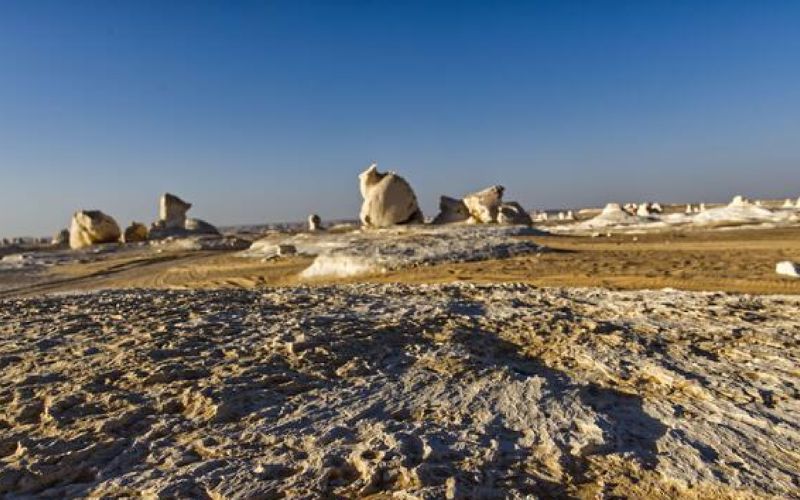
The nearby White Desert is the region’s best-known attraction. Its pale chalk formations, sculpted by erosion, create landscapes that can resemble mushrooms, towers, and abstract works of art.
But Farafra itself deserves attention.
Visitors can explore the old settlement of Qasr Al-Farafra, discover contemporary oasis art at Badr Museum, see agricultural gardens sustained by groundwater, and learn how communities have adapted to living in an extremely dry environment.
For travelers planning Egypt in 2027, Farafra is especially appealing as part of a carefully organized Western Desert itinerary. The distance from Cairo, limited tourism infrastructure, permit requirements, and changing protected-area access rules make advance planning essential.
This guide explains where Farafra is, what makes it special, how to reach it, the best places to visit, accommodation options, seasonal weather, and how to build a realistic itinerary.
Where Is Farafra Oasis in Egypt?
Farafra Oasis is located in Egypt’s Western Desert, southwest of Cairo and south of Bahariya Oasis. Administratively, it belongs to New Valley Governorate, known in Arabic as Al-Wadi Al-Gadid.
The wider oasis includes cultivated areas, villages, natural springs, and desert terrain. Its principal settlement is Qasr Al-Farafra, sometimes written as Qasr El-Farafra.
The surrounding landscape forms part of the immense Western Desert, which extends across much of Egypt west of the Nile Valley.
For geographical context, Farafra lies between Bahariya Oasis to the north and Dakhla Oasis to the south.
It is an important stopping point on longer journeys through Egypt’s interconnected oasis regions.
Farafra Oasis Egypt Map: Understanding Its Location
A simple way to understand Farafra’s location is to picture the Western Desert route extending south from Cairo through Bahariya and onward toward Dakhla and Kharga.
| Destination | Relationship to Farafra | Approximate road distance |
| Cairo | Northeast, typically via Bahariya | 550–600 km, depending on starting point and route |
| Bahariya Oasis | North | 170–180 km |
| White Desert protected area | Northwest of Farafra town | Approximately 38–45 km to the general reserve area |
| Dakhla Oasis | South | 300–320 km |
| Kharga Oasis | Farther south and east | Reached via the wider oasis road network |
| Assiut | East, toward the Nile Valley | Route-dependent; confirm the Farafra–Dairut connection |
Distances are approximate planning references, not guaranteed navigation measurements. The route, destination within each oasis, checkpoint arrangements, and actual road conditions can affect the journey.
Farafra’s geographical position explains much of its tourism appeal.
Travelers approaching from Bahariya experience changing desert scenery before reaching the oasis. Those continuing toward Dakhla travel deeper into the Western Desert’s settled agricultural regions.
The landscape alternates between open desert, limestone formations, rocky plateaus, cultivated fields, and clusters of date palms.
For a broader understanding of the landscape, see our guide to Egypt’s Western Desert.
Is Farafra in the Sahara Desert?
Yes. Farafra Oasis lies within the Sahara, the vast desert region extending across North Africa.
Egypt’s Western Desert forms the eastern part of the Libyan Desert, itself a major geographical region within the Sahara.
However, calling Farafra simply a desert can be misleading.
An oasis is an area where water supports vegetation and human settlement in an otherwise arid environment.
Farafra’s cultivated land survives because groundwater is available through wells and springs.
This is why visitors encounter green agricultural fields and palm gardens surrounded by dry desert landscapes.
The contrast is an essential part of the Farafra experience.
Is Farafra the Same as the White Desert?
No. Farafra Oasis and the White Desert are closely connected but geographically different.
Farafra is an inhabited oasis with farms, houses, streets, local businesses, and accommodation.
The White Desert is a protected natural landscape famous for its wind-sculpted chalk formations.
Many visitors explore both during the same trip, but they should not be treated as interchangeable attractions.
This distinction matters when booking accommodation, arranging transportation, or choosing an itinerary.
A hotel listed as being in Farafra does not necessarily place you among the White Desert’s chalk formations. Similarly, a White Desert safari may explore the protected landscape without including much time in Farafra town.
Travelers primarily interested in geological scenery should also consult our dedicated guide to the White Desert in Egypt.
Why Is Farafra Oasis Famous?
Farafra is best known for its proximity to the White Desert, but several geographical and cultural characteristics distinguish it from Egypt’s other oases.
Its most important attraction is the surrounding natural environment.
The White Desert contains extraordinary chalk and limestone formations, geological features that preserve evidence of the region’s ancient environmental history.
Over long periods, geological processes and weathering have exposed and shaped these rocks into the formations visible today.
The second major attraction is the contrast between the desert and the oasis itself.
Water supports date palms, agricultural gardens, and settlements in a region receiving very little rainfall.
These cultivated areas demonstrate how oasis communities depend on careful use of groundwater.
A third attraction is Farafra’s architectural and cultural heritage.
Traditional buildings made from mud brick reflect construction methods suited to a hot, dry climate. Local artwork also provides insight into the surrounding landscape and the community’s relationship with it.
Finally, Farafra offers a slower travel experience.
While Egypt’s major archaeological destinations often involve organized sightseeing schedules, Farafra rewards travelers who enjoy observing landscapes, exploring small settlements, and spending time outdoors.
What Makes Farafra Different From Other Egyptian Destinations?
Farafra is not an alternative version of Luxor or Cairo.
Its value is not measured by the number of famous monuments a traveler can visit in one day.
Instead, the experience is built around geography, local culture, open landscapes, and the transition between inhabited oasis environments and protected desert scenery.
The most memorable part of a Farafra journey may be the contrast itself: green palm gardens in the morning, dark rocky formations along the desert road, and pale chalk landscapes later in the day.
That diversity makes the region especially interesting for photographers, geology enthusiasts, and visitors returning to Egypt after experiencing its better-known historical attractions.
Is Farafra Oasis Worth Visiting in 2027?
Farafra is worth visiting if you enjoy unusual natural landscapes and are comfortable traveling beyond Egypt’s main tourist routes.
It is particularly suitable for travelers interested in:
- The White Desert and Western Desert geology.
- Scenic photography and wide desert landscapes.
- Traditional oasis settlements and local art.
- Guided 4WD exploration.
- Quiet destinations with relatively limited tourism infrastructure.
- Multi-day journeys connecting different Egyptian oases.
Farafra may be less suitable for travelers with extremely limited time, those seeking luxury resort facilities, or visitors who prefer destinations with extensive public transportation and easily accessible medical services.
A traveler spending only five days in Egypt may be better served by focusing on Cairo and one additional major destination.
Someone spending two weeks in Egypt, especially on a return visit, may find Farafra a rewarding addition.
The strongest itinerary is one that allows enough time to enjoy the landscape without turning every day into a long drive.
Best Things to Do in Farafra Oasis, Egypt
Farafra’s attractions fall into three main groups: oasis culture, natural springs and agricultural landscapes, and the desert environments surrounding the settlement.
The following experiences offer the strongest reasons to visit.
1. Explore the White Desert National Park
The White Desert Protected Area is the principal natural attraction associated with Farafra.
It is known for pale chalk surfaces and sculptural geological formations that stand out against the surrounding desert.
Some resemble mushrooms. Others have narrow stems beneath broad tops, while taller formations suggest towers, cliffs, or natural monuments.
The White Desert’s unusual appearance results from the interaction of geological history, rock characteristics, and erosion.
Wind carrying sand contributes to the gradual shaping of exposed surfaces. Differences in rock resistance can leave some portions standing after surrounding material has worn away.
The effect is particularly striking when sunlight creates shadows across the formations.
For many travelers, the White Desert is the highlight of a Western Desert journey.
However, it is a protected landscape, not an unrestricted recreational area.
Access to specific routes, activities, and campsites depends on current rules and official permissions.
Travelers should arrange visits through experienced, properly authorized operators rather than assuming that any vehicle can enter the park.
Suggested experience: Allow a substantial portion of a day for permitted desert exploration, with flexibility for stops and changing access conditions.
2. Discover Qasr Al-Farafra
Qasr Al-Farafra, also written Qasr El-Farafra, is the main settlement traditionally associated with the oasis.
The name qasr can mean a fortress or fortified settlement.
The older part of Farafra reflects the region’s historic need to build communities capable of coping with environmental challenges and geographical isolation.
Traditional architecture commonly employed locally available mud brick.
Thick walls and relatively compact building arrangements helped moderate indoor temperatures in an extremely dry climate.
The settlement’s historical development is associated with the region’s caravan connections and occupation during different historical periods.
Some surviving remains are traditionally linked to a fortified settlement with roots extending back to Roman times, although particular surviving structures may belong to later periods.
Visitors should not expect a fully preserved Roman fortress or a restored archaeological complex.
Instead, Qasr Al-Farafra is best approached as a living settlement containing remnants of older architecture.
The value lies in understanding how people organized daily life in a desert oasis.
Look for the relationship between the buildings, narrow streets, elevated ground, agricultural land, and surrounding desert.
Visitor advice: Ask a knowledgeable local guide which historic areas can currently be visited. Avoid entering unstable structures or treating residential spaces as open-air museums.
3. Visit Badr Museum
Badr Museum is one of Farafra’s distinctive cultural attractions.
The small museum is associated with local artist Badr Abdel Moghny, whose work explores life in the oasis.
Rather than concentrating on monumental ancient Egyptian artifacts, the collection focuses on artistic interpretations of local people, the desert environment, and community traditions.
Clay sculpture and other artistic media help convey the character of Farafra’s surroundings.
The museum is particularly valuable because it adds a human perspective to a destination often described mainly through its geology.
A traveler who visits only the White Desert may leave with memories of remarkable rock formations but little understanding of the people who live nearby.
Badr Museum offers an opportunity to balance those impressions.
Artistic representations of oasis life may communicate traditional occupations, everyday scenes, and the relationship between residents and their environment.
This makes the museum worthwhile even for travelers who do not usually include small local art collections in their itineraries.
Allow approximately 30–60 minutes, depending on availability and personal interest.
Because small museums may operate flexibly, confirm visiting arrangements locally rather than relying on a fixed online opening schedule.
4. Experience Bir Sitta Hot Spring
Bir Sitta, meaning Well Six, is a well-known spring in the Farafra area.
It is located a short drive from the principal settlement, commonly described as approximately six kilometers away.
Natural springs and groundwater-fed pools are important features of oasis environments.
In Farafra, water has both practical and cultural significance because agriculture and permanent settlement depend on reliable supplies.
Bir Sitta is frequently included in descriptions of Farafra’s local attractions.
Depending on its condition and current access arrangements, visitors may be able to see or use the spring-fed pool.
However, facilities, cleanliness, water temperature, and suitability for bathing should be checked before arrival.
Do not assume that every natural spring is maintained to the standards of a hotel swimming pool.
Visitors should also avoid interpreting claims about therapeutic or medicinal benefits as established medical facts.
The primary reason to visit is to experience another aspect of Farafra’s oasis landscape.
Practical tip: Check locally whether bathing is permitted, what clothing is culturally appropriate, and whether there are functioning changing facilities.
5. Walk Through Farafra’s Palm Groves and Agricultural Areas
One of the most overlooked activities in Farafra is simply exploring the cultivated landscape.
An oasis may appear as a green patch on a desert map, but seeing the agricultural system at ground level provides a much richer understanding.
Date palms are particularly recognizable, while other crops and vegetables may be grown where water and farming conditions permit.
The contrast between vegetation and surrounding desert helps explain why oases have historically been important places for settlement and movement.
Water is the key resource.
Without groundwater, Farafra would not support the same agricultural activity or permanent population.
A short guided walk can introduce travelers to irrigation practices, cultivated fields, and the way farmland is organized around local settlements.
Morning and late afternoon are generally more comfortable for outdoor walks than the hottest part of the day.
Because agricultural land is privately or communally used, ask permission before entering fields or photographing people working there.
The aim should be to learn respectfully, not to turn daily agricultural work into a staged tourist attraction.
6. See Crystal Mountain
Crystal Mountain is a geological landmark along the wider Bahariya–Farafra desert route.
Despite its name, it is not a towering mountain covered with diamonds.
It is a relatively compact crystal-rich rock formation, associated with exposed ancient cave and karst features.
The most notable feature is the way the crystals catch the sunlight.
Visitors can observe sparkling mineral surfaces and natural rock structures that differ considerably from the nearby chalk landscapes.
Geological research identifies calcite crystals among the important features of the site. Descriptions that characterize the entire formation as pure quartz are misleading.
Crystal Mountain is better treated as a short geological stop than as a destination requiring several hours.
Its significance comes from the exposed minerals and geological processes, not its physical height.
Recommended visit: Plan a short stop as part of a wider guided route, allowing time to observe the rock and take photographs.
Do not break off or remove crystals.
Collecting geological material damages the site and diminishes the experience for future visitors.
7. Explore the Agabat Valley Landscape
Agabat, sometimes written El Agabat, is another striking landscape commonly included in Western Desert safari routes.
It is known for dramatic rock formations, sandy areas, and unusual contrasts between different landforms.
Unlike the cultivated environment of Farafra town, Agabat emphasizes the scale and openness of the surrounding desert.
Its terrain creates opportunities to appreciate rock formations from different perspectives.
The main attraction is not a single monument but the wider landscape.
Visitors may encounter elevated viewpoints, natural valleys, and transitions between exposed rock and sand.
The exact route depends on authorized access and local conditions.
A knowledgeable guide is important because the area can include soft sand, uneven surfaces, and tracks that are not suitable for ordinary vehicles.
For photographers, Agabat provides a different visual experience from the White Desert’s white chalk sculptures.
Combining the two can help travelers understand the geological variety found within a relatively limited region.
8. Discover the Black Desert
The Black Desert is usually associated more closely with the Bahariya section of the Western Desert route.
Nevertheless, travelers journeying between Bahariya and Farafra may encounter it as part of a broader itinerary.
The landscape includes hills and surfaces covered with dark mineral-rich rock fragments.
This creates a striking contrast with the brighter limestone and chalk landscapes encountered farther along the route.
The difference in color is one of the most memorable features of a multi-stop Western Desert journey.
A morning among dark rocky hills can be followed by an afternoon in landscapes dominated by pale formations.
The Black Desert should not be confused with the White Desert, nor should their names be taken to mean that the two regions have identical geological origins.
Each environment reflects different rock materials and geological processes.
Travelers wanting a broader comparison can explore the different desert landscapes of Egypt.
9. Enjoy the Desert Sky After Sunset
One of Farafra’s natural advantages is the relatively low level of artificial lighting in many surrounding desert areas.
Away from settlements and major roads, clear nights can offer excellent opportunities to observe the stars.
The experience can be particularly rewarding for travelers accustomed to bright urban environments.
However, a good location does not guarantee a perfect night sky.
Moonlight, cloud, dust, wind, and visibility all affect conditions.
The best viewing periods are generally those with a darker moon phase and clear weather.
Travelers should not assume that an overnight camp inside the protected area is permitted.
If camping is unavailable, an evening observation experience at an authorized, accessible location may be an alternative.
Suitable accommodation with an outdoor terrace can also provide opportunities to enjoy the desert sky.
Before arranging nighttime activities, confirm access rules, transportation arrangements, and the ability to return safely after dark.
10. Experience Farafra’s Local Food and Hospitality
Food in Farafra reflects the practical realities of living in an oasis.
Local agriculture, regional cooking traditions, and the availability of ingredients influence everyday meals.
Visitors may encounter familiar Egyptian foods alongside simple dishes prepared with locally available produce.
Bread, vegetables, rice, legumes, dates, and other seasonal ingredients can feature in meals.
The exact menu depends on the household, accommodation, or tour operator.
A meal in Farafra is not necessarily a formal culinary performance.
Its appeal often lies in simplicity and the setting.
After traveling through long stretches of desert, sitting down to a freshly prepared meal can become one of the most enjoyable parts of the day.
Travelers with allergies or dietary requirements should communicate them before departing Cairo or Bahariya.
Small settlements may not offer the same range of specialist ingredients available in major cities.
Vegetarian meals may be possible to arrange, but they should be confirmed in advance.
11. Learn About Traditional Mud-Brick Architecture
Farafra’s older buildings provide insight into environmental adaptation.
Mud brick was widely used in oasis settlements because suitable earth-based materials were locally available.
Thick earthen walls can reduce the rate at which external heat affects interior spaces.
Courtyards, compact buildings, and shaded passages can also improve comfort.
These design approaches developed long before modern air-conditioning became common.
The architectural significance of Farafra is therefore practical as well as historical.
Buildings represent solutions to the problems of heat, resource availability, and settlement security.
Travelers should be aware that old earthen structures can deteriorate through weathering, erosion, and neglect.
A picturesque wall may also be unstable.
It is important to respect barriers, avoid climbing fragile remains, and follow local guidance.
12. Observe Desert Nature Without Disturbing It
The Western Desert may initially appear almost empty, but desert environments support specialized forms of life.
Vegetation is concentrated where water and suitable conditions are available.
Other plants and animals have adapted to aridity and extreme temperature changes.
The White Desert Protected Area is recognized for its environmental significance as well as its geological scenery.
Visitors should remember that wildlife encounters are uncertain.
A desert tour should not be marketed as a wildlife safari promising sightings of particular animals.
Seeing tracks, observing sparse vegetation, or learning about ecological adaptations can be rewarding even when animals remain out of view.
Responsible behavior is especially important in fragile environments.
Do not feed wildlife, disturb nesting areas, drive over vegetation, or collect fossils and minerals.
13. Explore Farafra as Part of a Longer Oasis Journey
Farafra becomes especially interesting when visited as part of a route connecting several Western Desert settlements.
Bahariya, Farafra, Dakhla, and Kharga each have different landscapes and cultural features.
Bahariya is a common starting point for travelers approaching from Cairo.
Farafra is associated with the White Desert and its own distinctive oasis community.
Dakhla contains a wider range of settlements and historic sites spread across its depression.
Kharga provides another important connection between the oasis region and the Nile Valley.
The complete route is considerably more demanding than a short White Desert excursion.
Travelers must account for long road distances, accommodation availability, fuel stops, permits, and changing checkpoint arrangements.
Those with enough time can enjoy a more comprehensive picture of Western Desert life.
For shorter trips, concentrating on Bahariya, Farafra, and authorized White Desert routes is often more practical.
The White Desert Near Farafra: What Travelers Should Know
The White Desert is the reason many international travelers first become interested in Farafra.
However, a successful visit requires understanding what the landscape actually is and how it can be explored.
How Was the White Desert Formed?
The White Desert is famous for exposed pale chalk and limestone formations.
The rocks reflect a much longer geological history involving sediment deposition, environmental change, exposure, and erosion.
Some of the region’s carbonate rocks formed from sediments deposited in ancient marine environments.
Over geological time, changes in the Earth’s surface exposed these deposits.
Wind and other weathering processes then helped shape the exposed materials.
Because rock layers differ in their resistance to weathering, erosion does not remove every part of the landscape at the same rate.
The result is a variety of natural formations.
These include narrow columns, broad-topped shapes, rounded surfaces, and irregular rock masses.
The shapes are not carved monuments.
They are the products of natural geological processes operating over extremely long periods.
Understanding this makes the landscape more interesting than simply comparing the rocks to familiar objects.
Why Are the Rocks White?
The dominant pale appearance comes from chalk and other carbonate-rich geological materials.
Chalk is a soft, fine-grained form of limestone.
Its light color creates a strong visual contrast with surrounding sand, darker rock fragments, and shadows.
The White Desert is not covered in permanent snow.
It is also not simply a conventional sand desert painted white.
Although sand is present, the distinctive visual character comes largely from the exposed rock.
This distinction explains why visitors often describe the White Desert as looking unlike the dunes they expected to see in the Sahara.
What Are the Mushroom-Shaped Rocks?
The mushroom-like formations are examples of differential erosion.
Their broad upper sections and narrower bases result from variations in rock characteristics and weathering.
Sand-bearing wind can contribute to the erosion of exposed surfaces, while differences in rock resistance help determine which portions remain.
Each formation is unique.
Some resemble familiar objects, but these comparisons are subjective.
A feature described as a mushroom by one visitor may look like an umbrella or abstract sculpture to another.
The important point is that these are natural landforms, not intentionally constructed structures.
Is the White Desert a UNESCO World Heritage Site?
The White Desert is an officially protected natural area in Egypt, but it should not automatically be described as a UNESCO World Heritage Site.
Protected-area status and UNESCO World Heritage inscription are different forms of recognition.
Egypt established the White Desert protected area under national legislation in 2002.
Its geological, environmental, and scenic significance forms the basis of its protected status.
Travelers should not assume that every important protected landscape is on the UNESCO World Heritage List.
Can You Camp in the White Desert in 2027?
Camping in the White Desert cannot be guaranteed for 2027.
Authorities may restrict specific routes, campsites, safari operations, or overnight activities.
Australia’s official travel guidance has warned about safari and camping restrictions near Bahariya and the possibility of restrictions on White Desert camping.
This makes it especially important to confirm the exact permitted activity shortly before departure.
Some published tour descriptions continue to advertise overnight camps, but commercial advertising does not establish legal access.
Before booking, request written confirmation that the intended route and overnight arrangement are authorized for your travel dates.
If camping is restricted, ask whether a lawful daytime visit is possible.
Do not accept an operator’s suggestion to bypass checkpoints or camp outside approved areas.
The experience should be adapted to the rules in force, not the other way around.
What Is a Typical White Desert Safari Like?
When authorized, a guided White Desert excursion generally combines road travel and selected off-road exploration.
The exact sequence depends on the itinerary and permitted routes.
A traveler may begin by leaving Bahariya or Farafra, meeting the safari team, and transferring to an appropriate vehicle.
The operator should explain what the tour includes before departure.
Potential experiences include stops at geological viewpoints, time to observe rock formations, short walks, and scenic photography.
Trips may also incorporate nearby geological attractions such as Crystal Mountain or Agabat, depending on the route.
An overnight itinerary, when legally permitted, may include a supported campsite.
Travelers should ask what sleeping arrangements, sanitation facilities, food, drinking water, emergency equipment, and communication systems are provided.
The quality of these services varies.
A good safari is not simply a vehicle driving quickly between famous photo stops.
It should provide enough time to appreciate the landscape, understand its environmental significance, and travel safely.
Do You Need a 4WD Vehicle?
A suitable four-wheel-drive vehicle is important for authorized off-road desert routes.
The paved highway connecting the oases is different from the sandy or uneven tracks used during some desert excursions.
An ordinary passenger car may be adequate for certain paved journeys, but it should not be taken onto unverified desert tracks.
Soft sand, rocky surfaces, and isolated terrain create risks that are easy to underestimate.
A stuck vehicle can become a serious problem when mobile reception is limited.
A professional desert operator should assess the route, vehicle, equipment, weather, and safety requirements.
The purpose of a 4WD is not to make the trip unnecessarily extreme.
It is to provide suitable transport for the terrain where off-road travel is permitted.
What Should Visitors Avoid in the White Desert?
The White Desert’s formations are vulnerable to damage.
Even apparently solid rocks can have fragile surfaces.
Visitors should avoid climbing formations without explicit permission and local safety assessment.
Do not collect stones, crystals, or fossils.
Driving over protected surfaces can damage both natural features and less visible ecological areas.
Litter is another major concern.
Lightweight packaging can travel long distances in the wind, while food waste may affect wildlife behavior.
A responsible visit leaves the landscape unchanged.
Our guide to desert safari experiences in Egypt provides additional context for planning desert activities.
How to Get to Farafra Oasis in Egypt
Reaching Farafra is one of the most important parts of trip planning.
It is a remote destination, and most visitors arrive by road.
The appropriate route depends on whether the traveler is starting from Cairo, Bahariya, Dakhla, or the Nile Valley.
Cairo to Farafra Oasis
The conventional tourist approach from Cairo travels southwest toward Bahariya Oasis before continuing south to Farafra.
The overall distance is roughly 550–600 kilometers, depending on the exact starting and ending points.
It should be treated as a substantial driving day.
Although some journey descriptions give optimistic driving times, actual travel can be longer because of traffic, stops, checkpoints, and road conditions.
Travelers should avoid planning a tightly scheduled activity immediately after arrival.
The road journey itself may be rewarding, with significant changes in scenery along the way.
However, it is more enjoyable when passengers have enough time for breaks.
For visitors coming from international flights, spending a night in Cairo before beginning a long desert journey is often sensible.
A long-haul arrival followed immediately by many hours of driving can create unnecessary fatigue.
Bahariya Oasis to Farafra
Bahariya is approximately 170–180 kilometers north of Farafra.
It is the most familiar intermediate destination on many Western Desert tour routes.
The road connection makes it possible to combine the two oases within a multi-day itinerary.
However, sightseeing along the route may substantially increase the day’s total duration.
For example, a traveler interested in the Black Desert, Crystal Mountain, Agabat, and the White Desert should not think of the journey as merely a straightforward transfer between towns.
The experience may involve multiple stops and additional off-road driving.
That is why a dedicated sightseeing day can be preferable to simply adding attractions to a transfer.
Before traveling, learn more about Bahariya Oasis and how it fits into the Western Desert route.
Al-Farafra, Egypt to Assiut, Egypt
Travelers researching the journey from Al-Farafra to Assiut should distinguish between Assiut city and nearby Nile Valley towns.
The Farafra–Dairut road connection is relevant because Dairut lies within Assiut Governorate.
Reaching Assiut city may require additional travel along the Nile Valley road network.
This route is not the same as the usual Cairo–Bahariya–Farafra tourist itinerary.
Before choosing it, confirm road availability, checkpoint requirements, permitted vehicle movements, fuel arrangements, and the expected travel time.
Do not assume that a direct public bus or regularly available shared transport operates between every point.
For visitors using the route to connect with Nile Valley destinations, a locally arranged transfer with current route information is preferable.
Dakhla Oasis to Farafra
Dakhla Oasis lies approximately 300–320 kilometers south of Farafra.
The two oases are connected by the wider Western Desert road network.
Travelers continuing between them should allow significant time for the journey and avoid treating the route as a short transfer.
Accommodation, fuel availability, and travel permissions should be arranged in advance.
This connection is particularly useful for travelers undertaking a longer Western Desert itinerary.
However, it is not necessary for someone whose only goal is to visit the White Desert.
Can You Reach Farafra by Public Transportation?
Public transportation to Farafra can be less predictable than transport between Egypt’s major cities.
Bus services, shared vehicles, and local connections may change.
Published timetables should not be treated as confirmed unless verified with the operating company.
Public transport also does not solve every aspect of the journey.
Even if a traveler reaches Qasr Al-Farafra independently, exploring protected desert areas may still require authorized guides, permits, and suitable vehicles.
The apparent savings from using public transport can diminish if local transfers are difficult to arrange.
Independent travelers should compare the full logistics of the trip rather than only the initial ticket cost.
Private Transfer or Organized Tour: Which Is Better?
| Transport option | Advantages | Limitations | Best suited to |
| Organized multi-day desert tour | Coordinated logistics, guide, vehicle and permit arrangements | Less independence; quality varies by operator | First-time visitors |
| Private road transfer | Flexible departure times and comfortable road travel | Desert activities require separate arrangements | Travelers staying in Farafra |
| Public transport | Potentially lower initial transport cost | Uncertain connections and limited flexibility | Experienced independent travelers |
| Self-drive on authorized paved roads | Greater independence | Checkpoints, breakdown risks and access restrictions | Travelers with appropriate local knowledge |
| Guided 4WD excursion | Suitable for approved off-road itineraries | Requires a qualified operator and legal access | Desert sightseeing |
For many international visitors, the most practical option is an organized trip that includes transport, local guidance, and clearly confirmed access arrangements.
Travelers should compare operators based on safety and itinerary quality rather than price alone.
You can explore the types of itineraries available through Touring in Egypt’s desert safari tours.
Best Time to Visit Farafra Oasis in 2027
The best time to visit Farafra is generally from October through April, when daytime conditions are more comfortable for outdoor sightseeing.
Farafra has a hot desert climate, with very little rainfall and considerable differences between summer and winter temperatures.
The climate is one of the most important factors when planning a visit.
Unlike destinations along the Mediterranean coast, Farafra does not benefit from the same maritime moderation of temperatures.
The surrounding desert can become extremely hot during summer afternoons.
Winter brings more comfortable daytime conditions, but nights can be surprisingly cold.
Farafra Weather by Season
| Season | General conditions | Travel recommendation |
| December–February | Mild or cool days; cold nights | Excellent for sightseeing with warm layers |
| March–April | Warmer days; possible wind and dust | Good for outdoor travel with weather flexibility |
| May–September | Very hot daytime conditions | Less suitable for extensive outdoor sightseeing |
| October–November | Increasingly comfortable temperatures | Among the most appealing periods for visiting |
Climate averages are useful for planning, but individual days may be substantially hotter, colder, or windier than expected.
Farafra Oasis in Winter
Winter is one of the most comfortable periods to explore Farafra.
Daytime temperatures are generally much easier to manage than during summer.
Walking through Qasr Al-Farafra, visiting agricultural areas, and exploring permitted desert viewpoints are more pleasant when the heat is moderate.
However, travelers should prepare for cold nights.
Desert environments can lose heat quickly after sunset, especially under clear skies.
If an overnight camping experience is authorized, suitable sleeping equipment and warm clothing are essential.
Even travelers staying in hotels should bring a jacket or fleece.
January is generally among the coolest months.
Long outdoor days may feel comfortable, but temperatures after sunset can be dramatically different.
Farafra in Spring
March and April can be good months to visit, particularly when travelers prefer warmer daytime weather.
However, spring is also a season when wind and dust can affect some Egyptian desert regions.
The khamsin, a name commonly associated with hot, dusty winds, can occasionally disrupt travel conditions.
These events are not guaranteed to occur on particular dates.
Nevertheless, they are a reason to allow flexibility.
Strong winds may reduce visibility and make outdoor activities uncomfortable.
A professional operator should be willing to modify the itinerary if weather conditions deteriorate.
Travelers should not prioritize a fixed sightseeing schedule over safety.
Farafra in Summer
Summer is generally the least comfortable season for extended desert exploration.
High daytime temperatures increase the risks associated with dehydration, heat exhaustion, and physical activity.
The lack of shade in some landscapes makes prolonged exposure particularly demanding.
Visitors considering summer travel should avoid assuming that they can follow the same schedule recommended for winter.
Outdoor activities should be limited to appropriate conditions, with careful attention to hydration and heat risk.
Some desert excursions may be unsuitable during particularly hot periods.
For travelers with flexible dates, the cooler season offers a more comfortable experience.
Farafra in Autumn
October and November are particularly attractive months for travelers who want comfortable outdoor conditions without the colder winter nights.
As the intense summer heat recedes, longer sightseeing days become more practical.
Autumn can work well for combining Farafra with Cairo or other Egyptian destinations.
However, early October may still be warm, and temperatures vary from year to year.
For wider seasonal planning, see our guide to the best time to visit Egypt.
Which Month Should You Choose?
For travelers primarily interested in sightseeing, November, February, and March are particularly appealing choices.
December and January are also excellent if you are comfortable with cooler evenings and nights.
April can work well, but wind and rising temperatures should be considered.
Travelers interested in photography may prefer a season with comfortable temperatures and sufficient flexibility to revisit locations when conditions are favorable.
The most important consideration is not finding a perfect month.
It is choosing a season that allows enough time outdoors without excessive heat or unnecessary weather-related risk.
Where to Stay in Farafra, Egypt
Accommodation in Farafra is limited compared with Egypt’s major tourist destinations.
Visitors should not expect the extensive selection of international hotels available in Cairo, Luxor, or the Red Sea resorts.
Farafra’s accommodation is better suited to travelers who value location, simplicity, and access to the surrounding region.
The main possibilities include established local hotels, smaller lodging properties, and authorized organized camping experiences where permitted.
Badawiya Hotel Farafra Egypt
Badawiya Farafra Hotel is a recognized accommodation name associated with the oasis.
The property’s published description emphasizes traditional mud-brick architecture and facilities designed for visitors exploring the Western Desert.
Its advertised features have included guest rooms, a restaurant, courtyard areas, and communal spaces.
The traditional architectural style is part of its appeal.
Rather than resembling a modern high-rise city hotel, the property has been presented as accommodation reflecting the character of the oasis.
However, travelers should verify the hotel’s current operational status, room availability, facilities, prices, and booking arrangements directly before making plans for 2027.
Older hotel descriptions are not reliable confirmation that every advertised service remains available.
This applies especially to swimming pools, restaurants, heating, internet access, and transportation services.
Small Hotels and Local Guesthouses
Smaller properties may offer a more personal accommodation experience.
However, the selection can be limited, and not every property maintains an up-to-date online booking system.
Travelers should confirm the details that matter most to them.
These include whether the room has a private bathroom, whether hot water is available, and whether heating or air-conditioning is provided.
Meal arrangements are also important.
A property may not operate a restaurant throughout the day.
It may instead prepare meals only when requested in advance.
Visitors who require particular dietary options should confirm availability before arriving.
Can You Stay Inside the White Desert?
Some safari itineraries have traditionally included supported camping in the White Desert.
However, camping arrangements must comply with current protected-area restrictions.
An advertised campsite does not necessarily indicate a permanently authorized accommodation facility.
Travelers should distinguish between a licensed hotel in Farafra and a temporary desert camp.
The facilities, safety arrangements, and legal requirements are different.
Camping should be considered only when the relevant authorities permit it and a qualified operator can organize it responsibly.
If overnight access is restricted, choose accommodation in an authorized settlement and arrange permitted daytime sightseeing instead.
Farafra Hotel or Desert Camp: Which Is Better?
| Consideration | Hotel in Farafra | Authorized desert camp |
| Sleeping arrangements | Conventional room | Usually tent-based or supported outdoor sleeping |
| Bathroom facilities | Property-dependent, but generally more conventional | May be very basic |
| Electricity | Typically more accessible | May be limited or unavailable |
| Meals | Hotel or locally arranged | Usually prepared by the safari team |
| Weather protection | Better protection from wind and cold | Depends on equipment and conditions |
| Accessibility | Must be checked individually | Often physically demanding |
| Permits | Standard accommodation rules | Additional protected-area permissions may apply |
| Availability | Requires direct confirmation | Depends on legal authorization and operating conditions |
For first-time travelers, a hotel stay may be the more predictable option.
A desert camp can be memorable when legally permitted and properly supported, but it should not be treated as the only worthwhile way to experience the White Desert.
Visitors unfamiliar with desert camping should read about the practical differences between accommodation styles in our guide to camping in Egypt.
What to Confirm Before Booking Accommodation
Before making a reservation, establish the following:
- Whether the property is operating on the intended dates.
- Whether the quoted rate includes meals and taxes.
- Whether the room has reliable heating or cooling.
- Whether private bathroom facilities and hot water are provided.
- Whether electricity and internet access are available.
- Whether the property can arrange authorized local transportation.
- Whether the booking is refundable if desert access changes.
Travelers should also obtain clear arrival instructions.
A vague location pin may not be sufficient when arriving after a long desert journey.
How Much Does a Farafra Oasis Trip Cost in 2027?
The cost of visiting Farafra depends on transportation, trip duration, accommodation, group size, and the type of desert activities included.
There is no reliable single price that represents every Farafra trip.
A private Western Desert journey from Cairo has a different cost structure from a short local excursion starting in Bahariya.
Likewise, a trip including several days of 4WD transport and local guiding should not be compared directly with a simple road transfer.
Main Factors Affecting the Price
Transportation is often a significant expense because of the distances involved.
A trip from Cairo may require a private vehicle, driver, fuel, road transfers, and potentially an additional specialist vehicle for approved off-road exploration.
Accommodation is another factor.
A conventional hotel room may be priced differently from a package that includes meals and organized safari services.
Private tours also become more expensive per person when fewer travelers share the vehicle and operating costs.
However, group discounts should not come at the expense of appropriate vehicle capacity or safety.
Farafra Trip Cost Breakdown
| Expense | What affects the cost | What to verify |
| Cairo–Farafra transportation | Distance, vehicle type, duration | Fuel, driver expenses, return transfer |
| Local 4WD excursion | Route, vehicle, group size | Authorized access, equipment, guide |
| Accommodation | Hotel category, room type, season | Meals, taxes, heating or cooling |
| Protected-area access | Applicable official fees and rules | Current permit and entrance charges |
| Meals and water | Duration and dietary requirements | Included meals and drinking water |
| Local attractions | Site-specific arrangements | Current entrance fees and visiting hours |
| Overnight camping | Authorization, equipment, staffing | Legal access, tents, bedding, sanitation |
| Additional destinations | Extra distance and travel days | Dakhla, Kharga, or Nile Valley extensions |
Because fees and operational arrangements can change, it is more useful to request an itemized quotation than to rely on an unsupported fixed price.
How to Compare Two Farafra Tour Quotes
Suppose two operators offer what appear to be similar three-day Western Desert trips.
The first includes transport, accommodation, meals, and a guided excursion.
The second advertises a lower starting price but excludes the specialist vehicle, some meals, and protected-area charges.
The lower advertised price may not represent the cheaper completed journey.
Before choosing, ask both operators to provide the same information.
Confirm the exact itinerary, number of nights, vehicle arrangements, meal inclusions, guide qualifications, cancellation policy, and legal access conditions.
A quotation should also explain how the trip will change if a planned desert activity becomes unavailable.
A transparent alternative arrangement is more valuable than a promise that cannot be guaranteed.
Is Farafra a Budget-Friendly Destination?
Farafra is not necessarily expensive in terms of local accommodation and everyday services.
However, remoteness adds transportation costs.
For two travelers, private transport and specialist guiding may represent a substantial share of the total trip expense.
Traveling with a small group can reduce some per-person costs, provided the vehicle is appropriately equipped and the itinerary remains comfortable.
The best way to manage the budget is to decide which experiences matter most.
Travelers interested only in the White Desert may not need to extend the journey to Dakhla and Kharga.
Those who want a full oasis circuit should allow enough days to avoid spending too much of their trip driving.
Is Farafra Oasis Safe for Tourists in 2027?
Farafra’s safety depends on current regional conditions, official travel restrictions, the chosen route, the competence of the operator, and the traveler’s circumstances.
It should not be described as universally safe or unsafe without considering these factors.
Travel advice for Egypt’s Western Desert varies between countries and can change.
The region includes permitted tourist routes as well as restricted or higher-risk areas.
Visitors must distinguish between them.
Official Travel Advice for Farafra
The UK’s Foreign, Commonwealth & Development Office identifies the oasis towns of Bahariya, Farafra, Dakhla, and Kharga, along with specified desert areas and roads, as exceptions to its broader advice against non-essential travel in the Western Desert.
However, the UK also states that travelers entering the Bahariya, Farafra, White Desert, and Black Desert areas must arrange permits in advance and use an official guide.
The United States publishes strong security warnings concerning the Western Desert and identifies professionally licensed tour arrangements as essential for travel to the Black and White Deserts.
Australia identifies the Giza–Farafra corridor, including Bahariya, the Black Desert, White Desert, and Farafra, within areas where it advises exercising a high degree of caution. It also warns about specific safari and camping restrictions.
These positions are not identical.
Travelers should consult the current advice issued by their own government and evaluate whether their insurance covers the intended route and activities.
No travel company can override a government’s travel advisory or guarantee personal safety.
Do You Need a Permit for Farafra?
Permit requirements can apply to travel in the Farafra and surrounding Western Desert areas.
Visitors should not assume that access to an oasis settlement automatically grants access to protected desert routes.
Requirements can differ according to the route, nationality, activity, and current administrative arrangements.
A qualified local operator should explain which approvals are required and who is responsible for arranging them.
Ask for confirmation before departure.
Do not rely on outdated travel blogs or informal assurances that permits are unnecessary.
Why a Licensed Guide Matters
A properly qualified and authorized local guide or operator contributes much more than sightseeing commentary.
Local knowledge is important for understanding which routes are permitted, where checkpoints are located, and how to respond to changes in access.
An experienced operator should also be able to assess weather conditions, travel times, fuel needs, and communication limitations.
This is particularly important in remote areas.
A visitor may be comfortable navigating city streets independently but lack the skills or equipment needed for desert travel.
The right guide can make the experience both more informative and better organized.
Common Safety Risks in Farafra
Some risks are environmental rather than security-related.
Heat and dehydration: High daytime temperatures can make walking and physical activity dangerous, especially in summer.
Cold nights: Desert temperatures can fall considerably after sunset, and inadequate bedding can become a serious problem.
Limited communication: Mobile phone coverage may be weak or unavailable outside settlements.
Vehicle difficulties: Breakdowns, punctures, or getting stuck in sand can create significant complications far from services.
Medical access: Emergency medical facilities are limited compared with major cities.
Dust and reduced visibility: Strong winds can affect driving conditions and outdoor activities.
Unapproved routes: Entering restricted areas can create legal and security problems.
These risks should be considered when planning the itinerary rather than only after reaching the desert.
Practical Safety Precautions
Travelers should carry identification, sufficient drinking water, appropriate clothing, and essential medication.
An operator should have a realistic emergency plan.
Ask how the team communicates when ordinary mobile coverage is unavailable.
It is also sensible to share the confirmed itinerary and expected return arrangements with a trusted contact.
Avoid changing routes independently.
Do not approach military facilities, checkpoints, or restricted installations for photography.
Travelers who are concerned about regional security should review the wider guidance in our article about safety in Egypt.
What About Travel Insurance?
Insurance should be checked before booking a Western Desert itinerary.
Some policies exclude travel against official government advice.
Others may exclude certain adventure activities, remote-area travel, or activities conducted without licensed operators.
Ask the insurer whether the actual destinations and planned activities are covered.
A general statement that a policy covers Egypt may not be enough.
The policy should also be reviewed for emergency medical assistance, evacuation arrangements, cancellation, and interruption caused by restrictions.
For a remote trip, insurance conditions are an important planning consideration.
Suggested Farafra Oasis Itineraries for 2027
The ideal itinerary depends on whether Farafra is the principal destination or one stop within a longer Egyptian holiday.
The following examples are planning frameworks, not guaranteed tour departures.
Each assumes that the relevant roads and activities are legally available.
Three-Day Farafra and Western Desert Itinerary
A three-day itinerary is an efficient introduction, although it involves considerable road travel.
Day 1: Cairo to Bahariya Oasis
Depart Cairo at a reasonable hour and travel southwest toward Bahariya.
Allow time for road stops and arrival procedures.
Depending on the actual schedule, the afternoon can be spent exploring the oasis or relaxing at the accommodation.
Stay overnight in Bahariya.
Day 2: Bahariya to Farafra via Permitted Desert Stops
Travel south toward Farafra.
If authorized, include selected geological attractions along the route.
Possible stops may include Crystal Mountain, Agabat, or permitted White Desert viewpoints.
The number of stops should reflect actual driving conditions and available daylight.
Continue to Farafra for an overnight hotel stay.
Day 3: Farafra to Cairo
If time and access permit, begin with a brief visit to the old settlement or another nearby attraction.
Then start the long return journey to Cairo.
This itinerary is workable as a road-based introduction but leaves limited time to appreciate Farafra’s local attractions.
Travelers who want a more relaxed experience should add another day.
Four-Day Farafra and White Desert Itinerary
Four days provide a better balance between sightseeing and transportation.
Day 1: Cairo to Bahariya
Travel from Cairo to Bahariya and settle into the accommodation.
Avoid filling the day with too many activities after the journey.
Day 2: Bahariya and the Desert Route
Explore permitted geological landscapes on the route toward Farafra.
Allow enough time for photography and short guided walks.
Continue to Farafra and stay overnight.
Day 3: Discover Farafra Oasis
Spend the day exploring Qasr Al-Farafra, Badr Museum, and agricultural areas.
Visit a local spring if access and conditions are suitable.
This is the day that distinguishes an actual Farafra visit from a trip focused only on the White Desert.
Stay another night in Farafra or in suitable accommodation along the authorized route.
Day 4: Return to Cairo
Depart early enough to make the road journey comfortable.
Schedule breaks and allow flexibility for traffic or checkpoints.
Avoid arranging a tightly timed international flight immediately after the return drive.
Five-Day Farafra and Western Desert Journey
Five days allow more time for the desert and local culture.
A practical structure is:
| Day | Main destination | Main focus |
| 1 | Cairo to Bahariya | Transfer and oasis introduction |
| 2 | Bahariya region | Local sightseeing and permitted desert attractions |
| 3 | Route to Farafra | Geological landscapes and White Desert access, if authorized |
| 4 | Farafra Oasis | Qasr Al-Farafra, Badr Museum, springs and agriculture |
| 5 | Return to Cairo | Comfortable road journey |
The advantage of this itinerary is flexibility.
If weather or protected-area access changes, the itinerary has more room for adjustments than a rushed two-day schedule.
Seven-Day Western Desert Oasis Circuit
Travelers interested in geography, archaeology, and remote Egyptian communities may prefer a longer journey.
A seven-day route could connect Cairo, Bahariya, Farafra, Dakhla, and Kharga before returning toward the Nile Valley or Cairo.
This is a more demanding itinerary and requires professional route planning.
An illustrative schedule is:
Day 1: Cairo to Bahariya.
Day 2: Explore the Bahariya region and available attractions.
Day 3: Continue south toward Farafra with permitted geological stops.
Day 4: Explore Farafra and its oasis attractions.
Day 5: Travel toward Dakhla and visit selected local sites.
Day 6: Continue toward Kharga, subject to route and accommodation arrangements.
Day 7: Return toward the Nile Valley or continue to another confirmed destination.
This is a fairly active schedule.
Travelers interested in spending meaningful time in Dakhla and Kharga may prefer eight to ten days.
The exact route should be reviewed against current regional travel advice.
Do not assume that every theoretical road connection is suitable for every nationality or tour.
Can You Combine Farafra With Cairo, Luxor, and Aswan?
Yes, but the route must be carefully organized.
Farafra is not located on the standard Cairo–Luxor–Aswan tourist corridor.
Adding it introduces substantial travel time.
A traveler who has ten to fourteen days in Egypt may be able to combine a Western Desert segment with archaeological sightseeing.
However, attempting to include Cairo, the White Desert, Farafra, Luxor, Aswan, and several other destinations in a very short trip may create an exhausting itinerary.
A sensible approach is to prioritize the experiences that matter most.
For example, a visitor may choose four days in the Western Desert, followed by several days exploring Luxor and Aswan.
Another traveler may prefer Cairo, Bahariya, and Farafra without extending farther south through the oases.
Our Egypt itinerary guide can help with planning the wider holiday.
What If You Have Only Two Days?
Two days are usually better suited to a limited Bahariya-based desert excursion than a thorough visit to Farafra from Cairo.
The long road journey makes a comprehensive Farafra experience difficult.
A two-day itinerary may emphasize transport and selected desert stops rather than the oasis settlement itself.
Travelers should not expect to see every major landscape, explore Farafra’s cultural attractions, and enjoy a relaxed pace within such a limited period.
If Farafra is a major reason for traveling, adding a third or fourth day is worthwhile.
Farafra vs Bahariya vs Siwa vs Dakhla: Which Oasis Should You Visit?
Egypt’s Western Desert oases are not interchangeable.
Each offers a different combination of landscapes, historical attractions, transportation logistics, and visitor experiences.
Choosing the right oasis depends on what you want from the journey.
| Oasis | Main appeal | Travel style | Best reason to choose it |
| Farafra | White Desert access, oasis culture, local art | Nature and slow exploration | Extraordinary desert scenery combined with a smaller settlement |
| Bahariya | Gateway to popular Western Desert routes | Shorter desert excursions | Convenient starting point from Cairo |
| Siwa | Distinctive oasis culture, salt lakes, historic sites | Multi-day independent or organized stay | Extended oasis relaxation and cultural exploration |
| Dakhla | Historic settlements and agricultural landscapes | Longer road itinerary | Oasis heritage and deeper Western Desert exploration |
| Kharga | Archaeological sites and regional history | Multi-stop road journey | Connecting the oases with the Nile Valley region |
Farafra or Bahariya?
Choose Bahariya if you have relatively little time and want an accessible starting point for exploring part of the Western Desert.
Choose Farafra if you want to spend more time around the White Desert region and explore an oasis community rather than simply visit geological attractions.
Many travelers benefit from combining both.
Farafra or Siwa?
Farafra is particularly appealing for White Desert landscapes and the wider Bahariya–Farafra corridor.
Siwa offers a different cultural and geographical setting in the northwestern Western Desert.
Its attractions include its distinctive oasis environment, historic settlement areas, and saltwater landscapes.
Siwa is not a convenient direct substitute within the standard Bahariya–Farafra route.
Travelers considering Siwa should plan it as a separate destination or part of a carefully organized longer itinerary.
Our Siwa Oasis guide explains more about that destination.
Farafra or Dakhla?
Farafra is better suited to visitors whose main interests are the White Desert and its surroundings.
Dakhla may appeal more to travelers interested in historic settlements, archaeology, and the wider landscape of an inhabited oasis depression.
Both can be included in a longer Western Desert circuit.
However, visitors should not add Dakhla simply because it looks close on a small-scale map.
The road journey is substantial.
Who Should Visit Farafra Oasis?
Farafra appeals to several types of travelers, but the experience must match their expectations.
Nature Lovers and Landscape Photographers
Farafra is especially rewarding for people interested in geological landscapes.
The contrast between chalk formations, dark rocky hills, sandy valleys, and cultivated oasis gardens creates diverse photography opportunities.
Light changes dramatically during the day.
Strong overhead sunlight can emphasize the brightness of pale rock, while lower-angle light adds shadows and reveals surface textures.
Photographers should plan enough time to observe the landscape rather than rush between locations.
Protected-area regulations and weather conditions should always take priority over obtaining a particular photograph.
Couples
Farafra can be an attractive destination for couples who enjoy quiet surroundings and natural landscapes.
A private itinerary may allow more flexibility than a large group departure.
However, romance should not be confused with luxury.
Accommodation and facilities may be relatively simple.
Couples expecting premium spa resorts, extensive restaurant options, or guaranteed private desert camps should adjust their expectations.
The region is better suited to travelers who value scenery, calm environments, and shared exploration.
Families With Children
Farafra can work for families, particularly those with older children who enjoy nature and outdoor learning.
The White Desert’s unusual formations can provide opportunities to discuss geology and environmental conservation.
Badr Museum and oasis farms may also interest children.
However, family suitability depends on the child’s age, the length of the road journey, the season, and access to appropriate facilities.
Long drives can be tiring for younger children.
Heat and limited medical services are additional considerations.
Families should choose a vehicle with suitable restraints and plan regular breaks.
A short, comfortable hotel-based itinerary may be more appropriate than a demanding camping expedition.
Senior Travelers
Farafra can appeal to older travelers who enjoy scenery and cultural exploration without intensive physical activity.
However, the long road journey and limited facilities deserve careful consideration.
A well-planned trip can emphasize comfortable transportation, short walks, and accessible viewpoints where available.
Travelers with mobility limitations should ask specific questions about vehicle access, steps, walking surfaces, bathrooms, and accommodation.
It would be misleading to describe the entire region as wheelchair-accessible.
Many desert surfaces are uneven, sandy, or difficult to navigate.
Solo Travelers
Solo travelers may appreciate Farafra’s quieter atmosphere and distinctive landscapes.
However, independent travel requires preparation.
Transportation connections are limited, and suitable desert activities may require professionally organized services.
Joining a legitimate small-group excursion may be more practical than arranging every part of the journey independently.
Solo visitors should also be cautious about accepting informal off-road transportation offers.
Clear booking details, verified operators, and a known return plan are important.
Travelers With Limited Mobility
Some experiences in Farafra may be possible with appropriate vehicle arrangements.
However, accessibility cannot be assumed.
Mud-brick streets, uneven ground, sandy tracks, and outdoor camps can present significant obstacles.
A traveler requiring step-free access should confirm each component of the trip individually.
This includes accommodation, toilets, transport vehicles, restaurant access, and planned sightseeing stops.
Operators should describe actual facilities rather than simply labeling a trip accessible.
What to Pack for Farafra Oasis, Egypt
Packing for Farafra differs from preparing for a typical city holiday in Egypt.
The remoteness of the area means travelers should be more self-sufficient.
It is particularly important to prepare for seasonal temperature differences.
Clothing for Desert Conditions
During cooler months, layered clothing is useful.
A lightweight shirt may be comfortable during the day, while a fleece or insulated jacket may be necessary after sunset.
Long trousers and sleeves help protect against sunlight, wind, and dust.
Comfortable closed shoes are generally more suitable than open sandals for walking across rocky or sandy surfaces.
Visitors planning longer walks should choose footwear with adequate grip.
Loose clothing can be comfortable in hot weather, provided it offers appropriate sun protection.
Essential Items
| Item | Why it matters |
| Refillable water bottle | Helps maintain access to drinking water during road journeys |
| Sun protection | Strong sunlight and limited shade |
| Sunglasses | Reduces discomfort from glare and dust |
| Hat or head covering | Provides additional sun protection |
| Warm jacket | Useful during cold desert evenings |
| Closed walking shoes | Better suited to uneven terrain |
| Personal medication | Remote areas may have limited pharmacy access |
| Small first-aid kit | Useful for minor problems |
| Power bank | Charging opportunities may be limited |
| Offline maps | Mobile data coverage may be unreliable |
| Tissues and hygiene supplies | Facilities vary |
| Cash | Card acceptance may be limited |
| Copies of travel documents | Useful where identification is required |
Photography Equipment
Photographers should bring appropriate protection for cameras and lenses.
Fine dust and wind can affect equipment.
A sealed camera bag and cleaning materials are useful.
A tripod may help with landscape or night-sky photography where permitted.
However, travelers should avoid carrying excessive equipment if it will make walking difficult.
Drone use requires particular caution.
Egypt has strict rules regarding drones and aerial photography, and visitors should not bring or operate a drone without obtaining the necessary official authorizations.
Health and Comfort Supplies
Travelers should take any essential prescription medication in quantities appropriate for the trip, together with relevant documentation.
People with health conditions that may be affected by heat, remote travel, or limited access to medical care should discuss their plans with a qualified healthcare professional.
Dust-sensitive travelers may benefit from suitable face coverings or other protective measures.
Anyone considering desert camping should confirm the sleeping equipment supplied by the operator rather than assume that a basic blanket will be sufficient.
For a wider packing checklist, see what to pack for Egypt.
Responsible Tourism in Farafra and the White Desert
Farafra’s natural and cultural heritage is valuable partly because it remains closely connected to the local environment.
Tourism should support the region without damaging the features that make it distinctive.
Respect Protected Landscapes
The White Desert is protected under Egyptian environmental legislation.
Activities that damage wildlife, plants, geological features, or the wider ecosystem are not appropriate.
Visitors should remain on authorized routes and follow instructions from approved guides and protected-area officials.
Removing crystals or fossils may seem insignificant to an individual traveler, but repeated collecting can permanently damage a site.
Rock formations should be observed rather than treated as climbing equipment.
Avoid Leaving Waste
Travelers should remove all litter from desert locations.
This includes food packaging, bottles, tissues, and other small items that can easily be dispersed by wind.
Where toilet facilities are limited, ask the operator how sanitation is handled.
A responsible operator should have a clear plan rather than leave the issue to individual improvisation.
Respect Local Residents
Farafra is a real community, not a purpose-built tourist attraction.
Visitors should ask permission before photographing individuals or private homes.
The same applies to agricultural workers and families in residential areas.
A local guide can help explain appropriate behavior.
Modest clothing is generally sensible when exploring villages and community spaces.
Respect for privacy improves the experience for both visitors and residents.
Support Local Businesses
Where appropriate, choose legitimate local guides, accommodation providers, restaurants, and craft producers.
Local services can help ensure that tourism generates economic benefits for the community.
However, supporting local businesses does not mean overlooking safety or legal requirements.
An operator should still demonstrate appropriate licensing and professional standards.
Protect Groundwater and Natural Springs
Water is a fundamental resource in Farafra.
Visitors should treat springs and cultivated areas with care.
Do not use soap, shampoo, or other products in natural water sources unless a facility is specifically designed and authorized for that purpose.
Avoid contaminating irrigation channels or damaging agricultural infrastructure.
The availability of water is what makes the oasis possible.
Protecting it is part of responsible travel.
Common Mistakes to Avoid When Visiting Farafra
Farafra is a rewarding destination, but several planning mistakes can reduce the quality of a visit.
Mistake 1: Treating Farafra as a Simple Day Trip From Cairo
Farafra is too far from Cairo for a comfortable, comprehensive day trip.
The round-trip road journey can consume most of the day.
Plan a multi-day visit if you want to experience both the oasis and the surrounding landscapes.
Mistake 2: Confusing the Oasis With the White Desert
The White Desert and Farafra town are separate destinations.
Check which one your tour actually visits.
An itinerary advertised as a Farafra tour may prioritize desert scenery while providing little time for the oasis itself.
Mistake 3: Assuming Desert Camping Is Always Permitted
Camping restrictions can change.
Never book on the assumption that a published itinerary proves overnight access is currently authorized.
Request confirmation for the precise dates and location.
Mistake 4: Booking Without Checking the Inclusions
A cheap initial quotation may exclude important costs.
Check transportation, accommodation, permits, meals, guide services, and emergency arrangements.
Mistake 5: Ignoring Seasonal Temperatures
Farafra can be very hot in summer and cold at night in winter.
Travelers should prepare for the season rather than assume typical Cairo or Red Sea resort conditions.
Mistake 6: Relying Entirely on Mobile Internet
Coverage may be limited.
Download essential information before leaving major towns and carry the details of your accommodation and operator.
Mistake 7: Trying to Visit Too Many Oases Too Quickly
The Western Desert covers immense distances.
Farafra, Dakhla, Kharga, Bahariya, and Siwa should not be treated as neighboring city attractions.
Build the route around actual travel times.
Mistake 8: Assuming Every Historical Structure Is Open to Visitors
Old mud-brick buildings may be fragile or privately occupied.
Visit only areas where access is permitted.
Mistake 9: Expecting Major-City Facilities
Farafra has a different level of infrastructure from Cairo or Luxor.
Medical services, restaurants, shopping options, accommodation choices, and transport may be limited.
Mistake 10: Choosing an Operator Based Only on Price
Legal access, experience, appropriate vehicles, and emergency planning matter more than the lowest advertised rate.
Ask detailed questions before paying.
Frequently Asked Questions About Farafra Oasis Egypt
1. Where is Farafra Oasis located in Egypt?
Farafra Oasis is located in Egypt’s Western Desert within New Valley Governorate. It lies approximately 170 kilometers south of Bahariya Oasis and around 300–320 kilometers north of Dakhla Oasis. The main settlement is Qasr Al-Farafra, and the oasis is closely associated with the nearby White Desert Protected Area.
2. How far is Farafra from Cairo?
Farafra is approximately 550–600 kilometers from Cairo by the commonly used road route through Bahariya Oasis, depending on the exact starting point and destination. The journey should be treated as a substantial driving day. Traffic, road stops, security checkpoints, and conditions can affect travel time.
3. Is Farafra Oasis worth visiting?
Yes, Farafra is particularly worthwhile for travelers interested in desert landscapes, geology, local culture, and destinations beyond Egypt’s major tourist centers. It is less suitable for visitors with very limited time or those expecting extensive resort facilities. Most travelers benefit from including Farafra in a multi-day Western Desert itinerary.
4. What is the White Desert in Farafra famous for?
The White Desert is famous for pale chalk and limestone formations shaped by natural geological and weathering processes. Many resemble mushrooms, columns, or other sculptural shapes. The area is protected under Egyptian environmental legislation and requires visitors to follow current access and conservation rules.
5. Can tourists visit Farafra without a tour guide?
Travel rules and access requirements depend on the precise destination and activity. Official guidance identifies advance permits and an official guide as requirements for foreign visitors entering relevant Western Desert areas. Protected desert routes may have additional restrictions. International travelers should arrange and verify the necessary permissions through a qualified operator before departure.
6. Is White Desert camping allowed in 2027?
White Desert camping availability for 2027 must be confirmed with the relevant authorities and an authorized operator. Restrictions have affected safari and camping activities in parts of the Western Desert. Travelers should not assume that an advertised overnight tour is legal or available on their chosen dates.
7. What is the best month to visit Farafra Oasis?
November, February, and March are generally excellent choices because temperatures are more comfortable for outdoor activities. December and January are also suitable, although desert nights can be cold. Summer is less favorable because of high daytime heat, while spring conditions can sometimes be affected by wind and dust.
8. Are there hotels in Farafra Egypt?
Yes, Farafra has limited hotel and local accommodation options. Badawiya Farafra Hotel is one of the recognized names associated with the oasis. However, travelers should verify current operations, prices, facilities, and availability before booking. Accommodation options are much more limited than in Cairo or major Egyptian resorts.
9. What is Crystal Mountain near Farafra?
Crystal Mountain is a compact crystal-rich geological formation along the wider Bahariya–Farafra route. Its exposed mineral features include calcite crystals associated with ancient cave and karst geology. It is a popular short sightseeing stop on suitable authorized desert itineraries, rather than a large mountain requiring a lengthy climb.
10. How do you travel from Al-Farafra to Assiut?
Travel between Al-Farafra and Assiut Governorate can involve the road connection toward Dairut, with onward travel required to reach Assiut city. Travelers should confirm the route, road conditions, checkpoints, and transport availability locally. The journey should not be planned using an unverified direct bus schedule or a guessed driving time.
11. Does Farafra Oasis have an airport?
Farafra is not served by a regular international passenger airport suitable for standard tourist flight itineraries. International visitors generally enter Egypt through larger airports and continue to Farafra by road. Travelers should plan transportation accordingly rather than assume they can book a scheduled flight directly to the oasis.
12. Can you swim in Farafra’s hot springs?
Some spring-fed pools, including Bir Sitta, have traditionally been used for bathing. However, access, maintenance, water quality, and facilities should be verified locally. Natural spring water should not automatically be assumed suitable for swimming or drinking, and claims about medical benefits should not replace professional medical advice.
13. Is Farafra suitable for children?
Farafra can suit families with children who enjoy outdoor activities and unusual landscapes, provided the itinerary is age-appropriate. Long road journeys, strong heat, limited facilities, and changing desert access rules require careful planning. Families should prioritize suitable vehicle restraints, reliable accommodation, hydration, and realistic sightseeing days.
14. What is the difference between Farafra and Siwa Oasis?
Farafra is particularly associated with the White Desert and its remarkable chalk formations. Siwa lies much farther northwest and is known for its distinctive oasis culture, historic sites, and saltwater landscapes. The two destinations require different routes and should not be treated as interchangeable stops on a short itinerary.
15. How many days do you need in Farafra?
Two days in the immediate area can provide a limited introduction if you are already nearby, but three to four days is more practical when traveling from Cairo. A longer itinerary allows time for Bahariya, Farafra’s cultural attractions, and permitted desert sightseeing. A broader Western Desert circuit may require seven days or more.
Final Thoughts: Should Farafra Be Part of Your Egypt Itinerary?
Farafra Oasis offers a side of Egypt that many first-time visitors never experience.
Its appeal is not based on massive temples, royal monuments, or busy tourist districts.
Instead, Farafra reveals the relationship between people, water, agriculture, architecture, and the surrounding Sahara.
The nearby White Desert adds another dimension, with geological formations unlike the landscapes most travelers associate with Egypt.
For visitors who enjoy natural scenery and cultural exploration, the combination can be particularly rewarding.
However, Farafra deserves careful planning.
The road distances are substantial, tourism infrastructure is limited, and protected-area activities may require advance permits or be subject to restrictions.
Travelers should verify current arrangements, choose qualified operators, and allow enough time to appreciate both the oasis and the desert.
For a first visit, three or four days is a sensible starting point.
For a more extensive exploration of the Western Desert, a longer oasis itinerary may be worthwhile.
If you would like to combine Farafra, the White Desert, Cairo, or other destinations into one journey, Touring in Egypt can help plan a tailor-made Egypt holiday around your interests, available time, and the access rules in effect for your travel dates.
The best Farafra journey is not necessarily the one with the most stops.
It is the one that allows enough time to experience the landscape, understand the oasis, and travel responsibly.