Quick Answer: Where is the best scuba diving in Egypt?
The best scuba diving in Egypt is found in the Red Sea, particularly at Ras Mohammed National Park, the SS Thistlegorm wreck, the Straits of Tiran, Dahab, Elphinstone Reef, the Brothers Islands, and Daedalus Reef. Sharm El Sheikh and Hurghada are excellent for beginners and recreational divers, while Marsa Alam and offshore marine parks attract experienced divers seeking sharks, dramatic coral walls, and remote underwater adventures.
Few diving destinations offer such contrasting underwater experiences within one country. In Egypt, you can explore a shallow coral garden in the morning, drift along a spectacular reef wall the next day, and later descend toward a World War II shipwreck where trucks and motorcycles still rest inside the sunken vessel.
The remarkable part is how accessible these experiences can be. Some of Egypt’s best scuba diving spots are reached directly from beaches, while others require a short boat journey or a dedicated liveaboard expedition.
For travelers planning a diving holiday in 2027, choosing the right destination is more important than simply picking the most famous dive site.
A first-time diver will probably enjoy the sheltered reefs around Hurghada more than an exposed offshore site with powerful currents. An experienced wreck diver may prefer the northern Red Sea, while someone hoping to encounter oceanic sharks may focus on Marsa Alam and the southern marine parks.
This guide explores the best scuba diving sites in Egypt, explains who each destination suits, compares diving conditions and costs, and shows how to combine unforgettable underwater experiences with a wider Egyptian vacation.
Where Is the Best Scuba Diving in Egypt?
Egypt’s most celebrated scuba diving destinations are concentrated along the Red Sea coastline and the Gulf of Aqaba, with dive centers operating from Sharm El Sheikh, Dahab, Hurghada, Safaga, El Quseir, Marsa Alam, and locations farther south.
Each region offers a different experience.
Sharm El Sheikh provides access to extraordinary coral reefs, wrecks, and boat diving. Dahab is especially appealing for shore diving and underwater topography. Hurghada combines beginner-friendly reefs with established diving infrastructure, while Marsa Alam is renowned for marine encounters and access to more remote reefs.
For advanced divers, offshore destinations such as the Brothers Islands and Daedalus Reef are among Egypt’s most impressive underwater locations.
Best scuba diving spots in Egypt at a glance
| Diving destination | Best for | Experience level | Main attraction |
| Ras Mohammed National Park | Spectacular coral reefs | Intermediate–advanced | Shark Reef and Yolanda Reef |
| Straits of Tiran | Reef walls and drift diving | Intermediate–advanced | Jackson, Thomas, Woodhouse and Gordon reefs |
| SS Thistlegorm | Historic wreck diving | Experienced divers | World War II cargo ship |
| Dahab | Shore diving and underwater landscapes | Beginner–technical, depending on site | Lighthouse, Canyon and Blue Hole |
| Hurghada and Giftun Islands | First-time and recreational diving | Beginner–intermediate | Coral gardens and reef fish |
| Abu Nuhas | Multiple historic shipwrecks | Intermediate–advanced | Wrecks along a northern reef |
| Safaga and Panorama Reef | Deep walls and reef diving | Intermediate–advanced | Dramatic drop-offs |
| Abu Dabbab, Marsa Alam | Turtles and seagrass habitats | Beginner–intermediate | Green turtles and occasional dugongs |
| Marsa Shagra | Flexible house-reef diving | Beginner–advanced | Shore-access coral reefs |
| Elphinstone Reef | Sharks and challenging currents | Advanced | Offshore reef walls |
| Brothers Islands | Pelagic species and wrecks | Advanced | Big Brother and Little Brother |
| Daedalus Reef | Remote offshore diving | Advanced | Hammerheads and coral walls |
| Fury Shoals | Coral formations and reef exploration | Beginner–advanced, site-dependent | Southern reefs and swim-throughs |
| St. John’s Reefs | Remote coral reefs | Intermediate–advanced | Reef systems and coral formations |
| Rocky and Zabargad Islands | Remote liveaboard expeditions | Advanced | Offshore marine habitats |
The important distinction: The most spectacular site is not necessarily the best site for your certification, recent experience, or comfort in the water.
Always confirm suitability with a qualified local dive professional. Conditions can change considerably between dives, even at the same location.
Why Is Egypt One of the World’s Best Scuba Diving Destinations?
The Red Sea has earned its international diving reputation through a combination of accessible reefs, exceptional underwater landscapes, abundant marine life, historic shipwrecks, and favorable diving conditions for much of the year.
However, several characteristics make Egyptian scuba diving particularly distinctive.
Exceptional underwater visibility
The Red Sea is famous for clear water, especially around exposed reefs and offshore islands.
According to PADI’s destination guidance, visibility frequently reaches approximately 20–50 meters (65–164 feet), although actual conditions depend on the location, season, currents, weather, and recent underwater activity.
PADI+1
Good visibility makes reef formations easier to appreciate and can help underwater photographers compose images of large coral structures, schooling fish, and wrecks.
It also creates an unusual sensation when diving along steep underwater walls. The seabed may disappear into the blue even when the diver remains at a moderate recreational depth.
Clear water does not, however, make deep water safer. Divers must monitor their depth and gas supply carefully.
Extraordinary coral reef formations
Egypt’s Red Sea reefs include shallow coral gardens, pinnacles, plateaus, vertical walls, and extensive reef systems.
Some reefs begin just below the surface and descend into deep water. Others create sheltered lagoons or sandy bays suitable for introductory diving.
Divers may encounter hard corals, soft corals, sea fans, and colorful reef fish within a relatively small area.
These ecosystems are living habitats, not just attractive scenery. Their condition depends on responsible tourism, effective protection, and careful management of diving activities.
Travelers interested in the wider coastal environment can explore the Red Sea in Egypt and its beaches, islands, and marine attractions.
Marine life for different interests
Egypt offers opportunities to observe both small reef creatures and much larger marine animals.
Common underwater subjects include:
- Butterflyfish, angelfish, parrotfish, and anthias.
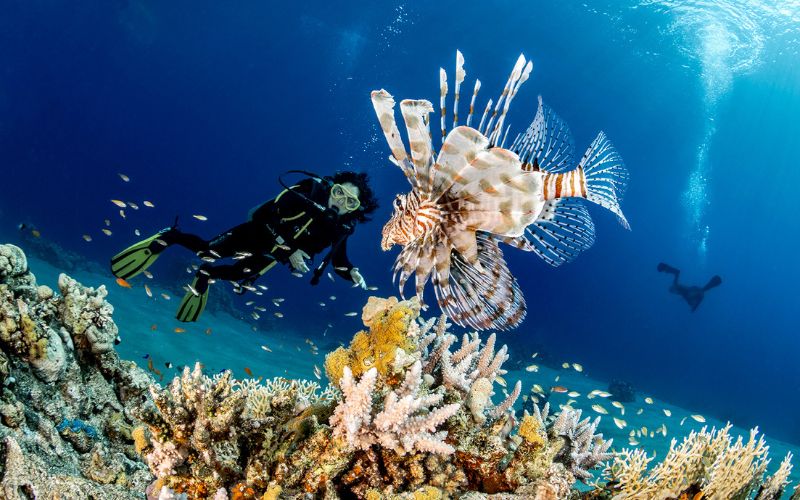
- Moray eels, lionfish, and scorpionfish.
- Blue-spotted rays and occasionally larger rays.
- Green turtles and hawksbill turtles.
- Nudibranchs, cleaner shrimp, and other macro life.
- Barracuda, trevally, and schooling reef fish.
- Reef sharks and offshore pelagic sharks.
- Dolphins and, in suitable seagrass habitats, occasional dugongs.
The likelihood of seeing particular animals varies dramatically by site and season.
A diver spending an entire vacation around shallow reefs should not expect the same wildlife opportunities as someone joining a specialized offshore expedition.
Wildlife encounters are never guaranteed, and reputable guides avoid promising specific sightings.
Famous historic shipwrecks
Egypt is also an important destination for wreck diving.
The northern Red Sea contains several well-known shipwrecks, including the SS Thistlegorm and the vessels around Abu Nuhas Reef.
These wrecks attract divers interested in maritime history, underwater photography, and the complex relationship between artificial structures and marine ecosystems.
Some wrecks are suitable for external observation at recreational depths. Others involve significant depth, overhead environments, sharp metal, entanglement hazards, or strong currents.
A recreational certification does not automatically qualify someone to enter a shipwreck.
Diving throughout the year
Unlike destinations with sharply limited diving seasons, much of the Egyptian Red Sea offers diving opportunities year-round.
Spring and autumn are particularly appealing because they often balance comfortable air temperatures with good underwater conditions.
Winter brings cooler water and sometimes challenging winds. Summer offers warmer seas but can be extremely hot on land.
The best season therefore depends on your priorities: water temperature, comfort, photography, marine life, or liveaboard routes.
Convenient combinations with cultural tourism
Another advantage is the possibility of combining scuba diving with Egypt’s major archaeological attractions.
A diving holiday in Hurghada or Sharm El Sheikh can be part of a longer trip featuring Cairo, Giza, Luxor, or Aswan.
For example, travelers can spend several days exploring archaeological sites before finishing their vacation beside the Red Sea.
Those arranging a mixed cultural and diving holiday may find the Egypt itinerary planning guide useful when deciding how many days to allocate to each region.
Best Scuba Diving in Sharm El Sheikh: Reefs, Walls and Historic Wrecks
Best for: first-time Red Sea visitors, certified recreational divers, coral enthusiasts, and wreck divers.
Sharm El Sheikh sits at the southern end of the Sinai Peninsula, close to the meeting of the Gulf of Aqaba and Gulf of Suez.
Its geographical position provides access to some of the most famous dive sites in Egypt.
The resort has a developed diving industry, a wide variety of accommodation, international air connections, and opportunities for both recreational training and advanced diving.
What makes Sharm especially attractive is the range of experiences available from one base.
A diver can spend one day exploring colorful reefs near the coast, another diving in the Straits of Tiran, and another visiting Ras Mohammed National Park.
Experienced divers can also arrange excursions to significant shipwrecks when conditions and operator schedules permit.
Ras Mohammed National Park: Egypt’s iconic reef diving
Ras Mohammed National Park is located near the southern tip of the Sinai Peninsula and is one of Egypt’s most celebrated marine protected areas.
Its underwater environment includes dramatic reef walls, coral-covered formations, and areas where currents carry nutrients through the reef system.
The most famous diving area includes Shark Reef and Yolanda Reef.
What makes it special?
At Shark Reef, divers can encounter steep walls decorated with coral and surrounded by colorful reef fish.
Nearby, Yolanda Reef offers a particularly unusual underwater attraction: cargo associated with the wreck of the Yolanda, including bathroom fixtures resting among coral formations.
This combination of marine life, dramatic scenery, and maritime history makes the area distinctive.
At certain times of year, large schools of fish gather around exposed sections of the reef. Such encounters can be spectacular, but their timing and density vary.
Who should dive here?
Many Ras Mohammed sites are most appropriate for comfortable certified divers, particularly where currents require drift diving.
The park also contains locations with gentler conditions, but the suitability of any specific dive depends on weather, the chosen route, and the individual diver.
A newly certified diver should not assume that every dive in Ras Mohammed is appropriate for their experience level.
Practical recommendation: Choose a dive center that explains the planned entry and exit points, current direction, maximum depth, and boat pickup procedure before entering the water.
Ras Mohammed is also a protected natural environment. Respecting park rules is essential.
Shark Reef and Yolanda Reef: Two different underwater experiences
Although often discussed together, these adjacent reefs deserve separate attention.
Shark Reef is particularly famous for its dramatic drop-off, reef scenery, and opportunities to observe schooling fish.
Yolanda Reef adds the distinctive wreck-related cargo scattered across the seabed.
A guided drift dive may combine sections of both reefs, depending on current direction and conditions.
Their appeal is not limited to large marine animals. Coral formations, anthias, and smaller reef creatures can make the dive memorable even when no sharks appear.
For photographers, the most rewarding moments may involve the contrast between coral-covered walls and open blue water.
Anemone City: A colorful Ras Mohammed reef
Anemone City is another well-known site in the Ras Mohammed area.
Its name reflects the abundance of sea anemones and their associated clownfish.
The reef also supports other marine species, making it particularly interesting for divers who enjoy observing fish behavior and coral habitats.
Depending on the route, Anemone City may be incorporated into a more demanding drift dive.
Its underwater beauty should not distract divers from the current or their position relative to the reef.
Best suited to: Certified divers comfortable with the day’s planned dive profile.
Main attraction: Anemones, reef fish, coral formations, and the possibility of a combined reef dive.
Planning tip: Ask whether the outing will focus on the sheltered portions of the reef or a more exposed drift route.
Straits of Tiran: Four famous reefs in one diving region
The Straits of Tiran lie near the entrance to the Gulf of Aqaba, northeast of Sharm El Sheikh.
Four principal reefs are especially well known:
- Jackson Reef
- Thomas Reef
- Woodhouse Reef
- Gordon Reef
Together, they provide an impressive range of coral landscapes, walls, slopes, and drift-diving possibilities.
The reefs are exposed to moving water, making conditions variable.
Some sections are appropriate for experienced recreational divers, while others may be too challenging for beginners.
Jackson Reef
Jackson Reef is particularly famous for its coral formations, walls, and pelagic fish encounters.
The underwater landscape includes slopes, coral-covered structures, and areas descending into deeper water.
Divers may encounter barracuda, trevally, and other large fish.
Shark sightings are possible but cannot be predicted reliably.
The reef’s exposed position means that the current, sea state, and selected dive route matter greatly.
Jackson Reef is a good example of why a site may be world-famous without being ideal for every diver.
Thomas Reef
Thomas Reef is relatively compact but offers dramatic underwater topography.
Its coral-covered walls and deeper formations attract experienced divers.
Some diving routes follow reef sections where depth increases quickly.
Technical divers may be interested in deeper geological features, but those environments require appropriate specialized training and planning.
Recreational divers should remain within their certification, gas, and no-decompression limits.
Woodhouse Reef
Woodhouse is an elongated reef where divers may experience substantial current.
Its underwater features include coral slopes, walls, and marine life associated with the exposed reef environment.
Because of the reef’s shape, drift diving can be an important part of the experience.
Conditions may differ between the northern and southern sections.
A carefully planned route can be rewarding, while the wrong conditions can make the same site unsuitable.
Gordon Reef
Gordon Reef is particularly recognizable for the wreckage of a ship above the waterline.
Underwater, the reef offers coral formations and a variety of fish.
Some areas are relatively approachable for certified recreational divers in favorable conditions.
Other sections may experience stronger current or require more experience.
For a traveler diving Tiran for the first time, Gordon Reef may provide a useful introduction when the chosen route is appropriate.
SS Thistlegorm: One of the world’s most famous wreck dives
The SS Thistlegorm is a British merchant ship that sank in the Red Sea in October 1941 during World War II.
The vessel was carrying military supplies, including vehicles and equipment.
Today, its submerged remains form one of the most historically fascinating dive sites in Egypt.
Motorcycles, trucks, railway equipment, and other cargo help tell the story of the vessel’s final voyage.
Marine organisms have colonized parts of the wreck, creating an unusual combination of history and underwater ecology.
Why do divers travel specifically to see the Thistlegorm?
Unlike a wreck where only the hull remains, the Thistlegorm still contains recognizable objects that help visitors understand its original purpose.
A diver observing the exterior can appreciate the vessel’s substantial size and structural features.
Properly trained wreck divers may also explore approved interior areas under suitable conditions and supervision.
However, entering enclosed spaces introduces significant hazards, including restricted exits, disorientation, silt, entanglement, and changing visibility.
Experience level: Experienced certified divers; additional wreck training is necessary for penetration.
Typical attraction: Historic cargo, ship structure, reef fish, and underwater photography.
Practical considerations: Boat journeys can be long, surface conditions variable, and suitable depths may exceed basic Open Water training limits.
Egypt’s Chamber of Diving and Water Sports published preservation guidance for visits to the SS Thistlegorm in October 2025. Divers should follow current operator briefings and avoid disturbing cargo or the wreck structure.
CDWS+1
Do not enter interior spaces without the required training, equipment, gas planning, and specialist supervision.
Is Sharm El Sheikh good for beginner scuba diving?
Yes. Sharm El Sheikh offers introductory scuba experiences, training courses, and sites suitable for newer divers.
However, its famous advanced locations should not define a beginner’s itinerary.
More sheltered reefs around the resort may be preferable for a first experience.
A suitable program should emphasize equipment familiarization, breathing techniques, equalization, buoyancy, and clear communication with an instructor.
A Discover Scuba Diving experience is not the same as earning an Open Water Diver certification.
Travelers who want to learn more about the destination before arranging their dive holiday can consult the Sharm El Sheikh travel guide.
Best Scuba Diving in Dahab: Shore Diving, Canyon and the Blue Hole
Best for: independent travelers, shore diving, underwater photography, diving courses, and technical diving specialists.
Dahab is located on the Gulf of Aqaba, north of Sharm El Sheikh.
Its diving culture is noticeably different from the large resort-based diving operations found elsewhere along Egypt’s Red Sea coast.
Many of Dahab’s best-known dive sites can be reached from shore.
This means divers can often avoid long boat journeys and spend more time exploring the underwater environment.
The area’s combination of accessible reefs, dramatic geological formations, and specialist diving centers has made Dahab internationally recognized.
Yet its reputation requires an important distinction.
Dahab has excellent beginner-friendly diving, but some of its most famous underwater features are associated with significant technical diving hazards.
Lighthouse Reef: A strong choice for training and relaxed dives
Lighthouse Reef is one of Dahab’s most accessible and useful dive sites.
It offers an environment suitable for learning, skills practice, and recreational exploration when conditions permit.
The underwater terrain includes sandy areas and reef formations supporting colorful marine life.
Divers may observe lionfish, moray eels, reef fish, and smaller creatures around the coral and rocky structures.
Its accessibility makes Lighthouse particularly appealing to travelers who want several dives without spending every day on a boat.
Why choose Lighthouse Reef?
It offers flexibility.
Instructors can select suitable training areas, while experienced divers may enjoy a relaxed dive focused on marine life or photography.
The site is also valuable for divers returning to scuba after a long break.
A refresher dive in familiar, manageable conditions can improve confidence before attempting more demanding locations.
The Canyon: Dahab’s dramatic underwater landscape
The Canyon is one of Dahab’s most distinctive dive sites.
Its underwater environment includes a sandy approach, coral formations, and a deep fissure in the reef.
The geological structure creates an extraordinary visual experience.
Light enters through openings, producing dramatic contrasts between illuminated water and darker rock formations.
However, the Canyon must be approached according to the diver’s training and experience.
The surrounding reef and sandy areas can offer rewarding diving without entering overhead environments.
Deeper or enclosed sections require appropriate specialist qualifications and conditions.
Best for: Certified divers interested in unusual underwater terrain.
Main attraction: Coral formations, underwater fissures, and distinctive lighting.
Important limitation: Not every route is suitable for recreational beginners.
The Blue Hole: Famous, beautiful and frequently misunderstood
Dahab’s Blue Hole is among the best-known underwater formations in the world.
It is a deep submarine sinkhole surrounded by reef structures.
Its circular shape and connection to the surrounding sea create a striking natural landmark.
Unfortunately, the Blue Hole is sometimes presented as though the most challenging route is the experience every visitor should attempt.
That is misleading.
Can recreational divers safely enjoy the Blue Hole area?
Yes, appropriately qualified recreational divers can explore suitable sections of the surrounding reef and approved routes within their limits.
The nearby Bells-to-Blue-Hole route is particularly well known among experienced divers.
However, the famous underwater Arch lies deep below ordinary recreational diving limits.
Attempting to reach or pass through it is a technical diving undertaking, not a recreational sightseeing activity.
The most rewarding Blue Hole experience for many divers is simply observing the outer reef and its marine life within a conservative dive profile.
Important safety distinction: A deep geological feature does not require a deep dive to appreciate it.
Avoid operators who encourage divers to exceed certification limits or treat extreme depths as an ordinary tourist experience.
Gabr El Bint: Dahab’s more remote reef experience
Gabr El Bint lies farther south of Dahab and is generally reached by organized boat excursions.
Its relative isolation gives it a different atmosphere from the town’s frequently visited shore dive sites.
The area is known for coral formations, reef walls, sea fans, and marine life.
Depending on the route, divers may encounter schooling fish, turtles, and attractive coral-covered slopes.
For travelers who have already explored Dahab’s accessible reefs, Gabr El Bint offers an appealing change of scenery.
It is particularly rewarding for divers who appreciate reef landscapes rather than concentrating exclusively on sharks or wrecks.
Who should choose Dahab instead of Sharm El Sheikh?
Choose Dahab if you prefer a relaxed diving atmosphere, independent travel, and frequent shore diving.
It also suits travelers interested in diving education or improving particular skills.
Choose Sharm El Sheikh if you want broader access to major boat-diving locations, luxury resort options, Ras Mohammed, and the Straits of Tiran.
Neither destination is universally better.
Dahab is especially appealing when the diving experience itself is central to the holiday, while Sharm offers a larger range of resort-based activities.
Best Scuba Diving in Hurghada: Coral Reefs, Islands and Accessible Dive Trips
Best for: beginners, certified recreational divers, families, diving courses, and travelers combining scuba with beach holidays.
Hurghada is one of the most accessible scuba diving destinations in Egypt.
Located on the western coast of the Red Sea, it has developed into a major tourism center with numerous hotels, marinas, diving operators, and international transport connections.
The diving experience differs from the dramatic offshore marine parks.
Many popular Hurghada sites offer coral gardens, reef slopes, sandy bottoms, and conditions suitable for recreational exploration.
This makes the area particularly attractive to people learning to dive or traveling with companions who prefer snorkeling and relaxation.
Giftun Islands: Classic Red Sea recreational diving
The Giftun Islands lie offshore from Hurghada and form an important part of the region’s marine tourism landscape.
The surrounding waters include coral reefs, colorful fish, and various diving and snorkeling areas.
Some locations offer relatively shallow reef environments suitable for beginners under appropriate supervision.
Others include deeper formations or conditions better suited to experienced divers.
What can you see?
Common marine life may include angelfish, butterflyfish, parrotfish, moray eels, and rays.
Coral formations create shelter for smaller fish, making the area enjoyable for underwater observation.
Giftun is especially appealing to travelers who want a balanced day of diving rather than an extremely demanding expedition.
Practical recommendation: Ask your diving operator which exact reef will be visited. Giftun refers to a broader island and reef area, not a single uniform dive site.
Small Giftun and surrounding reef systems
Some dives around the Giftun area involve gentle reef exploration, while others may feature more exposed walls or drift diving.
The right experience depends on the precise location.
An experienced diver may enjoy coral-covered slopes and deeper sections, while a beginner might benefit more from sheltered reef areas.
A well-organized dive center should separate groups according to experience rather than assuming that everyone aboard wants the same dive.
This matters particularly during busy holiday periods when a boat may carry divers with different certification levels.
Abu Nuhas: A fascinating concentration of shipwrecks
Abu Nuhas is a reef in the northern Red Sea famous for multiple shipwrecks.
Several vessels have come to rest along or near the reef, making it a major attraction for wreck-diving enthusiasts.
Well-known wrecks include the Giannis D and Carnatic, alongside other historic vessels.
Their different structures and histories create opportunities for varied underwater exploration.
Why is Abu Nuhas special?
Rather than visiting a single isolated wreck, experienced divers may explore multiple wreck sites during a suitable itinerary.
Each wreck offers a different visual environment.
Some have recognizable structural features and marine life growing around the remains.
Other sections require more experience because of depth, orientation, or penetration hazards.
Access depends on departure location, weather, and operator schedules.
Some trips are organized from Hurghada or El Gouna, while others are included in northern Red Sea liveaboard routes.
Best for: Certified divers with an interest in historic wrecks.
Important limitation: Different wrecks and different routes around the same wreck can require different qualifications.
El Gouna: A comfortable alternative base
El Gouna lies north of Hurghada and is known for its planned resort environment, marinas, and leisure facilities.
For divers, it offers access to northern Red Sea reefs and excursions organized by local operators.
It may suit travelers looking for a quieter resort atmosphere or a more upscale base while remaining close to diving opportunities.
El Gouna can also be convenient for mixed groups where some people want to dive and others prefer restaurants, beaches, or resort activities.
However, a hotel in El Gouna does not automatically make every northern Red Sea wreck easily accessible.
Check actual departure ports and boat journey times.
Why Hurghada works especially well for first-time divers
Hurghada combines established tourism infrastructure with a broad range of recreational dive sites.
A beginner can complete supervised introductory dives or pursue an entry-level certification without organizing a remote expedition.
Several practical advantages make it appealing:
- A wide choice of dive centers and training programs.
- Opportunities for multiple diving days from the same hotel.
- Snorkeling and beach activities for non-diving companions.
- Access to coral reefs without requiring a liveaboard.
- A variety of accommodation types and budgets.
Families can also combine diving with other Hurghada attractions and activities.
The main drawback is that popular areas can become busy, particularly during peak holiday periods.
Choosing a reputable operator with manageable group sizes can make a substantial difference to the experience.
Safaga, Soma Bay and El Quseir: Excellent Alternatives to Busy Resorts
Not every rewarding Egyptian diving destination needs the international reputation of Sharm El Sheikh or Hurghada.
The central Red Sea coast contains several appealing alternatives, especially for travelers who prefer dedicated diving holidays or quieter accommodation.
Safaga: Reef walls and serious recreational diving
Safaga lies south of Hurghada and offers access to impressive reef systems.
It is particularly attractive to experienced recreational divers interested in coral walls, drift diving, and relatively uncrowded excursions.
Panorama Reef is among the region’s best-known sites.
Its underwater terrain includes exposed coral formations, dramatic drop-offs, and marine habitats that may attract larger fish.
The conditions can vary substantially.
Some sections may have stronger currents than others, so the dive plan should reflect both the environment and participants’ experience.
Panorama Reef: One of Safaga’s signature dives
Panorama Reef is especially appealing to divers who enjoy dramatic underwater scenery.
Reef walls descend into deep water, while the upper areas support coral and reef fish.
Barracuda, schooling fish, and occasional larger marine animals can be encountered.
However, the presence of deep water means that depth control is essential.
Divers should follow a planned route rather than allowing good visibility to encourage an unintended descent.
Best for: Confident certified divers with suitable drift-diving experience.
Main attraction: Coral-covered walls, reef topography, and pelagic fish encounters.
Planning tip: Confirm whether the itinerary focuses on the northern or southern side of the reef and what currents are expected.
Soma Bay: Resort comfort with access to Red Sea reefs
Soma Bay is a resort destination along the central Red Sea coast.
It is attractive to travelers seeking comfortable accommodation, beach activities, and access to organized diving.
The available diving experiences depend on the specific operator and excursion route.
Some sites are suited to relaxed recreational diving, while more exposed reefs may require additional experience.
Soma Bay can be a practical choice for couples or families whose members have different interests.
El Quseir: A quieter coastal diving atmosphere
El Quseir is a historic coastal town between Safaga and Marsa Alam.
Its diving appeal comes partly from the possibility of shore-access reefs and a more relaxed environment.
The region includes reef systems where divers can focus on coral habitats, macro life, and underwater photography.
The precise diving experience depends on the dive center’s location and the condition of its house reef.
A hotel with reliable direct access to a healthy house reef may offer more practical diving value than a luxurious resort requiring long daily transfers.
For travelers who enjoy slower-paced holidays, El Quseir can be an excellent alternative to the larger resort cities.
Best Scuba Diving in Marsa Alam: Turtles, Dugongs and Offshore Reefs
Marsa Alam is one of Egypt’s most appealing destinations for divers who prioritize marine life and reef exploration.
Located farther south along the Red Sea coast, the region provides access to sandy bays, seagrass habitats, house reefs, and challenging offshore dive sites.
The distinction between these environments is important.
A traveler staying at a resort beside a sheltered bay may enjoy relaxed recreational diving, while an experienced diver departing for Elphinstone Reef may encounter strong currents and exposed open-water conditions.
Both experiences can be exceptional, but they require very different expectations.
Abu Dabbab Bay: One of Egypt’s best places for sea turtles
Abu Dabbab is especially famous for its seagrass habitats and green sea turtles.
The bay offers a different underwater experience from coral-dominated reefs.
Instead of spending the entire dive alongside dramatic walls, visitors may observe turtles feeding over the seagrass or explore nearby reef formations.
The relatively accessible setting can make the area suitable for newer certified divers in appropriate conditions.
Can you see dugongs at Abu Dabbab?
Dugongs have been recorded in the wider Marsa Alam region, and Abu Dabbab is frequently associated with possible sightings.
However, dugongs are wild, vulnerable marine mammals, and encounters are uncommon and unpredictable.
Travelers should never choose a dive trip on the assumption that a dugong sighting is guaranteed.
Turtles are generally a more realistic wildlife focus, although their presence and behavior still vary.
Responsible viewing matters. Maintain distance, avoid blocking an animal’s route to the surface, and never chase or touch marine life.
Divers should also take care not to damage seagrass beds with fins or uncontrolled buoyancy.
Marsa Shagra House Reef: Diving directly from the coast
Marsa Shagra is well known among divers who value convenient access to the reef.
A good house-reef setup allows certified divers to enjoy repeated dives without needing a full boat excursion every day.
The surrounding environment supports coral formations and a wide variety of marine life.
Divers may encounter turtles, rays, reef fish, and numerous smaller species.
For underwater photographers, having repeated access to the same reef offers an important advantage.
Different lighting conditions, animal behavior, and dive routes can produce very different experiences.
A diver who enjoys macro photography may spend an entire dive examining small reef creatures rather than searching for large animals.
Best for: Divers interested in reef photography, flexible schedules, and repeated shore dives.
Important consideration: Shore diving still requires appropriate planning, buddy procedures, emergency arrangements, and attention to currents.
Elphinstone Reef: One of Egypt’s premier advanced dive sites
Elphinstone is an exposed offshore reef near Marsa Alam.
It is internationally recognized for dramatic walls, coral formations, and opportunities to encounter pelagic marine life.
Unlike a sheltered bay, Elphinstone is strongly influenced by open-water conditions.
Currents can be powerful or unpredictable, making the reef unsuitable for inexperienced divers on challenging days.
The coral-covered walls are impressive even without large-animal encounters.
Schools of fish move around the reef, and the underwater landscape drops dramatically beyond the recreational diving zone.
What sharks can be seen at Elphinstone?
Oceanic whitetip sharks are among the most famous species associated with the area.
Hammerhead sharks may also be encountered, although sightings depend on seasonal and environmental factors.
The possibility of seeing sharks is a major attraction, but no responsible operator can guarantee an encounter.
What experience do you need?
Elphinstone is generally recommended for experienced advanced divers who are comfortable with currents, controlled descents, negative-entry procedures where appropriate, and blue-water ascents.
The exact qualifications and minimum logged dives depend on current operator requirements and the planned route.
Divers should be confident deploying a surface marker buoy and following the guide’s instructions for an unexpected separation.
A less experienced diver can still enjoy excellent scuba diving in Marsa Alam without visiting Elphinstone.
That is one of the region’s strengths.
Sha’ab Samadai: The famous Dolphin House area
Sha’ab Samadai, often called Dolphin House, is an important marine area near Marsa Alam.
It is known for spinner dolphins that use the area as a resting habitat.
The wider reef system also supports coral and marine life.
However, dolphin-focused excursions and scuba diving should not be treated as interchangeable activities.
Access, permitted activities, and interactions are subject to environmental management.
Some sections may be restricted or subject to specific rules designed to protect the dolphins.
What should travelers expect?
A well-managed excursion prioritizes the animals’ welfare rather than maximizing close encounters.
Visitors should not expect to swim freely among dolphins or approach resting groups.
The reef itself may provide rewarding underwater scenery where diving is permitted.
Before booking, confirm that the operator follows the current protected-area access rules.
Port Ghalib: A useful gateway for southern diving
Port Ghalib, near Marsa Alam International Airport, is an important departure point for many Red Sea liveaboard itineraries.
Its marina facilities make it convenient for travelers heading toward offshore reefs.
Depending on the vessel and route, trips may visit Elphinstone, Daedalus, the Brothers Islands, or locations farther south.
However, a liveaboard advertised as departing from Marsa Alam may actually use a marina some distance from the traveler’s hotel.
Always check the exact embarkation port.
For divers planning a longer expedition, choosing accommodation close to the departure point can reduce unnecessary transfers.
Who should choose Marsa Alam?
Marsa Alam is especially attractive to divers interested in marine life, relatively quiet resorts, and southern Red Sea exploration.
It works particularly well for:
- Turtle enthusiasts and underwater naturalists.
- Divers who enjoy house reefs.
- Couples seeking a quieter coastal holiday.
- Advanced divers targeting Elphinstone.
- Travelers joining southern liveaboard expeditions.
- Photographers interested in reefs and marine animals.
The main drawback is that attractions can be spread along a considerable stretch of coastline.
A hotel described as being in Marsa Alam may be far from another dive site in the same general region.
For that reason, the exact hotel and dive-center location matter more here than in many compact resort destinations.
Best Advanced Scuba Diving Sites in Egypt: Brothers, Daedalus and the Deep South
For experienced divers, Egypt’s offshore reefs offer some of the country’s most demanding and impressive underwater experiences.
These remote sites differ from resort diving in several important ways.
They are often exposed to wind and currents, may involve longer crossings, and frequently require divers to enter and exit the water using rigid inflatable boats.
The nearest coast may be a considerable distance away.
This makes proper experience, equipment, emergency planning, and operator selection particularly important.
Brothers Islands: Big Brother and Little Brother
The Brothers Islands, also known as El Akhawein, are two isolated islands in the Red Sea.
They are famous for steep reef walls, colorful corals, pelagic fish, and opportunities to encounter sharks.
Big Brother is particularly notable for its historic shipwrecks, including the Numidia and Aida.
Little Brother is known for dramatic reef formations and marine life around its exposed walls.
Why are the Brothers Islands special?
Their offshore location creates a very different diving environment from a sheltered coastal reef.
Water moves around the island structures, and marine animals use these exposed habitats.
Divers may see schooling fish, reef sharks, or other pelagic species.
The combination of reefs, walls, and shipwrecks makes the islands especially attractive to advanced divers.
However, the same conditions that make the diving exciting can also increase its difficulty.
Strong currents, rough seas, and blue-water ascents require confidence and experience.
How much experience is needed for the Brothers Islands?
Marine-park liveaboard itineraries commonly require advanced certification and a substantial number of logged dives.
Some operators specify at least 50 logged dives for routes visiting offshore marine parks such as the Brothers and Daedalus.
Requirements should be confirmed directly with the chosen operator because applicable regulations, route conditions, and company policies can differ.
Meeting a minimum number of logged dives is not enough by itself.
Recent diving experience, comfort with currents, buoyancy control, and emergency skills are equally important.
A diver with 100 easy, shallow dives is not necessarily better prepared for an exposed offshore reef than someone with fewer but more relevant dives.
Daedalus Reef: Remote walls and shark encounters
Daedalus Reef is a remote Red Sea reef known for its lighthouse, coral-covered walls, and potential encounters with large marine animals.
It is particularly popular among experienced divers who enjoy offshore environments.
Hammerhead sharks are one of the reef’s major attractions.
Other pelagic species may also be encountered, although wildlife sightings vary.
The underwater terrain features steep walls and reef formations descending into deep water.
What makes Daedalus challenging?
The exposed location means that wind, surface conditions, and current can significantly affect dive plans.
Divers may need to perform controlled entries, maintain close attention to their depth, and ascend into open water.
The ability to stay calm when a planned reef route changes is essential.
Daedalus is not an appropriate place to experiment with basic diving skills for the first time.
For a diver who has built the necessary experience, however, it can be one of the most rewarding destinations in Egypt.
Brothers vs. Daedalus: Which should you choose?
Both destinations offer exceptional advanced diving, but they have different attractions.
| Consideration | Brothers Islands | Daedalus Reef |
| Main appeal | Reef walls, sharks and wrecks | Remote reef walls and pelagic encounters |
| Historic wrecks | Major attraction at Big Brother | Not the principal attraction |
| Shark opportunities | Possible at exposed reefs | Known for potential hammerhead encounters |
| Access | Primarily liveaboards | Primarily liveaboards |
| Typical suitability | Advanced, experienced divers | Advanced, experienced divers |
| Conditions | Currents and exposed seas | Currents and exposed seas |
| Best choice for | Divers interested in reefs plus wrecks | Divers focused on offshore reef environments |
Many liveaboard itineraries combine both locations.
For appropriately qualified divers, a combined route can be an efficient way to experience several major offshore reefs during one vacation.
Fury Shoals: Coral exploration in the southern Red Sea
Fury Shoals is a collection of reefs in the southern Red Sea.
The area offers a varied underwater landscape, including coral gardens, reef walls, pinnacles, and swim-through formations.
Some sites are suitable for experienced recreational divers who prefer coral exploration to demanding shark dives.
Other sites may be more challenging.
The region is particularly appealing to photographers because different reef structures create interesting patterns of light and shadow.
Unlike an itinerary centered entirely on large pelagic animals, a Fury Shoals expedition can reward divers who enjoy examining reef details.
Sha’ab Claudia: Unusual reef structures and sunlight
Sha’ab Claudia is among the notable reefs associated with southern Red Sea diving.
Its underwater landscape includes channels and swim-through formations that can produce striking lighting effects.
The site is popular with photographers interested in coral architecture and illuminated underwater passages.
However, not all openings are equivalent.
Divers must distinguish between open swim-throughs suitable for their training and genuine overhead environments that may require specialist qualifications.
A beautiful passage is never a reason to enter a confined space without a safe exit strategy.
Best for: Divers comfortable with buoyancy control and reef navigation.
Main attraction: Coral formations, unusual underwater terrain, and natural light.
St. John’s Reefs: A remote southern underwater landscape
The St. John’s reef system lies in the southern Red Sea and is associated with liveaboard exploration.
It offers a combination of coral-covered structures, walls, and reef formations.
Some areas feature openings, caves, or swim-throughs that attract photographers and experienced divers.
St. John’s is not a single dive site with uniform conditions.
The suitability of each reef depends on its location, depth, currents, and planned route.
For divers seeking a quieter alternative to frequently visited northern sites, a carefully selected southern expedition can be especially rewarding.
Rocky Island: Exposed offshore diving
Rocky Island is known for steep underwater walls and an exposed marine environment.
Its offshore setting makes it attractive to divers interested in pelagic marine life and dramatic reef structures.
However, conditions can be demanding.
Strong currents and variable sea states mean that dive plans require flexibility.
Rocky Island is generally more appropriate for experienced divers joining suitable liveaboard itineraries.
It is not a destination to select solely because a photograph of a shark looks appealing.
Zabargad Island: Reef diving and remote scenery
Zabargad Island is another notable destination in the southern Red Sea.
The surrounding waters support reef habitats and opportunities for underwater exploration.
Some liveaboard routes combine Zabargad with Rocky Island and St. John’s Reefs.
The appeal of such a route comes from variety.
Divers can experience different reef structures and marine habitats during one expedition.
However, the remote location makes itinerary planning and vessel safety particularly important.
Are Egypt’s remote reefs worth the extra expense?
For advanced divers who enjoy exposed reef environments, they often are.
The opportunity to visit multiple offshore sites without returning to shore each evening can be a major advantage.
However, an expensive liveaboard does not automatically provide a better experience than excellent resort diving.
Someone who enjoys relaxed photography, shore access, and flexible schedules may be happier in Marsa Alam or Dahab.
The right choice depends on what you want to experience underwater, not the prestige of the itinerary.
Best Scuba Diving in Egypt for Beginners
Egypt is an excellent place to learn scuba diving because numerous established dive centers offer entry-level training and access to comparatively sheltered underwater environments.
However, beginners should focus on the quality of the instruction rather than the reputation of the most famous dive site.
Which destination is best for learning to scuba dive?
Three particularly practical choices are Hurghada, Sharm El Sheikh, and Dahab.
Hurghada is attractive for learners who want to combine diving with a conventional resort holiday. Many operators organize supervised introductory experiences and certification courses.
Sharm El Sheikh offers an extensive diving industry and opportunities to progress from sheltered training sites to more varied recreational diving.
Dahab is especially useful for travelers who appreciate shore diving and a focused diving atmosphere.
Marsa Alam can also be suitable when a resort has a well-managed, beginner-friendly house reef and qualified instructors.
Discover Scuba Diving or Open Water certification?
These are different experiences.
| Program | What it means | Best for |
| Discover Scuba Diving | A supervised introductory scuba experience, not a full certification | Visitors who want to try scuba |
| Open Water Diver course | Entry-level certification involving theory, confined-water skills and open-water training | Travelers who want to become independent certified recreational divers |
| Scuba refresher | Review of essential skills and equipment use | Certified divers returning after a break |
| Advanced Open Water training | Further experience and skills under instructor supervision | Certified divers ready to expand their training |
| Specialty training | Focused training in skills such as buoyancy, wreck or drift diving | Divers with specific goals |
Course requirements, minimum ages, instructor-to-student ratios, and permitted depths depend on the relevant training agency’s standards and applicable local rules.
Before booking, establish exactly which qualification you will receive.
How many days should you allow for scuba training?
An entry-level Open Water course commonly takes several days, depending on the training structure, agency requirements, and individual progress.
Some programs allow students to complete theory before arriving in Egypt.
This can make a diving holiday more efficient, although practical training and assessments still take time.
Avoid scheduling the entire course into an inflexible itinerary with no room for weather changes, extra skills practice, or medical clearance.
If you have only one free afternoon, an appropriate supervised introductory experience may make more sense than attempting a full certification.
Five signs of a good beginner diving experience
- The instructor explains the program and medical requirements before the dive.
- Equipment is properly fitted and essential skills are practiced.
- The chosen environment is appropriate for the student’s comfort and ability.
- Group size allows adequate instructor attention.
- The participant is never pressured to continue when uncomfortable.
A professional instructor should be willing to answer questions about equalization, breathing, buoyancy, equipment use, and emergency procedures.
The goal is not to descend as quickly or as deeply as possible.
It is to develop confidence, competence, and a lasting appreciation for the underwater environment.
Which Diving Destination in Egypt Is Best for Your Experience Level?
The best way to choose a location is to consider four factors: certification, recent experience, environmental conditions, and personal interests.
A destination may be famous for advanced diving but still offer suitable alternatives for beginners.
Similarly, a region known for easy diving may contain demanding reef walls or wrecks.
| Diver profile | Recommended base | Suitable experience |
| First-time scuba participant | Hurghada or Sharm El Sheikh | Supervised introductory dive |
| New Open Water Diver | Hurghada, Dahab, or sheltered Sharm sites | Shallow reef diving |
| Certified diver returning after a break | Dahab or Hurghada | Refresher and easy reef dives |
| Intermediate recreational diver | Sharm El Sheikh or Safaga | Varied reefs and suitable drift dives |
| Advanced wreck enthusiast | Sharm El Sheikh or northern liveaboard | Thistlegorm and Abu Nuhas |
| Experienced shark enthusiast | Marsa Alam or offshore liveaboard | Elphinstone, Brothers and Daedalus |
| Underwater photographer | Dahab, Marsa Alam or Sharm | Reefs, macro life, walls and wrecks |
| Technical diving specialist | Qualified technical operator in Dahab or another approved location | Specialist dives within technical qualifications |
| Family with divers and non-divers | Hurghada or Sharm El Sheikh | Diving, snorkeling and resort activities |
For underwater photographers
The ideal site depends on what you want to photograph.
For wide-angle reef photography, Ras Mohammed and the Straits of Tiran offer dramatic coral formations.
For wreck photography, the SS Thistlegorm and Abu Nuhas provide recognizable structures.
For macro life, suitable house reefs around Dahab and Marsa Alam can be highly rewarding.
For large marine animals, experienced divers may consider Elphinstone and offshore reefs.
However, clear visibility does not replace stable buoyancy.
A photographer who repeatedly contacts coral or stirs sediment can damage the habitat and spoil the experience for others.
For travelers who are uncomfortable on boats
Dahab and carefully selected Marsa Alam house reefs may be particularly appealing.
They offer opportunities for shore diving that can reduce time spent at sea.
However, shore access does not necessarily eliminate current, waves, difficult exits, or other hazards.
Check the specific conditions with the operator.
For travelers interested in sharks
The offshore reefs around Elphinstone, the Brothers Islands, and Daedalus may be attractive.
These locations require careful consideration of skill level and season.
Shark encounters are wildlife observations, not guaranteed tourist activities.
Divers should follow the guide’s instructions, maintain appropriate distances, and avoid behavior that could disturb marine animals.
For divers traveling with family members
Hurghada and Sharm El Sheikh are often practical because non-divers have many alternative activities.
Some resorts also allow snorkeling and diving excursions to be organized on the same day, although not every boat or site is suitable for both activities.
Families should verify children’s age requirements, equipment availability, and supervision arrangements.
For more ideas beyond diving, explore Egypt with kids and its wider family-travel possibilities.
Best Time for Scuba Diving in Egypt in 2027
The best overall months for scuba diving in Egypt are generally March to May and September to November.
These periods often provide an appealing balance of water temperature, air temperature, visibility, and diving conditions.
However, there is no single month that is ideal for every destination or diving objective.
The best time to visit depends on whether you prioritize comfortable water temperatures, quieter dive boats, offshore expeditions, or particular marine species.
Egypt scuba diving seasons compared
| Season | Approximate water conditions | Advantages | Considerations |
| December–February | Cooler, often around 21–24°C | Good winter diving and comfortable sightseeing weather | Wind, cooler water and rough offshore crossings |
| March–May | Gradually warming, often around 22–26°C | Comfortable spring conditions and varied diving | Busy periods and changing winds |
| June–August | Warmest period, often around 26–29°C | Warm water and opportunities for summer pelagic encounters | Intense daytime heat and site-specific currents |
| September–November | Generally warm, gradually cooling | Excellent balance of diving and surface comfort | Popular diving period and variable offshore conditions |
These temperature bands are approximate planning guides, not guarantees for individual locations. Actual readings vary by region, year, and depth.
Scuba diving in Egypt during winter
Winter is a useful season for divers who also want to explore Egypt’s ancient sites.
Air temperatures around the Red Sea are generally more comfortable for sightseeing than during the hottest summer months.
Underwater, however, the sea can feel significantly cooler, particularly after repeated dives.
A suitable wetsuit, hood when necessary, and wind protection aboard the boat can improve comfort.
Wind is an important consideration.
Even when visibility is good underwater, surface conditions may make offshore excursions uncomfortable or unsuitable.
Divers joining winter liveaboards should allow for route changes caused by weather.
Scuba diving in Egypt during spring
March, April, and May offer a particularly attractive combination of conditions.
The air becomes warmer, while the sea gradually gains heat after winter.
Spring can suit both recreational divers and travelers interested in combining diving with cultural sightseeing.
However, conditions are not uniformly calm.
Wind and changing currents can affect particular sites, and some offshore reefs may be challenging.
For a first diving holiday in Egypt, late spring can be a sensible choice when the water is warming and the most intense summer heat has not yet arrived.
Scuba diving in Egypt during summer
Summer brings the warmest sea temperatures.
For divers who dislike cold water, this can be appealing.
The Red Sea’s underwater environment remains attractive, and certain pelagic species may be encountered during warmer months.
However, high air temperatures can make time on the boat or outdoor transfers uncomfortable.
Hydration, shade, and appropriate sun protection become especially important.
Divers should avoid assuming that warm water means calm conditions.
Currents, wind, and exposed reef environments still require careful planning.
Scuba diving in Egypt during autumn
September, October, and November are among the most appealing months for Red Sea diving.
The sea retains much of its summer warmth, while the air becomes more comfortable.
This combination is especially attractive to travelers from colder climates.
Autumn can also be an interesting period for certain shark encounters in the southern Red Sea.
Nevertheless, animal behavior changes from year to year, and sightings cannot be promised.
Popular diving destinations and liveaboards may attract significant demand during this period.
For a detailed overview of the country’s seasons beyond the Red Sea, consult the best time to visit Egypt.
When is the best season to see sharks in Egypt?
There is no single shark season that applies equally to all species or dive sites.
Hammerhead opportunities are often associated with warmer months at some offshore reefs.
Oceanic whitetip encounters may be more prominent during autumn and parts of the cooler season in certain southern locations.
PADI identifies June to September as an important period for hammerhead opportunities in Egyptian waters, while noting that seasonal marine life encounters are variable.
PADI Travel+1
For travelers specifically interested in sharks, the practical approach is to choose the species and region first, then ask an experienced local operator about recent seasonal patterns.
Even with excellent timing, a trip may produce no shark sightings.
The coral reefs and other marine life should remain part of the reason for visiting.
How Much Does Scuba Diving in Egypt Cost in 2027?
Scuba diving prices in Egypt depend on the location, certification level, equipment requirements, type of excursion, and operator.
A two-dive day boat from Hurghada may cost significantly less than a specialized wreck trip or remote offshore liveaboard expedition.
Prices also vary according to whether the quote includes equipment, transportation, meals, national park charges, and other extras.
Published prices to help plan a 2027 budget
The following examples reflect publicly advertised 2026 operator rates and recent liveaboard listings. They are planning references, not confirmed 2027 prices.
| Diving activity | Published price examples | Important exclusions or variations |
| Hurghada two-dive day | Approximately €40–€70 | Equipment, transfers and park fees may be extra |
| Sharm El Sheikh two-dive day | Approximately €80–€95 | Equipment, meals and park fees vary |
| Introductory scuba experience | Approximately €45–€100 | Duration and number of actual dives differ |
| Open Water certification | Approximately €330–€350 in selected published offers | Check course materials, certification and equipment |
| Advanced Open Water course | Approximately €250–€260 in selected offers | Check prerequisites and included materials |
| Seven-night Red Sea liveaboard | Roughly US1,000–US1,800 for many advertised departures | Higher-priced options, supplements and fees are common |
The ranges above draw on selected dive-center price lists and a liveaboard pricing review from October 2026. They are not official national averages and should not be treated as fixed quotations.
Mina Diving in Hurghada+3
What is usually included in a diving excursion?
A standard certified-diver boat excursion may include:
- Boat transportation to the dive sites.
- A qualified dive guide.
- Scuba cylinder and weights.
- Two planned dives.
- Drinking water or refreshments.
- Lunch on longer excursions.
- Hotel pickup within a specified area.
However, inclusions vary considerably.
Some operators charge separately for complete scuba equipment, dive computers, additional cylinders, marine park permits, or transfers from distant resorts.
A price that initially appears cheap may become less attractive once the full package is calculated.
Common extra expenses
When comparing diving offers, ask about:
Equipment rental: Does the quote include a regulator, buoyancy compensator, wetsuit, mask, fins, and dive computer?
Marine park charges: Are applicable environmental or protected-area fees included?
Special excursions: Do premium sites such as the Thistlegorm require additional payments?
Nitrox: Is enriched air available, and what is the cost per cylinder?
Transfers: Is pickup included from the actual hotel, or only from central resort areas?
Insurance: Does the operator require separate diving accident coverage?
Course fees: Are digital learning materials and certification charges included?
Gratuities: Are crew tips customary or already included?
The most reliable comparison is the total price for the same diving experience with equivalent inclusions.
Is Hurghada cheaper than Sharm El Sheikh for diving?
Hurghada frequently offers competitively priced recreational diving packages.
Its extensive selection of operators can make it attractive to budget-conscious travelers.
However, the cheapest advertised price is not necessarily the best value.
Sharm El Sheikh may be worth the additional expense for someone whose priority is Ras Mohammed, Tiran, or a particular northern wreck excursion.
Likewise, a traveler who values shore diving may find Dahab more practical.
Choose the destination based on the desired dive sites first, then compare operators and prices.
How much should you budget for five days of diving?
A certified diver taking two recreational dives per day can compare five-day packages rather than booking individual days separately.
Using published 2026 Hurghada examples, some five-day packages for ten dives were advertised at approximately €200–€300 before various possible extras.
The final cost depends on equipment rental, any park charges, transportation, and the selected dive center.
For Sharm El Sheikh, published multi-day packages may cost more.
A traveler planning a five-day diving holiday should also budget for accommodation, meals not included in the package, and a non-diving interval before flying home.
Is a Red Sea liveaboard worth the money?
A liveaboard can offer excellent value for experienced divers who want to reach multiple remote sites.
The price typically covers accommodation aboard the vessel and a planned diving itinerary, although exact inclusions differ.
The main benefit is logistical.
Rather than returning to a hotel after every diving day, the boat travels between locations and provides access to reefs that may be impractical for ordinary day trips.
However, costs should be assessed carefully.
Marine park supplements, equipment rental, nitrox, transfers, crew gratuities, and other charges may be separate.
A liveaboard is not automatically cheaper than resort diving, especially for travelers who only want a few relaxed dives.
Red Sea Liveaboard vs. Resort Diving: Which Is Better?
This is one of the most important decisions for certified divers planning a longer holiday in Egypt.
Both options can provide excellent experiences, but they suit different travel styles.
| Factor | Resort or land-based diving | Red Sea liveaboard |
| Accommodation | Hotel, resort or guesthouse | Cabin aboard the dive vessel |
| Dive site access | Shore dives and day-boat routes | Multi-day routes, including remote reefs |
| Daily flexibility | Usually greater | Limited by vessel schedule |
| Suitable for beginners | Often yes, with appropriate programs | Many routes require substantial experience |
| Non-diving activities | Restaurants, beaches and excursions | Primarily boat-based |
| Number of dives | Selected daily schedule | Often multiple planned dives per diving day |
| Weather disruption | Alternative shore or local activities may be available | Entire itinerary may change |
| Best for | Mixed holidays and flexible diving | Dedicated diving expeditions |
Why choose resort diving?
Resort diving allows travelers to combine underwater exploration with a conventional vacation.
You can choose to dive for several days and spend the remaining time enjoying beaches, restaurants, or sightseeing.
This is particularly useful for couples where only one person is a diver.
It is also a good option for beginners, recently certified divers, and people who prefer to sleep on land.
A suitable resort location can provide access to dive centers while allowing greater flexibility.
Why choose a liveaboard?
A liveaboard is ideal for divers who want the majority of their vacation to revolve around diving.
Experienced participants may visit multiple reef systems during a single journey.
This can include wrecks, coral walls, and remote marine parks.
However, a liveaboard involves a more structured schedule.
Wake-up times may be early, meals are organized around diving, and participants spend considerable time aboard the vessel.
Cabin space is more limited than in many hotels.
Weather conditions can also influence both comfort and the planned route.
Best Egyptian liveaboard routes
Northern Red Sea wrecks and reefs
Northern itineraries commonly emphasize historic wrecks and reef diving.
Depending on the route, destinations may include the Thistlegorm, Abu Nuhas, and reefs near the Straits of Tiran.
These trips appeal to experienced divers who enjoy wreck photography and maritime history.
Brothers, Daedalus and Elphinstone
Often abbreviated to BDE, this is a popular route for advanced divers interested in offshore reefs and pelagic life.
The itinerary can involve challenging conditions and long distances from shore.
It is inappropriate for divers who lack the necessary experience.
Southern Red Sea and Fury Shoals
Southern routes may focus on coral formations, reef structures, and a combination of sheltered and exposed locations.
The experience can be especially appealing to photographers and divers interested in coral environments.
St. John’s, Rocky and Zabargad
These itineraries emphasize remote southern reef systems.
They generally require greater commitment and flexibility than a typical resort-based diving holiday.
Exact destinations depend on vessel schedules, permits, weather, and the operator.
Questions to ask before booking a liveaboard
A responsible operator should be able to explain the following:
- What certification and minimum experience are required?
- Which reefs are planned, and what alternative routes are available?
- How many dives are normally scheduled each day?
- What are the expected current, depth, and surface conditions?
- Is nitrox available, and what training is required?
- What emergency oxygen, communications, and rescue arrangements are aboard?
- Where does the vessel depart, and when must passengers arrive?
- Which permits, park charges, equipment rentals, and supplements are extra?
- What happens if weather prevents the planned itinerary?
- What evacuation and diving insurance requirements apply?
A professional operator should provide clear information rather than vague promises of guaranteed wildlife encounters.
How to Combine Scuba Diving with an Egypt Vacation
A diving holiday does not need to exclude Egypt’s archaeological sites and cultural attractions.
With appropriate planning, travelers can enjoy both experiences during one trip.
The main challenge is geography.
Egypt’s major historical attractions are concentrated around Cairo, Luxor, and the Nile Valley, while the most famous diving destinations lie along the Red Sea and Sinai coastlines.
Trying to visit too many regions in a short period can create unnecessary transfers.
Five-day Red Sea diving itinerary
Best for: Travelers mainly interested in recreational scuba diving.
Recommended base: Hurghada or Sharm El Sheikh.
| Day | Suggested activity |
| Day 1 | Arrive, settle into the resort and organize diving documentation |
| Day 2 | Refresher or introductory reef dives appropriate to experience |
| Day 3 | Two guided recreational dives |
| Day 4 | Visit additional suitable reefs or complete training |
| Day 5 | Non-diving relaxation, sightseeing and departure planning |
This itinerary is particularly suitable for travelers who want to dive without constantly changing hotels.
The final dive must be scheduled with sufficient time before any flight.
Seven-day Sharm El Sheikh diving itinerary
Best for: Certified divers seeking varied northern Red Sea experiences.
Day 1: Arrival in Sharm El Sheikh
Check into accommodation, organize equipment, review certification documentation, and confirm the diving schedule.
Day 2: Local reef diving
Begin with manageable dives that allow you to become familiar with your equipment and the Red Sea’s conditions.
Day 3: Ras Mohammed National Park
Explore suitable reef sites according to your experience and the day’s currents.
Day 4: Straits of Tiran
Enjoy a guided reef-diving excursion, with the precise reefs selected according to weather and operator plans.
Day 5: Specialized diving day
Experienced, appropriately qualified divers may consider a Thistlegorm excursion.
Other participants can select alternative reef dives or additional training.
Day 6: Flexible final diving or non-diving day
The schedule should depend on departure timing and the required post-dive surface interval.
Day 7: Departure
Travel home after allowing an appropriate interval since the last dive.
The itinerary intentionally leaves flexibility because wind, currents, and weather can affect particular sites.
Seven-day Marsa Alam itinerary
Best for: Marine-life enthusiasts and travelers who prefer a quieter coastal atmosphere.
Day 1: Arrival and resort check-in.
Day 2: Check dive and exploration of a suitable house reef.
Day 3: Abu Dabbab Bay or another appropriate coastal reef.
Day 4: Additional shore or boat diving, with emphasis on marine life observation.
Day 5: Experienced advanced divers may consider Elphinstone if conditions and operator requirements permit. Other travelers can choose a more sheltered alternative.
Day 6: A flexible day for suitable diving, snorkeling, or rest, depending on the upcoming flight schedule.
Day 7: Departure.
This itinerary works especially well when accommodation is selected close to the planned diving locations.
Otherwise, long coastal transfers can reduce the amount of time available for relaxation.
Ten-day Egypt history and diving itinerary
Best for: International visitors interested in both Ancient Egypt and the Red Sea.
| Day | Destination | Main experience |
| 1 | Cairo | Arrival and hotel check-in |
| 2 | Cairo and Giza | Pyramids and historical attractions |
| 3 | Cairo | Museums and cultural sightseeing |
| 4 | Luxor | Transfer and major temple visits |
| 5 | Luxor | West Bank archaeological attractions |
| 6 | Red Sea | Transfer to Hurghada or another suitable coastal base |
| 7 | Red Sea | Introductory or recreational diving |
| 8 | Red Sea | Additional guided diving |
| 9 | Red Sea | Relaxation and appropriate preflight surface interval |
| 10 | Departure | Return journey |
This is a sample framework, not a fixed tour schedule.
Transfer times, flight availability, and diving conditions should determine the final order.
Some travelers may prefer to spend fewer days in Cairo and more time diving.
Others may want additional sightseeing or a longer Nile Valley stay.
For a personalized combination of archaeology, resort accommodation, and Red Sea activities, Egypt tailor-made holidays can provide a starting point for discussing the overall itinerary.
Should you dive before or after visiting Luxor?
Either sequence can work, but altitude and flying considerations matter.
For many travelers, visiting Luxor and other historical attractions before the final Red Sea diving stay is convenient.
It allows time to enjoy sightseeing without worrying about recently completed dives.
If diving comes first, you must account for any subsequent flights or significant altitude changes during land travel.
This is particularly important when traveling inland from the coast.
Do not assume that a road transfer is automatically irrelevant to decompression safety.
The route’s altitude and the timing of the previous dives can matter.
Is Scuba Diving in Egypt Safe in 2027?
Scuba diving in Egypt can be a safe and enjoyable activity when conducted within appropriate training and experience limits, with properly maintained equipment and professional supervision.
However, scuba diving always involves risks.
Water conditions, equipment problems, medical issues, poor judgment, and inadequate emergency preparation can lead to serious incidents.
No destination or dive operator can eliminate these risks entirely.
For travelers visiting Egypt in 2027, the most important decision is choosing a properly authorized and safety-conscious diving provider.
Choose a properly registered diving center
Egypt’s Chamber of Diving and Water Sports (CDWS) has an important role in standards and oversight for diving and water-sports activities.
When evaluating an operator, check its current authorization and relevant certifications.
Do not assume that a shop is properly licensed simply because it has a professional website or positive online reviews.
A reliable operator should be willing to provide information about its qualifications, procedures, and equipment maintenance.
It should also explain the experience requirements for specific dive sites.
The CDWS publishes standards and technical requirements for recreational diving centers and safari boats, including updates relevant to diving operations.
CDWS+1
What should you check before booking?
Ask the dive center about the following:
- Current operating authorization and professional qualifications.
- Instructor or divemaster certifications.
- Equipment inspection and maintenance procedures.
- Availability of emergency oxygen and first-aid equipment.
- Boat safety equipment and emergency communications.
- Emergency evacuation procedures.
- Maximum group sizes and instructor-to-diver ratios.
- Requirements for certification and recent diving experience.
- Medical declarations and fitness-to-dive procedures.
- Diving accident insurance requirements.
- Policies for cancelling dives when conditions are unsuitable.
An operator who refuses to discuss safety procedures is not a good choice.
What certifications are required?
Requirements depend on the dive site, planned depth, type of dive, and operator.
A basic Open Water certification allows recreational diving within the limits of that qualification and the relevant training agency’s standards.
More advanced activities may require additional training.
These include deep diving, wreck penetration, challenging drift diving, technical diving, and certain offshore liveaboard expeditions.
A higher certification level does not remove the need for recent practical experience.
For example, an Advanced Open Water qualification obtained several years ago does not necessarily prepare a diver for a challenging offshore expedition without subsequent practice.
How many dives should you have before visiting advanced sites?
Some Red Sea operators require a minimum of 50 logged dives for particular offshore marine park itineraries.
Other routes may have different requirements.
These numbers should be treated as eligibility requirements where applicable, not proof of actual competence.
A diver preparing for challenging offshore locations should be comfortable with:
- Buoyancy control throughout the dive.
- Maintaining position in current.
- Controlled descents and ascents.
- Monitoring gas supply and dive-computer information.
- Deploying a surface marker buoy.
- Following established buddy procedures.
- Managing unexpected changes to a dive plan.
- Responding calmly to equipment or environmental problems.
If these skills are unfamiliar, additional training and practice at sheltered sites are a better preparation than booking a demanding expedition immediately.
Flying after scuba diving in Egypt
One of the most important planning considerations is the interval between the final dive and flying.
Flying too soon after diving can increase decompression stress.
Divers Alert Network provides the following minimum suggested surface intervals for common circumstances:
| Dive history | Suggested minimum interval before flying |
| One no-decompression dive | At least 12 hours |
| Multiple dives in one day | At least 18 hours |
| Multiple days of no-decompression diving | At least 18 hours |
| Dives requiring decompression stops | Longer than 18 hours, based on dive profile and specialist guidance |
These are minimum general recommendations, not guarantees of safety. DAN also explains that ascending to higher altitude by land can increase decompression stress.
Divers Alert Network+1
Many divers choose more conservative intervals, particularly after repeated diving.
Follow applicable training guidance, your dive computer, medical advice, and the specific recommendations of your dive operator.
For an international flight, arranging a full non-diving day before departure may be a practical planning choice.
Diving insurance and medical considerations
Ordinary travel insurance does not necessarily cover scuba diving accidents.
Before departure, verify that your insurance includes the specific activities you intend to undertake.
Important coverage may include emergency medical treatment, evacuation, and hyperbaric treatment where applicable.
Read the policy exclusions carefully, especially those concerning maximum depth, technical diving, and certification.
You may also need to complete a diving medical questionnaire.
Travelers with relevant medical conditions, symptoms, or medications should obtain appropriate medical advice before diving.
Do not conceal medical information to avoid delays or additional paperwork.
Can you scuba dive in Egypt without knowing how to swim?
A supervised introductory program may have different entry requirements from a full certification course.
However, water confidence and the ability to follow instructions are important.
Some introductory experiences may be available to people with limited swimming ability, subject to the training agency’s rules and the instructor’s assessment.
A full Open Water certification generally includes specific swimming and water-survival requirements.
Never assume that an introductory scuba experience eliminates all swimming-related risks.
If you are uncomfortable in the water, discuss this openly with the dive center before booking.
What about sharks?
Sharks are part of the natural Red Sea ecosystem.
Certain sites are known for possible shark encounters, particularly in offshore waters.
Divers should treat these encounters with respect and follow current professional guidance.
Do not chase, touch, feed, or deliberately provoke sharks.
Operators should assess current conditions and any relevant official advisories before conducting activities.
Wildlife encounters should always be approached conservatively.
What happens if the weather is unsuitable?
A professional dive operator should be prepared to modify or cancel diving plans when environmental conditions are inappropriate.
Possible alternatives include switching to sheltered reefs, changing departure times, or postponing the excursion.
For liveaboard trips, route adjustments can be more substantial.
Travelers should understand the cancellation and refund policy before booking.
A cancelled dive may be disappointing, but it is preferable to an avoidable incident caused by proceeding in unsafe conditions.
How to Travel to Egypt’s Best Scuba Diving Destinations
International travelers can reach Egypt’s major diving regions through a combination of flights and ground transfers.
The best arrival airport depends on the selected destination.
Airports for the main Red Sea diving areas
| Diving base | Common airport choice | Additional considerations |
| Sharm El Sheikh | Sharm El Sheikh International Airport | Convenient for Sharm resort areas |
| Dahab | Sharm El Sheikh International Airport | Requires a road transfer |
| Hurghada | Hurghada International Airport | Convenient for Hurghada and nearby resorts |
| El Gouna | Hurghada International Airport | Requires a transfer north of Hurghada |
| Safaga and Soma Bay | Hurghada International Airport | Road transfer depends on hotel location |
| El Quseir | Hurghada or Marsa Alam International Airport | Choose according to the exact resort |
| Marsa Alam | Marsa Alam International Airport | Coastal transfers can still be substantial |
| Port Ghalib | Marsa Alam International Airport | Convenient for many liveaboard departures |
Flight schedules and routes may change before 2027.
Travelers from the United States, Canada, Australia, and some European markets may need connecting flights.
The most efficient route depends on the departure city, travel dates, and available airline services.
Should you fly into Cairo first?
Flying into Cairo can make sense if your holiday includes the pyramids, museums, and other cultural attractions.
However, it is not always the most efficient option for a trip focused entirely on scuba diving.
If convenient flights are available directly to Sharm El Sheikh, Hurghada, or Marsa Alam, arriving near the diving base can reduce transfers.
For a combined cultural and diving holiday, Cairo may be a useful entry point.
Do you need a visa for a scuba diving holiday in Egypt?
Visa requirements depend on nationality, passport type, purpose of travel, and itinerary.
Certain travelers may be eligible for an electronic visa or visa-on-arrival arrangements, while others must obtain permission in advance.
Some Sinai-specific entry arrangements have geographical and duration restrictions.
Travelers should not assume that permission to stay in a particular Sinai resort area automatically authorizes travel throughout Egypt.
Review the appropriate requirements before departure using the Egypt visa requirements guide and confirm the current rules through official Egyptian authorities.
What should divers pack for Egypt?
Essential items depend on whether you rent equipment or bring your own.
A practical diving travel checklist includes:
- Passport and relevant travel documentation.
- Diving certification card or recognized digital credential.
- Logbook or digital record of diving experience.
- Diving accident insurance details.
- Relevant medical clearance documentation.
- Personal mask and other familiar equipment.
- Dive computer.
- Suitable exposure protection.
- Surface marker buoy where required.
- Reef-conscious sun protection.
- Reusable water bottle.
- Hat, sunglasses, and light clothing.
- Appropriate protection against wind after diving.
Divers bringing their own equipment should also check airline baggage rules.
Do not assume that all diving equipment can be transported in checked or carry-on luggage without restrictions.
For general luggage preparation, see the Egypt packing guide.
Responsible Scuba Diving: How to Protect Egypt’s Red Sea Reefs
Egypt’s coral reefs are among the country’s most valuable natural attractions.
They also face environmental pressures associated with human activity, coastal development, pollution, climate change, and other factors.
Responsible diving helps reduce avoidable local damage.
Maintain good buoyancy
Uncontrolled buoyancy can damage fragile coral structures.
Divers should avoid dragging fins, hoses, gauges, or other equipment across the reef.
Proper weighting and trim help maintain a safe distance from the seabed.
This is particularly important during photography.
Never touch or collect coral
Coral is a living organism and an essential part of the marine ecosystem.
Do not stand on coral, hold onto it, or break off pieces as souvenirs.
The same principle applies to shells, marine animals, and underwater archaeological objects.
Even apparently abandoned items may be protected or form part of a sensitive habitat.
Respect marine animals
Turtles, dolphins, sharks, dugongs, and other marine animals should be observed without harassment.
Do not chase wildlife for photographs.
Maintain appropriate separation and allow animals to move freely.
Divers should also avoid obstructing the swimming direction of marine animals.
Feeding wild fish or other marine life can alter their behavior and is inappropriate in protected areas.
Follow protected-area regulations
Ras Mohammed and other protected marine areas have rules designed to reduce damage to sensitive habitats.
These may include restrictions on fishing, anchoring, collection of marine materials, and access to particular locations.
In May 2026, Egypt’s environmental authorities announced the first phase of an initiative to install environmentally friendly mooring buoys at diving sites around Sharm El Sheikh and Ras Mohammed, with the initiative intended to reduce damage to coral reefs.
الاخبار
Such measures are relevant to future diving tourism, but travelers should verify current regulations and site access when arranging 2027 trips.
Choose operators with environmental standards
A responsible dive center should take marine conservation seriously.
Look for operators who brief divers on reef protection, manage waste appropriately, and use proper mooring procedures.
Divers can also support conservation by avoiding unnecessary single-use plastics and reporting observed environmental damage to the appropriate authorities.
The quality of a diving holiday should not be measured only by the number of dive sites visited.
Protecting the environment helps preserve the experience for future travelers.
Common Mistakes to Avoid When Scuba Diving in Egypt
Many disappointing diving holidays result from poor planning rather than a lack of attractive dive sites.
Avoiding the following mistakes can improve both safety and enjoyment.
Choosing the most famous site instead of the most suitable one
A newly certified diver may be excited by photographs of the Thistlegorm or Elphinstone.
However, these sites may require more experience than the diver currently possesses.
Choose a dive based on actual qualifications, recent experience, and the day’s conditions.
Booking a hotel too far from the dive center
A hotel advertised as being in Marsa Alam or Hurghada may be far from the planned departure point.
Repeated transfers can become inconvenient, especially with early morning boat departures.
Check the actual distance between accommodation and the diving operation.
Comparing only the advertised dive price
A low headline price may exclude equipment, park fees, transportation, or course materials.
Request an itemized quotation.
This is especially important when comparing multi-day packages and certification programs.
Underestimating Red Sea currents
Excellent underwater visibility can make a dive look deceptively easy.
Strong currents may still create demanding conditions.
Never rely on visibility as an indicator of overall safety.
Trying too many destinations in a short trip
Hurghada, Dahab, Sharm El Sheikh, and Marsa Alam offer different experiences, but they are not all neighboring resorts.
Changing locations repeatedly can consume valuable diving time.
For a first trip of five to seven days, choosing one well-suited base is often more rewarding.
Scheduling a flight too soon after diving
A tight itinerary can create unnecessary decompression concerns.
Plan the final diving day before purchasing nonrefundable flights.
Allow an appropriate surface interval based on the actual diving performed.
Assuming wildlife sightings are guaranteed
Dolphins, sharks, turtles, and dugongs are wild animals.
Their presence depends on environmental conditions and natural behavior.
A good diving holiday should still feel worthwhile even when a particular species is not encountered.
Ignoring the quality of the dive briefing
A professional briefing should explain the dive profile, underwater route, signals, potential hazards, and emergency procedures.
If anything is unclear, ask before entering the water.
Good communication is an essential part of diving safety.
Bringing unsuitable equipment
The Red Sea’s relatively high salinity can affect buoyancy and weighting.
Divers accustomed to freshwater or different equipment may need adjustments.
A check dive allows time to establish appropriate weighting and equipment configuration.
Diving beyond personal comfort
Certification is only part of readiness.
Fatigue, seasickness, anxiety, poor sleep, and unfamiliar equipment can affect how a diver performs.
It is reasonable to decline a dive when conditions or personal circumstances feel unsuitable.
How to Choose the Best Scuba Diving Destination in Egypt for 2027
The most effective planning approach begins with your travel priorities.
Rather than choosing a destination simply because it appears frequently on lists of the world’s best dive sites, consider what kind of underwater experience would make the trip worthwhile.
If this is your first scuba diving vacation
Choose Hurghada or Sharm El Sheikh.
Both have substantial tourism infrastructure and opportunities for introductory and recreational diving.
Prioritize a qualified instructor and suitable reef conditions.
If you prefer shore diving
Consider Dahab or a suitable house-reef resort around Marsa Alam.
The ability to enter from shore can create a relaxed, flexible diving schedule.
Confirm the entry and exit conditions beforehand.
If you want historic shipwrecks
Choose Sharm El Sheikh or a suitable northern Red Sea liveaboard route.
The Thistlegorm and Abu Nuhas are important attractions.
Make sure you have the qualifications required for the intended dives.
If you want sharks and offshore adventure
Consider Marsa Alam, Elphinstone, or an advanced liveaboard expedition visiting the Brothers and Daedalus.
These are best suited to confident, experienced divers.
If you are traveling with non-divers
Hurghada and Sharm El Sheikh are practical options because they offer a wide variety of alternative activities.
Snorkeling, beaches, restaurants, and excursions can help make the holiday enjoyable for the whole group.
Travelers interested in surface-level marine activities can also review the snorkeling in Egypt guide.
If you want diving and ancient history
Consider a combined Cairo, Luxor, and Red Sea itinerary.
Hurghada can be a practical coastal base for travelers including Luxor, while Sharm El Sheikh works well for those prioritizing Sinai diving.
For travelers seeking a varied holiday, Egypt offers the opportunity to combine archaeological exploration with one of the world’s established recreational diving destinations.
Frequently Asked Questions About the Best Scuba Diving in Egypt
1. What is the best place for scuba diving in Egypt?
Ras Mohammed National Park near Sharm El Sheikh is one of Egypt’s outstanding reef-diving locations, while the SS Thistlegorm is a leading choice for experienced wreck divers. Hurghada is especially suitable for beginners, Dahab is famous for shore diving, and Marsa Alam offers excellent marine-life opportunities. The best destination depends on certification, recent experience, interests, and conditions.
2. Is Egypt good for scuba diving beginners?
Yes. Egypt has established diving centers and numerous sites suitable for introductory experiences and beginner training. Hurghada, Sharm El Sheikh, and Dahab are particularly practical starting points. Choose a professionally supervised program in an appropriate environment and confirm that the dive meets your training level. Famous advanced sites should not be treated as beginner attractions.
3. Which is better for scuba diving: Hurghada or Sharm El Sheikh?
Hurghada is particularly attractive for recreational diving, training, and family resort holidays. Sharm El Sheikh offers convenient access to Ras Mohammed, the Straits of Tiran, and northern wreck excursions. Both provide excellent diving, but Sharm may be more appealing to experienced divers interested in its signature sites, while Hurghada can be especially convenient for relaxed diving holidays.
4. Where can you see sharks while scuba diving in Egypt?
Elphinstone Reef, the Brothers Islands, and Daedalus Reef are well-known destinations for potential shark encounters. Depending on conditions and season, divers may observe oceanic whitetips, hammerheads, and other species. Sightings are never guaranteed, and many of these offshore locations require advanced experience. Choose a responsible operator and follow wildlife interaction guidance.
5. Is the Dahab Blue Hole suitable for beginners?
Some surrounding reef areas may be suitable for appropriately supervised recreational diving, depending on conditions. However, the Blue Hole’s famous deep Arch is not a recreational beginner dive. It requires specialized technical diving qualifications and equipment. First-time divers should consider suitable training sites such as Lighthouse Reef rather than attempting deep or challenging routes.
6. What is the best month for scuba diving in Egypt?
April, May, September, and October are attractive choices because they often offer comfortable conditions above and below the surface. However, diving is possible throughout the year. Winter can be cooler and windier, while summer brings warmer water and hotter weather. Travelers interested in particular marine species should select dates based on their preferred diving region.
7. How much does scuba diving cost in Egypt?
Published 2026 prices from selected operators show that a two-dive recreational boat day may cost approximately €40–€95, depending on location and inclusions. Introductory programs, certifications, wreck excursions, and liveaboards have different pricing structures. For 2027, confirm the current quote and whether equipment, transfers, protected-area fees, and certification charges are included.
8. Do you need a diving certificate in Egypt?
A full diving certification is normally required for independent recreational diving activities offered to certified divers. However, beginners can participate in suitable supervised introductory programs without already holding a certification. Advanced sites, wreck penetration, technical diving, and some liveaboard itineraries require additional qualifications or experience. Always confirm the applicable requirements before booking.
9. Can you scuba dive in Egypt throughout the year?
Yes. Many Egyptian Red Sea diving centers operate throughout the year. However, weather, wind, currents, and sea conditions may affect individual excursions. Offshore marine parks can be more exposed than sheltered coastal reefs. There is no guarantee that a specific dive site will be accessible on a particular day, even during a generally favorable season.
10. Where is the best scuba diving in Egypt for turtles?
Abu Dabbab Bay near Marsa Alam is among Egypt’s best-known locations for observing green sea turtles in seagrass habitats. Turtles can also be encountered at various reefs around Sharm El Sheikh, Dahab, and other Red Sea destinations. Wildlife sightings are not guaranteed. Divers should maintain distance and avoid disturbing feeding or resting animals.
11. What is the best wreck dive in Egypt?
The SS Thistlegorm is one of Egypt’s most celebrated wreck dives because of its World War II history and recognizable cargo. Abu Nuhas is another major wreck-diving area, with several historic vessels. Both offer rewarding opportunities for appropriately qualified divers. Interior wreck exploration requires specialized preparation, and the applicable depth and environmental conditions must be considered.
12. Is diving in Egypt better than snorkeling?
Scuba diving allows certified divers to explore underwater environments for longer periods and observe reef structures at depths beyond ordinary snorkeling. However, snorkeling can be equally enjoyable for travelers who prefer staying near the surface. Egypt offers excellent opportunities for both activities. The better choice depends on swimming ability, confidence, training, and personal interests.
13. How many days do you need for the best scuba diving in Egypt?
Three to five diving days provide a useful introduction to a single Red Sea destination. A seven-day holiday allows more time for varied recreational dives, training, or suitable wreck excursions. Experienced divers joining liveaboards often choose longer expeditions. Always reserve enough time after the final dive before flying and allow flexibility for weather-related changes.
14. What should I wear for the best scuba diving in Egypt?
The appropriate wetsuit depends on the season, dive duration, water temperature, and personal tolerance to cold. Winter often requires thicker exposure protection than summer. Some divers also benefit from a hood or additional thermal protection during repeated dives. Ask the dive center about current water temperatures rather than relying solely on seasonal averages.
15. Can you combine scuba diving with the pyramids and a Nile cruise?
Yes. Many international visitors combine Red Sea diving with Cairo, Giza, Luxor, Aswan, or a Nile cruise. A practical itinerary usually includes several cultural sightseeing days followed by a dedicated coastal stay. Consider travel distances carefully and schedule sufficient time between diving and subsequent flights or significant altitude changes.
Final Thoughts: Where Should You Go Scuba Diving in Egypt?
The best scuba diving in Egypt is not limited to one reef, resort, or underwater attraction.
The country offers a remarkable variety of experiences, from colorful coral gardens suitable for new divers to remote offshore walls that challenge highly experienced enthusiasts.
For most first-time visitors, Sharm El Sheikh and Hurghada are excellent starting points.
Sharm provides access to celebrated reef systems and historic wrecks, while Hurghada combines accessible recreational diving with a wide range of holiday facilities.
Dahab offers a different experience built around shore diving and impressive underwater formations.
Marsa Alam is particularly attractive for travelers interested in turtles, house reefs, and southern Red Sea exploration.
Experienced divers looking for offshore adventure may find the Brothers Islands, Daedalus, and Elphinstone especially rewarding.
The most successful diving holiday begins with realistic expectations.
Choose a destination that matches your experience, select a properly authorized operator, respect marine habitats, and allow enough time to enjoy the underwater environment without rushing.
If you are planning a combined diving and sightseeing vacation in 2027, Touring In Egypt can help you discuss suitable travel arrangements through its Egypt travel planning and tour inquiry service. Any scuba activities should be confirmed separately with a properly qualified diving provider.
Egypt’s underwater attractions are extraordinary, but the most memorable dive is often the one that balances natural beauty, thoughtful preparation, and the confidence to enjoy the experience safely.